.svg)
Sell on Tiqets.
The ticket unlocks the vehicle.
Tiqets is built for the traveler standing outside a museum right now—book it on the spot, use it in the next ten minutes. Levy answers with live availability, confirms in the same checkout, turns the booking into a real reservation automatically, and hands them a connected scooter, bike, or car that unlocks from their phone. No counter, no keys, no lead time.
2-Hour City E-Bike
Mobile ticket · Prepaid · Valid now
Confirmed
3 seconds ago · Ready
Battery
91%
Zone
City Centre
Return
12:24
Booked at the museum door
Capacity held instantly
Reservation created
Nobody re-keyed it
One connected operating path
Tiqets to Levy to the vehicle.
OCTO supplier API
Tiqets
Issues the mobile ticket for an immediate city activity
Reservation and fleet system
Levy Fleets
Confirms live availability and turns redemption into check-in
Physical fulfillment
Connected vehicle
Unlocks from the same phone already holding the ticket
The Tiqets Moment
They just walked out
of the museum.
Tiqets is a mobile-ticket marketplace for museums, attractions and city culture. Its travelers are not planning next March—they are two exhibits deep, deciding what to do with the afternoon, and the next thing on their list is twenty minutes away on foot.
That buying moment is unforgiving of stale inventory. If your availability is a file uploaded last night, you either turn away a sale you could have taken or sell a vehicle that is already out. Levy computes availability at request time from the same numbers that govern your own checkout, so the answer is correct at the moment it matters.
No lead time to absorb
Availability is recomputed on the request, not read off a nightly file. A slot that is gone reads as gone within the same minute it sold.
Confirmed inside the checkout
Freesale connections confirm straight against published availability, so the traveler gets a yes while they are still standing there.
Ticket-shaped products
Levy publishes QR-code and voucher delivery formats on every product, so a rental behaves like the mobile ticket a Tiqets traveler already expects.
Same-hour start times
A fixed-duration product carries its own start times and duration. A 2-hour city ride starting at the next slot is one tap, not a form.
The Difference
Scan to enter becomes scan to unlock.
A Tiqets traveler already knows the motion: the phone comes out, a code is presented, a door opens. Every other reservation system breaks that motion at exactly the wrong point—a booking-only platform hands you a confirmed booking and a customer name, and the rest is your problem. Someone has to be at the shop, find the right vehicle, hand over a key and hope it comes back. Levy is the only reservation system where the booking is attached to a connected vehicle, so the door that opens is the vehicle itself.
A traveler buys a ride on the steps of a museum and unlocks it before they finish walking over.
Marketplace booking, reservation, check-in, unlock, ride, return—one system, no handoffs. Nothing in that chain waits for a human, which is why a booking taken at 9 p.m. on a Sunday still turns into a completed rental.
Remote unlock at pickup
The traveler taps their phone and the vehicle opens. No counter, no key handoff, no staff member waiting around for them.
Live GPS and telemetry
Location, battery, speed and vehicle health streaming for the whole rental, not a guess about where it went.
Geofencing
Define the city-centre area the vehicle may cover. Get alerted the moment it crosses out of it.
Automatic ride billing
Overtime and extensions bill themselves against the rental instead of becoming an argument at return.
Return proof
Timestamped end-of-ride photos and location, so a dispute about how the vehicle came back has an answer.
Remote lock
Close the rental out from the dashboard. The vehicle secures itself wherever the traveler left it.
The Integration
Levy speaks OCTO. You stay the supplier.
Tiqets consumes OCTO—Open Connectivity for Tourism, the open standard for tours, activities and attractions. Levy ships a conformant OCTO supplier API: supplier handshake, product catalogue, availability, day-level calendar, reserve, confirm and cancel. Levy plays the reservation-system role, the same slot FareHarbor and Bokun occupy. Your business stays its own supplier, with its own contract, its own commission terms and its own product codes.
Live availability that cannot oversell
Capacity is your inventory caps, minus confirmed reservations, minus in-flight holds from every other channel and from Levy's own checkout. Capacity is taken at reserve rather than at confirm, and the recount happens inside a locked Postgres transaction—so two marketplaces cannot sell the same vehicle in the same second.
Two-phase booking
Reserve holds the capacity while the traveler pays. Confirm turns it into a real reservation. An abandoned checkout expires and hands its capacity back.
Idempotent by design
An Idempotency-Key or the reseller's own reference keys the booking. A retried call returns the original instead of selling a second vehicle.
No double entry
A marketplace booking becomes a real Levy reservation automatically. Nobody re-keys it into a second system, so nothing gets mistyped or quietly missed.
Sells both shapes of product
Fixed-duration rentals—a “2-hour city e-bike” where the marketplace sends only a start time and your mapping supplies the duration. And per-person timed departures for guided city tours, sold by seat against a real recurring schedule. Attraction-city operators almost always run both, so both are first-class.
The OCTO surface Levy implements
/supplierCredential and capability handshake
/productsYour mapped catalogue and options
/availabilityLive slots with real capacity
/availability/calendarDay rollup for a month view
/bookingsReserve and hold capacity
/bookings/{id}/confirmCreate the reservation
/bookings/{id}Current booking state
/bookings/{id}Cancel and release capacity
The Technical Flow
Marketplace tap to reconciled money, in eight steps.
This is the actual sequence, not a marketing abstraction of one. Two-phase OCTO booking commits the capacity while the traveler is still paying, and every step below either holds inventory, hands it back, or turns it into a rental that runs itself.
Traveler books on the marketplace
Standing on the museum steps, they pick a start time and a quantity. Everything after this point is machinery — no staff member is in the loop, which is what makes a 9 p.m. booking work.
Marketplace checkoutLevy answers availability live
Your inventory caps, minus overlapping confirmed reservations, minus every in-flight hold — from other marketplaces and from Levy’s own checkout. Computed on the request, so a slot that sold a minute ago reads as gone.
POST /api/octo/v1/availabilityReserve takes the capacity
Reserve, not confirm. The recount and the hold are written inside one locked Postgres transaction, so two marketplaces racing for the last vehicle cannot both win. A reseller that prefers a single call gets reserve and confirm run back to back.
POST /api/octo/v1/bookingsConfirm, once and only once
The traveler has paid the marketplace. Levy claims the reserved-to-confirming transition under a row lock, so exactly one confirm can ever create a reservation. Confirming twice returns the same booking unchanged.
POST /api/octo/v1/bookings/{id}/confirmA real Levy reservation exists
With the money split recorded on it — gross, commission, net, in the booking’s own currency. The hold is consumed only after the reservation exists, so nothing slips into the gap between releasing one and creating the other.
Reservation + channel bookingCheck-in goes out
A link that collects the contact details the marketplace never forwarded and gets your rental agreement signed before pickup. Deliberately best-effort: the traveler has already paid, so a check-in that fails must never fail the booking.
/checkin/{token}The vehicle unlocks
They walk over and their phone is the key. Same connected vehicle, same telemetry, same historic-centre geofences and the same ride billing your direct rentals already run on.
Rider app → vehicleThe statement reconciles
Weeks later the remittance arrives. Every line is checked against the booking it claims to pay for, and a confirmed booking the statement left out entirely is flagged rather than quietly lost.
Matched · Variance · Unmatched · MissingGET
/supplier
GET
/products
POST
/availability
POST
/availability/calendar
POST
/bookings
POST
/bookings/{id}/confirm
GET
/bookings/{id}
DELETE
/bookings/{id}
Inside a locked Postgres transaction — the recount happens in the same transaction as the write, not as read-then-write in application code.
An Idempotency-Key header, or the reseller’s own reference, keys the booking. A retried reserve hands back the booking that already exists.
Never before. Releasing first would open a window where a competing request could take the capacity you just sold.
A hold that is never confirmed expires on its own and a scheduled sweep returns its capacity to inventory. On a same-hour channel that matters more than anywhere else.
The Money
Know exactly what
you are owed.
A marketplace booking is paid—just not through your card processor. The traveler pays the marketplace, the marketplace keeps its commission, and the rest arrives weeks later on a statement. Levy records all three numbers on every booking, in the booking's own currency, so the gap between what the traveler paid and what lands in your bank is never a mystery.
Commission percentage, or a fixed net rate per unit. Whichever your contract actually says.
Gross equals commission plus net, enforced by a database constraint rather than trusted to code.
A confirmed booking their statement left out is the line that quietly costs you money.
What the marketplace sent is kept alongside the accounting figure, so a dispute is argued from their own number.
Gross
traveler paid
€3,940
Commission
channel retains
€886
Net
you are owed
€3,054
TQ-88104
City E-Bike, 2 hr
TQ-88117
Old Town Tour, 2 pax
TQ-88129
Scooter, half day
TQ-88140
City E-Bike, 2 hr
Control
A marketplace should
not run your fleet.
Distribution is worth having only if you stay in charge of it. Levy gives you the guardrails: how much inventory a channel may touch, exactly what each product code sells, and what a traveler has to complete before a vehicle unlocks.
Traveler check-in that never blocks
Marketplaces forward very little — often a first name and nothing else. Levy issues a check-in link that collects the missing contact details and gets the rental agreement signed before pickup. It chases the missing data; it never turns away a traveler who has already paid, and it never asks for payment twice.
Per-channel inventory ceiling
Cap how much of the fleet a single marketplace may consume. Your walk-ups, your own website and your other channels keep the inventory you set aside for them.
Explicit product mapping
Every product and option code maps to a specific vehicle model or tour schedule. An unmapped code is refused outright rather than guessed — because guessing hands a traveler the wrong vehicle.
Cancellations release capacity
A cancelled booking hands its capacity straight back to the pool, guarded so a double cancel cannot decrement twice. A cancelled seat is sellable again instead of stranded.
Where It Sells
Built for the
city centre.
Tiqets sells culture in dense, walkable European cities—museum quarters, cathedral squares, old towns. That is exactly the geography where a rental beats a taxi and a taxi beats a bus: short hops between attraction clusters, on streets a car cannot use well.
Levy already runs on that geography. Pickup locations sit where your vehicles actually live, zones keep riders inside the historic centre, and telemetry tells you which dock ran dry at 2 p.m. so tomorrow's inventory sits where the demand was.
Map each product to the location nearest the cluster it serves.
Keep vehicles inside the area you are permitted to operate in.
The rest of the platform
Marketplace bookings land in the same fleet you already run on Levy. Same vehicles, same zones, same dashboard, same rider app—now with an extra sales channel attached to it. Levy Fleets starts at $250/mo.
How It Works
Three steps to distribution
Connect the channel
Open Distribution channels in your dashboard, add the connection, and set the commission your contract specifies. Levy mints an API key scoped to your account alone — shown exactly once, and stored only as a hash.
Map your products
Point every product and option code at a vehicle model or tour schedule, with duration and start times for rentals. Set an inventory ceiling if you want to hold part of the fleet back. Nothing sells until the mapping exists, which is deliberate.
Go live and stay hands-off
Flip the connection to live and it runs itself. Availability, reservations, check-in links, unlock, billing and the money trail all work from switch-on, without anyone re-typing a thing.
One build, every marketplace
OCTO is an open standard, so the same conformant build that serves Tiqets serves the rest of the tours-and-activities ecosystem. The same inventory, the same holds, the same money model back every channel you connect—adding the next one is a mapping exercise, not another integration project.
Operator implementation snapshot
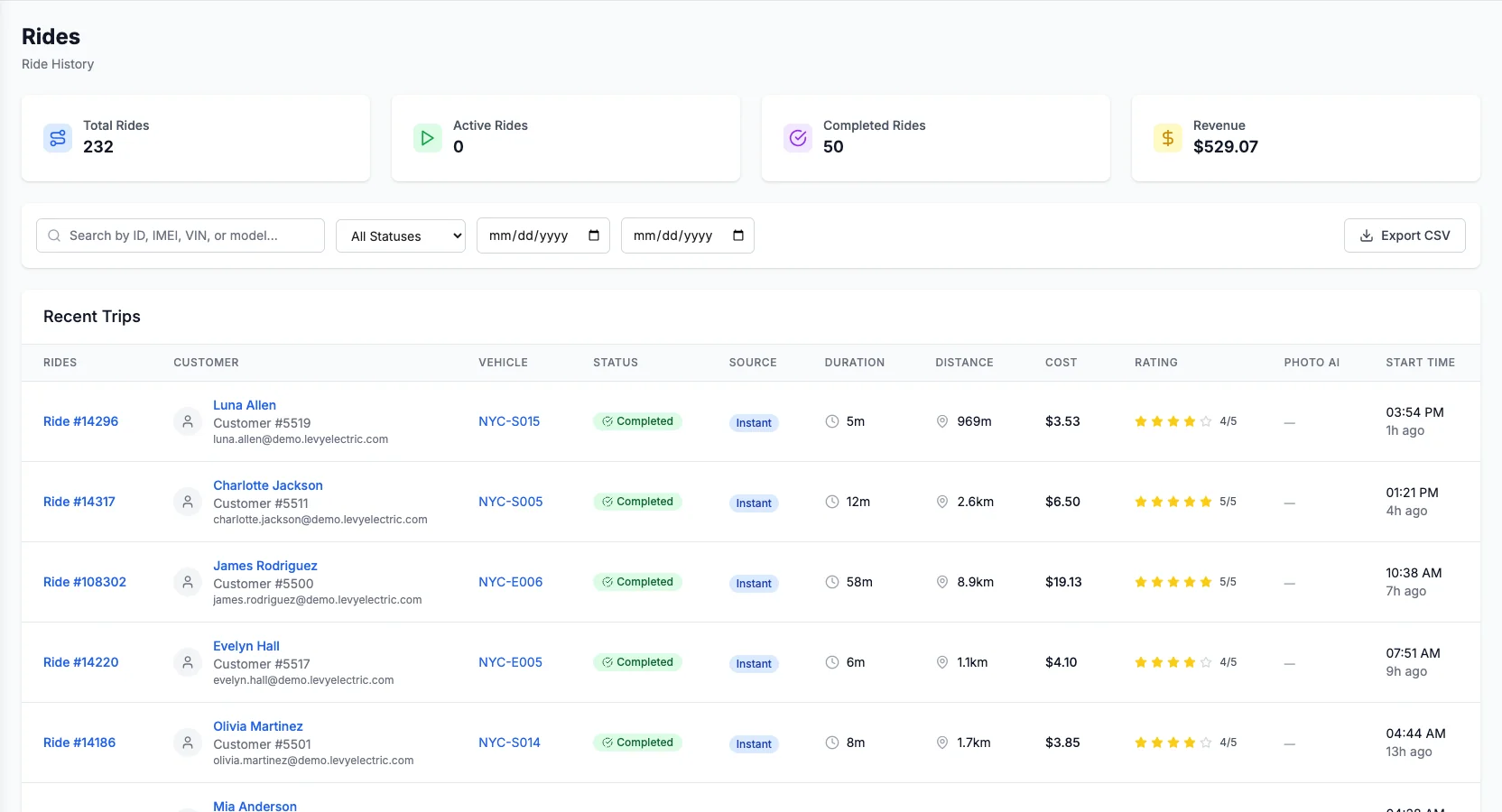
Instant mobile redemption continues all the way to the vehicle.
The booking, guest readiness, and ride are visible as one timeline, so the operator can support an immediate pickup without a separate ticket desk.
Without the connected workflow
A digital ticket can still end in an analog handoff when the booking platform has no relationship to the physical vehicle.
With the Levy connection
- Mobile booking becomes a real reservation
- Agreement and readiness status stay visible
- Ticket-to-unlock handoff remains self-service
Immediate booking timeline
Live Levy Fleets operator interface
Related Integrations
One OCTO connection reaches all of them.
Tiqets, Expedia Group, Headout, Klook and GetYourGuide all read OCTO. That is the point of building against the standard properly rather than one marketplace at a time: the same conformant supplier API, the same live availability and the same money model serve every one of them. Adding the next channel is a mapping exercise, not another integration project.
The same OCTO supplier API at the other end of the funnel: trip-context demand, booked months before the traveler lands.
A tightly curated, in-destination shelf — few listings, no lead time, the same last-minute pressure on your availability.
Also an OCTO consumer, with its strongest reach across Asia-Pacific travel demand.
Two-phase booking over the same standard, for planned trips and same-day bookings alike.
The free complement to this page. A published GBFS feed puts your vehicles in trip-planning apps with no commission and no marketplace in the path — walk-up discovery next to prebooked demand.
Hotel demand at the source. Guests already on property book a vehicle and bill it to the room folio — the same city-centre traveler, reached before they open a marketplace at all.
Marketplaces, channel managers, property systems and open data feeds — the full list, and which one fits the way you already sell.
See the Tiqets integration in action
Tell us how you sell today. We'll walk you through the Tiqets connection — live availability, automatic reservations, and keyless handoff.
Levy Fleets is an independent fleet management and reservation platform. Tiqets and the other marketplaces named on this page are trademarks of their respective owners; they are named only to describe how Levy connects to them, and none of them has endorsed, certified or partnered with Levy Fleets. OCTO is an open connectivity standard maintained independently of Levy. Connecting a marketplace requires your own supplier account and contract with that marketplace.