.svg)
Sell your fleet on GetYourGuide.
Without ever overselling it.
Levy is the reservation system behind your listings. Live availability, a two-phase booking flow that holds the actual vehicle while a traveler checks out, and every booking landing in your fleet as a real reservation—one a traveler can unlock with their phone.
Marketplace Booking
4-Hour E-Bike Rental · 2 travelers
Checkout abandoned? The hold expires and the vehicle returns to inventory on its own.
One connected operating path
GetYourGuide to Levy to the vehicle.
Reserve and confirm API
GetYourGuide
Checks availability, reserves capacity, and confirms checkout
Reservation and fleet system
Levy Fleets
Protects the held vehicle and converts confirmation into a reservation
Physical fulfillment
Connected vehicle
Moves from held inventory to the traveler’s pickup flow
GetYourGuide + Levy Fleets
You are the supplier. Levy is the reservation system.
Levy takes the role FareHarbor and Bokun play for tour operators—the system a marketplace queries for availability and books against. Your fleet stays yours; the connection just makes it sellable.
Live Availability That Cannot Oversell
Capacity is your inventory caps, minus confirmed reservations, minus every in-flight hold—from other marketplaces and from Levy's own checkout. One number, computed at request time, shared by every channel.
No Double Entry
A confirmed booking becomes a real Levy reservation on the spot. Nothing to re-key, no spreadsheet in the middle.
Rentals and Tours
Sell fixed-duration rentals like a 4-hour e-bike, or per-person seats on a timed tour departure. Both models, one connection.
Explicit Product Mapping
Every product and option code maps to one vehicle model or tour schedule. An unmapped code is refused, never guessed.
Per-Channel Ceiling
Cap how much of the fleet this channel may consume, so one marketplace can never swallow your whole inventory.
Gross, Commission, and Net—Kept Separate
What the traveler paid, what the channel retains, and what you are actually owed are three different numbers. Levy tracks all three on every booking so payouts are never computed off the wrong one.
Two-Phase Booking
The vehicle is held while the traveler is still paying.
Most booking connections take capacity at confirm, which leaves a window where two marketplaces can sell the same last scooter in the same second. Levy takes capacity at reserve. That single choice is what makes the oversell impossible rather than unlikely.
Reserve
GetYourGuide reserves capacity the moment the traveler starts paying. Levy places a hold on the actual vehicle or seat and keeps it there for the length of that checkout.
Confirm
Payment clears, the marketplace confirms, and the hold turns into a real Levy reservation. The reservation exists before the hold is released, so nothing can slip into the gap.
Swept Back
If the traveler walks away mid-checkout, the hold expires on its own and the capacity returns to inventory. An abandoned cart never strands a vehicle for the rest of the day.
Retries do not sell a second vehicle
The marketplace's own booking reference is the idempotency key. A network hiccup, a duplicate callback, or a retried confirm returns the original booking instead of quietly creating another one. And a hold that becomes a seat on a tour departure always has a matching release, so a canceled booking gives the seat back rather than shrinking the departure forever.
The hold is visible to every channel at once—including Levy's own storefront.
Why This Channel
The traveler booking
on the day they ride.
Nightly inventory files were built for tours planned weeks ahead. They fall apart on a rental booked from a hotel lobby at 10am for an 11am pickup. Levy answers each availability request against the live fleet, so late demand is real demand.
Strongest Across Europe
If your fleet sits in a European city with visitors in it, this is the marketplace where those visitors are already shopping for something to do.
Mobile-First Travelers
The audience skews young and books on a phone. They arrive expecting to unlock with that same phone, which is exactly what a Levy vehicle does.
Same-Day and Last-Minute
Availability is answered live at request time, not from a file synced overnight. A booking made an hour before pickup reflects the fleet as it is right now.
Built for Short Rentals
A half-day scooter or e-bike is the shape of product this audience books. Fixed-duration rental products map cleanly onto your existing vehicle models.
The Flow
From a tap on GetYourGuide to an unlocked vehicle.
Eight things have to happen between a traveler starting a checkout and riding away on your e-bike. GetYourGuide is a genuinely two-phase channel—capacity is committed in phase one, while the traveler is still on the payment screen, and only becomes a reservation in phase two.
- 01
GetYourGuide
Marketplace
Phase 1
- 02
Availability
Levy
Phase 1
- 03
Reserve → hold
Levy
Phase 1
- 04
Confirmation
Marketplace
Phase 2
- 05
Reservation
Levy
Phase 2
- 06
Check-in
Traveler
Phase 2
- 07
Vehicle unlock
Pickup
Later
- 08
Reconciliation
Money
Later
Steps 01–03 are the reserve call. Steps 04–06 are the confirm call. Steps 07 and 08 happen later, on their own.
A traveler picks a slot on GetYourGuide
The marketplace asks Levy what is bookable for the dates it is showing. Nothing is synced overnight and nothing is cached — the answer is computed when the question is asked.
POST /api/channels/getyourguide/v1/availabilityLive capacity, computed at request time
Your inventory caps minus overlapping reservations minus every in-flight hold — from other marketplaces and from Levy's own checkout. A requested start must also match a slot your calendar actually publishes.
Capacity is taken while the traveler pays
This is the whole point of a two-phase flow. The hold is written inside a locked Postgres transaction that re-counts reservations and live holds in the same breath, and it carries a time-to-live from your connection settings.
POST /api/channels/getyourguide/v1/reservationPayment clears and the marketplace confirms
Traveler details arrive here rather than at reserve, which is why check-in is triggered from confirm. The reserved-to-confirming transition is claimed under a row lock, so exactly one confirm can ever create a reservation.
POST /api/channels/getyourguide/v1/bookingA real reservation lands on your calendar
The same calendar your walk-ups and website checkouts use, with gross, commission, and net recorded on it. The hold is consumed only after the reservation exists, so no competing request can slip into the gap.
Levy chases what the marketplace did not forward
A check-in link collects the missing email and phone number and gets your rental agreement signed before pickup. It never turns away a traveler who has already paid.
The vehicle unlocks from their phone
No counter, no key handoff. Live GPS, geofencing, and automatic ride billing run for the rest of the rental, and the vehicle locks itself at the end.
The statement is matched line by line
Weeks later the remittance arrives. Every line is matched, flagged as a variance, or surfaced as a confirmed booking the statement left out entirely.
Capacity decisions live in the database
Reserve, confirm, and release each run inside a locked database function rather than as read-then-write in application code. That is the difference between an oversell that is unlikely and one that cannot happen.
A retry returns the original booking
The marketplace reference is the idempotency key, backed by a unique index. A duplicate callback or a retried reserve hands back the booking that already exists rather than selling a second vehicle.
Abandoned holds are swept back
Plenty of checkouts are abandoned in phase one. A sweep running every few minutes returns that capacity to inventory, guarded so overlapping runs cannot release the same hold twice.
The Difference
Everyone else stops at the booking.
FareHarbor, Bokun, and Rezdy hand you a confirmed booking and a name. What happens next—meeting the traveler, handing over a key, hoping the vehicle comes back—is still entirely manual.
On Levy the booking is attached to a connected vehicle. A traveler can land in a city, open their phone, and unlock the scooter that booking reserved. You watch it move, bill it automatically, and lock it remotely when it comes back.
Channel bookings
38
Held now
3
On the road
11
Net owed
Tracked
4-Hour E-Bike
Confirmed · EB-204
City Scooter Day
Confirmed · ES-118
Harbor Tour 14:00
Reserved · 2 seats
Half-Day Moped
Confirmed · MP-061
The Money
The traveler pays the marketplace. You still need the numbers right.
A channel booking is already paid—just not to you, and not yet. Levy records what the traveler paid, what the marketplace retains, and what you are owed as three separate figures on the reservation, so nothing downstream is ever computed off the gross by accident.
Commission or fixed net rate
Some contracts give the marketplace a percentage of what the traveler paid. Others owe you a fixed amount per unit regardless of what it retails for. Levy supports both, and the split always reconciles to the cent—one side is derived from the other rather than rounded independently.
Remittance reconciled line by line
When the statement arrives weeks later, every line is checked against the booking it claims to pay for. Corrections can simply be re-fed—a re-imported statement replaces its own lines instead of double-counting.
Matched — Ties to a booking and the money agrees. Nothing to do.
Variance — Ties to a booking but the money disagrees — usually a changed commission or a refund processed on their side.
Unmatched — The statement bills a reference with no booking behind it.
Missing — You hold a confirmed booking the statement left out entirely. This is the one that quietly costs money.
Traveler Check-In
A marketplace booking is not a complete rental
A traveler arriving from a marketplace has no account with you, no card on file, and nothing signed. Levy closes that gap between confirm and pickup.
Details arrive at confirm
The marketplace forwards the traveler it has — often a first name and little else. Each one becomes a distinct customer record rather than collapsing onto a shared guest profile.
Agreement signed before pickup
Levy issues a check-in link that collects the full name, email, and mobile number still missing, and gets your rental agreement signed — so the handover is a handover and not a paperwork session.
Never a blocker
A traveler who already paid is not turned away over a missing phone number. Check-in chases the data; it does not gate the reservation. And it never asks for payment twice.
How It Works
Three steps to a sellable fleet
Connect the Channel
Add the channel from your Levy dashboard and set the commission terms you agreed to. You get an API key, shown once, to hand to the marketplace.
Map Your Products
Point each product and option code at a vehicle model or tour schedule, with duration and start times for rentals. Set a ceiling if you want to reserve part of the fleet for walk-ups.
Go Live
Flip the connection to live and bookings start arriving as Levy reservations with nothing left to key in. Availability, holds, check-in and unlock all run from the moment it is switched on.
Operator implementation snapshot
The vehicle stays protected while the traveler finishes checkout.
The operator can see what is merely held, what is confirmed, and what is ready for pickup without maintaining a second availability calendar.
Without the connected workflow
A checkout in progress and a direct booking can compete for the same last vehicle unless both read the same hold-aware inventory.
With the Levy connection
- In-flight holds visible to every channel
- Expired checkout capacity returns automatically
- Confirmed booking becomes the ride record
Hold-aware reservations
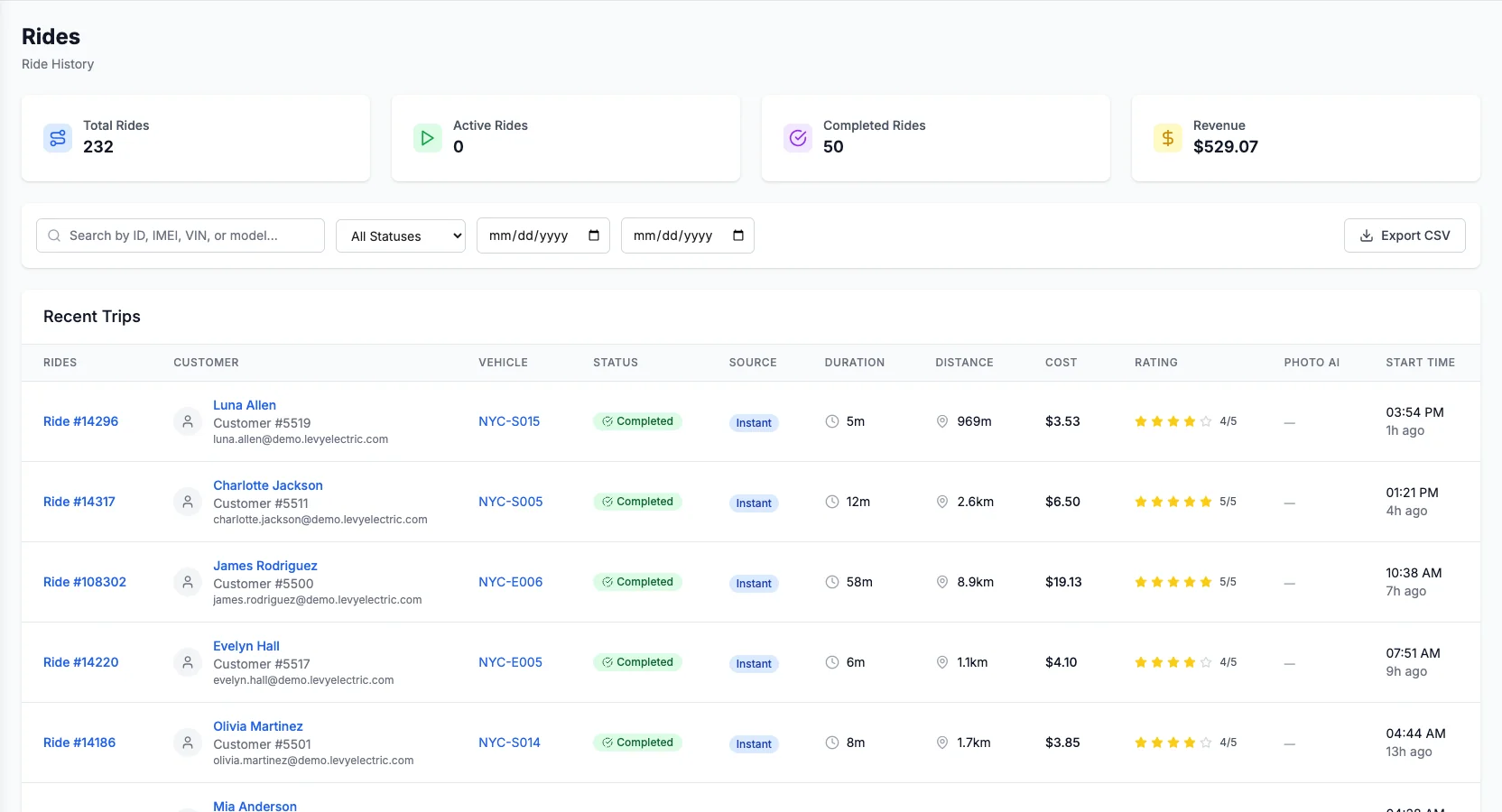
Live Levy Fleets operator interface
Related Integrations
Where operators go next.
Every channel runs on the same availability, the same holds, and the same money model. Adding one more is a mapping exercise, not another integration project.
Viator
The largest experiences marketplace, and a single-call booking flow rather than a two-phase one. Connecting it also reaches TripAdvisor Experiences.
TripAdvisor
TripAdvisor Experiences sells Viator inventory, so one Viator connection covers both. Trip-planning traffic at the very top of the funnel.
Klook
Inbound Asia-Pacific travelers who book same-day, over the same OCTO surface and the same two-phase reserve-then-confirm flow.
Google Maps
Free discovery with no marketplace commission. Travelers searching for a rental nearby book you direct instead.
Mews
Hotel demand. Guests add a scooter or e-bike to the room folio at the front desk, with no marketplace in the middle.
All integrations
Every marketplace, PMS, OEM, and IoT connection Levy speaks, in one directory.
See the GetYourGuide integration in action
Tell us how you sell today. We'll walk you through the GetYourGuide connection — live availability, automatic reservations, and keyless handoff.
Levy Fleets is an independent fleet management and reservation platform. GetYourGuide is a trademark of its respective owner and is named here only to describe how Levy connects to that marketplace.