.svg)
The guest asks the front desk for a bike.
Charge the room. They unlock it with their phone.
No marketplace commission. No browsing. No comparison shopping. Your guest has a room, they are standing at the desk, and they want to be somewhere in the next ten minutes. Levy's Mews integration turns that moment into a real reservation, a charge on the guest folio, and a connected vehicle they unlock with their phone—instead of a line in the concierge's notebook.
Coastal E-Bike · 3 hr
Room 412 · Guest rate
Ready to Ride
Waiver signed · No card needed
Battery
96%
Zone
Town
Return
4:30 PM
Booked at the front desk
No card, no checkout
Posted to room 412
Settles at departure
One connected operating path
Mews to Levy to the vehicle.
PMS and room folio
Mews
Identifies the staying guest and accepts the rental charge
Reservation and fleet system
Levy Fleets
Creates the reservation, waiver flow, folio event, and ride
Physical fulfillment
Connected vehicle
Leaves the key cabinet and unlocks from the guest’s phone
The Best Channel
The highest-intent rental demand in the world is standing in your lobby.
Marketplaces are worth having—Levy connects to them too. But a marketplace customer is browsing, comparing, and costing a commission before they have decided anything. A guest at the front desk has already decided. No auction, no acquisition cost, nobody else bidding for them. Just a question—“can I rent a bike?”—and whatever happens in the next ten minutes.
Today that question gets answered with a paper notebook.
The concierge writes down a name, photographs a driver's licence, and takes a key out of a cabinet. There is no reservation, no live availability, no signed agreement on file, and no way to know whether the bike came back or where it went. When the property bundles rentals into the room rate, there is not even a transaction to look at afterwards. Every one of those is a system Levy already runs.
Intent, already formed
They are not shopping. They asked. Converting a guest who walked up to the desk is a different sport from converting a click on a search result.
No marketplace in the middle
Somebody sleeping upstairs does not need to be bought from an OTA. There is no channel commission on demand the property already owns.
A room number attached
Every guest arrives with a folio, an identity the property already checked, and a place to put a charge. That is more than most rental checkouts ever collect.
A stay-shaped window
You know when they arrived and when they leave. Availability, pricing, and return times can be built around a stay instead of guessed.
The Difference
Every PMS add-on stops at “record a charge.”
Spa slots, restaurant covers, cabana rentals—the integration posts a line to the folio and its job is done. A vehicle is not a dinner reservation. Somebody still has to hand over a key, know where it went, and confirm it came back. Levy's booking is attached to a connected vehicle, so the part that happens after the charge is the part that runs itself.
A concierge stops managing a key cabinet.
The guest unlocks from their own phone. The ride is tracked and billed automatically. The vehicle is geofenced to the property or the town. Return is proven with a timestamp, a location, and a photo. Nobody has to be at the desk for any of it—which matters most at the hours when nobody is.
Remote unlock
The guest taps their phone at the rack. No key handoff, no deposit envelope, no staff member standing there.
Live GPS and telemetry
Location, battery, speed, and vehicle health streaming the entire time the vehicle is out.
Geofencing
Draw the property, or draw the town. Get alerted the moment a vehicle crosses the boundary you set.
Automatic ride billing
Overtime, extensions, and per-minute usage bill themselves. Nobody reconstructs a rental from memory at 6pm.
Return proof
Timestamped end-of-ride photos and location, so a late-return or damage conversation has an answer instead of two opinions.
Remote lock
Close out a rental from the dashboard. The vehicle secures itself, wherever it happens to be standing.
The Mews Integration
What the Mews integration does.
A hotel PMS is the system of record for who is staying, in which room, until when, and what they owe. A fleet platform is the system of record for which vehicle, for how long, in what condition, and where it is right now. The integration is the seam between those two—so a rental at the desk is one action instead of two systems and a notebook. Connect it from Dashboard → Distribution channels and pick Mews (hotel PMS — bills to the guest folio).
Bill it to the room, not to a card
The guest does not want a checkout. They want to say “put it on the room.” The rental posts to their folio through the Mews Connector API and settles at departure alongside the minibar and the spa—and the property's existing rates, taxes, and accounting setup keep doing their job.
No marketplace commission
A hotel does not take a cut from its own guest. A Mews connection carries a zero channel commission, so the net on every booking equals the gross.
Guest self-booking
A booking surface the guest reaches from a QR code in the room, the property's own site, or a link the desk texts them—reading the same live availability the desk does. No phone call.
Waiver, captured once
A vehicle rental needs a signed agreement even when no money changes hands. The guest signs on their phone before the vehicle unlocks, and it is stored against the booking.
A desk view worth using
What is out, what is due back, who is overdue, and which specific vehicle to hand the guest standing in front of you. A queue, not a spreadsheet.
The stay, carried through
The Mews reservation and the room number ride along onto the booking, and the folio charge reference comes back the other way—so either system can be traced from the other.
Availability that reflects the actual fleet
Not a number somebody typed in at the start of the season. Capacity comes from real inventory, minus real reservations, minus in-flight holds—the same live capacity every other channel sees. A bike promised at the desk cannot already be out with a Viator booking from ten minutes ago, and a bike sitting in the shop with a flat tyre is not bookable at all.
The Flow
From the lobby to the folio, step by step.
A hotel rental is not a marketplace rental, and the integration does not pretend otherwise. There is no reseller, no channel commission, and no card at the desk. This is the whole sequence, in the order it actually happens.
- Step 1
A guest asks the front desk for a bike
No browsing, no comparison shopping, no marketplace in the middle. Somebody with a room and ten minutes has already decided — the flow starts with a question, not a search result.
- Step 2
The desk books it, or the guest books it themselves
The concierge books from the queue view, or the guest books from a QR code in the room, the property's own site, or a link the desk texts them. Both paths hit the same connection and the same inventory.
- Step 3GET /api/channels/mews/v1/availability
Levy answers with live availability
Real inventory, minus confirmed reservations, minus in-flight holds taken by every other surface seconds earlier. Only genuinely bookable time units come back, so a bike promised at the desk is a bike that exists.
- Step 4POST /api/channels/mews/v1/booking
A real reservation is created
Capacity is claimed inside a locked Postgres transaction, and the property's own booking reference is the idempotency key — so a retried request returns the reservation that already exists instead of taking a second vehicle. The guest's Mews reservation and room number ride along onto the booking.
- Step 5
The charge posts to the guest folio
Levy posts the rental to the guest's folio through the Mews Connector API and stores the returned charge reference on the booking, so either system can be traced from the other in a billing question.
- Step 6
The guest unlocks with their phone
The waiver is signed on the phone, then the vehicle unlocks at the rack. No key cabinet, no card reader, no staff member standing there — and GPS, geofencing, and automatic overtime billing run for the length of the rental.
- Step 7
It settles with the room at checkout
The rental leaves on one bill with the minibar and the spa, under the property's existing rates, taxes, and accounting setup. Nothing to invoice separately, nothing to chase.
No marketplace commission
A hotel does not take a cut from its own guest. A Mews connection carries a zero channel commission, so the net on every booking equals the gross — and there is no remittance statement to reconcile, because nobody in the middle kept anything.
Settlement mode is the folio, not a card
The connection runs in folio settlement mode, so the money leaves the card-processing path entirely. The booking is funded by the channel, which is why the guest is never asked for a card at pickup.
The folio post is best-effort on purpose
The guest is standing at the rack about to ride. If Mews does not accept the charge, the rental still goes ahead and the billing failure is recorded against the booking to be chased afterwards. A hiccup in accounting never becomes a refused rental in the lobby.
The Foundation
A new adapter on a layer that already runs.
Levy operates a distribution channel layer: the machinery that lets an outside system read live availability, hold capacity, create a real reservation, check the guest in, and settle the money afterwards. It is what sits behind Levy's OCTO, Viator, and GetYourGuide surfaces. Mews is a different counterparty with a different wire format and a different money model—so the adapter translates it onto the same core, and a hotel booking inherits every guarantee a marketplace booking already had.
Running in the platform today
Connection management
Per-property connections with their own scoped API credentials, shown exactly once and stored only as a hash. Draft, testing, live, and a pause that takes effect on the next request.
Explicit product mapping
Every external product code points at a specific vehicle model or a scheduled departure. An unmapped code is refused outright rather than guessed, because guessing hands a guest the wrong vehicle.
Hold-aware live availability
Capacity computed from inventory caps, minus confirmed reservations, minus in-flight holds from every other surface, with an optional ceiling so one channel cannot swallow the fleet.
Reserve, then confirm
Two-phase booking where capacity is taken at reserve rather than at confirm, with the counterparty's own reference used as the idempotency key so a retried call never sells a second vehicle.
Gross, commission, and net
Every booking records what the guest paid, what any intermediary retained, and what the operator is owed — with the conservation identity enforced by a database constraint, not just by application code.
Remittance reconciliation
Statements reconcile line by line into matched, variance, unmatched, and the one that quietly costs money: a confirmed booking the statement left out entirely.
Folio posting instead of a card charge
A Mews connection runs in folio settlement mode: the money leaves the card-processing path entirely and becomes a charge on the stay's bill, posted through the Mews Connector API.
The stay, on the booking
The guest's Mews reservation and room number are stored on the Levy booking, and the returned folio charge reference is stored beside them — so neither side is a dead end in a billing question.
Property-level configuration
Each property gets its own connection: its own credentials, its own product mapping, its own currency and settlement mode, and its own pause switch that takes effect on the next request.
Folio posting is best-effort on purpose. The guest is standing at the rack, about to ride. If Mews does not accept the charge on the first try, the rental still goes ahead and the billing problem is recorded against the booking to be chased afterwards. A hiccup in accounting never becomes a refused rental in the lobby.
Out now
14
Ready
9
Overdue
1
Today
$1,840
Coastal E-Bike #12
Room 412 · 3 hr
4:30 PM
Out
Coastal E-Bike #07
Room 208 · Half day
5:00 PM
Out
Cruiser #03
Room 119 · 2 hr
12 min
Overdue
Cruiser #09
Unassigned
—
Ready
Available Now
The fleet side
already works.
The Mews connection removes the last piece of double entry. Everything around it is live and running at properties today: reservations with real holds, rental agreements and waivers, refundable deposits, an iPad at the desk with Stripe Terminal tap-to-pay, and delivery for the guest who would rather the bike came to them.
Getting Connected
Three steps from the dashboard
Connect the property
Create the connection in Dashboard → Distribution channels, choose Mews (hotel PMS — bills to the guest folio), and drop in your Mews Connector credentials. Each property gets its own connection and its own scoped keys.
Map what the property sells
Point each Mews product code at a specific vehicle model or scheduled departure. An unmapped code is refused rather than guessed, because guessing hands a guest the wrong vehicle.
Take the connection live
Run it in testing, watch a booking come through end to end, then flip it live. Availability, folio posting, and cancellation all work from the first real reservation.
Straight Answers
The questions properties actually ask
Is the Mews integration available today?
Yes. It is live in the platform. Connect it from Dashboard → Distribution channels, choose "Mews (hotel PMS — bills to the guest folio)," add your Mews Connector credentials, and map your vehicles to the property's product codes. It runs on the same channel core behind Levy's OCTO, Viator, and GetYourGuide surfaces.
How does a rental reach the guest's bill?
The charge posts to the guest's room folio through the Mews Connector API and settles at checkout alongside the minibar and the spa. The connection runs in folio settlement mode, so there is no card at the desk and no separate transaction. The Mews reservation and the returned folio charge reference are both stored on the booking.
Do we have to take payment at the desk?
No. A vehicle rental needs a signed agreement, not a checkout. The guest signs the waiver on their phone, the charge lands on the folio, and nobody reaches for a card reader.
What commission does Levy take on a Mews booking?
None on the channel side. A hotel does not take a marketplace cut from its own guest, so a Mews connection carries a zero channel commission and the net on every booking equals the gross. Levy's own platform pricing is separate and unchanged — see the pricing page.
Can the front desk and a marketplace sell the same vehicle?
No. Mews availability reads the same hold-aware capacity every other channel sees: real inventory, minus confirmed reservations, minus in-flight holds from every other surface. A bike promised at the desk cannot already be out with a Viator booking from ten minutes ago.
What happens if the folio post fails?
The rental goes ahead. Folio posting is best-effort by design, because the guest is standing at the rack about to ride. A failed post is recorded against the booking for the property to chase, and it never turns into a refused rental in the lobby.
What if we bundle rentals into the room rate?
That works. A bundled rental is a zero-charge booking — nothing posts to the folio — with a real reservation, a real signed waiver, and a real tracked vehicle behind it. Paid upgrades, a better e-bike or a longer window, sit on top of it as an upsell.
What happens when a guest cancels?
Cancel against the property's own booking reference and the capacity is released immediately, so the vehicle is bookable again the same second. The folio charge is reversed on the Mews side by the property — Levy does not silently credit a guest account it does not own.
What makes this different from any other PMS add-on?
Every other add-on stops at recording a charge. Levy's booking is attached to a connected vehicle: the guest unlocks it with their phone, the ride is tracked and billed automatically, the vehicle is geofenced to the property or the town, and return is proven with a timestamp, a location, and a photo. The concierge stops managing a key cabinet.
Is Levy a Mews partner?
No. Levy Fleets is an independent fleet management platform. Mews has not certified, endorsed, approved, or partnered with this work. Levy built against Mews' published Connector API because hotel operators on Levy kept asking for it.
Which vehicles does this cover?
Whatever the property runs: e-bikes, cruisers, seated scooters, mopeds, golf carts, LSVs, and cars. Levy speaks to a range of IoT platforms directly, so the vehicle type is a configuration question rather than an integration project.
Operator implementation snapshot
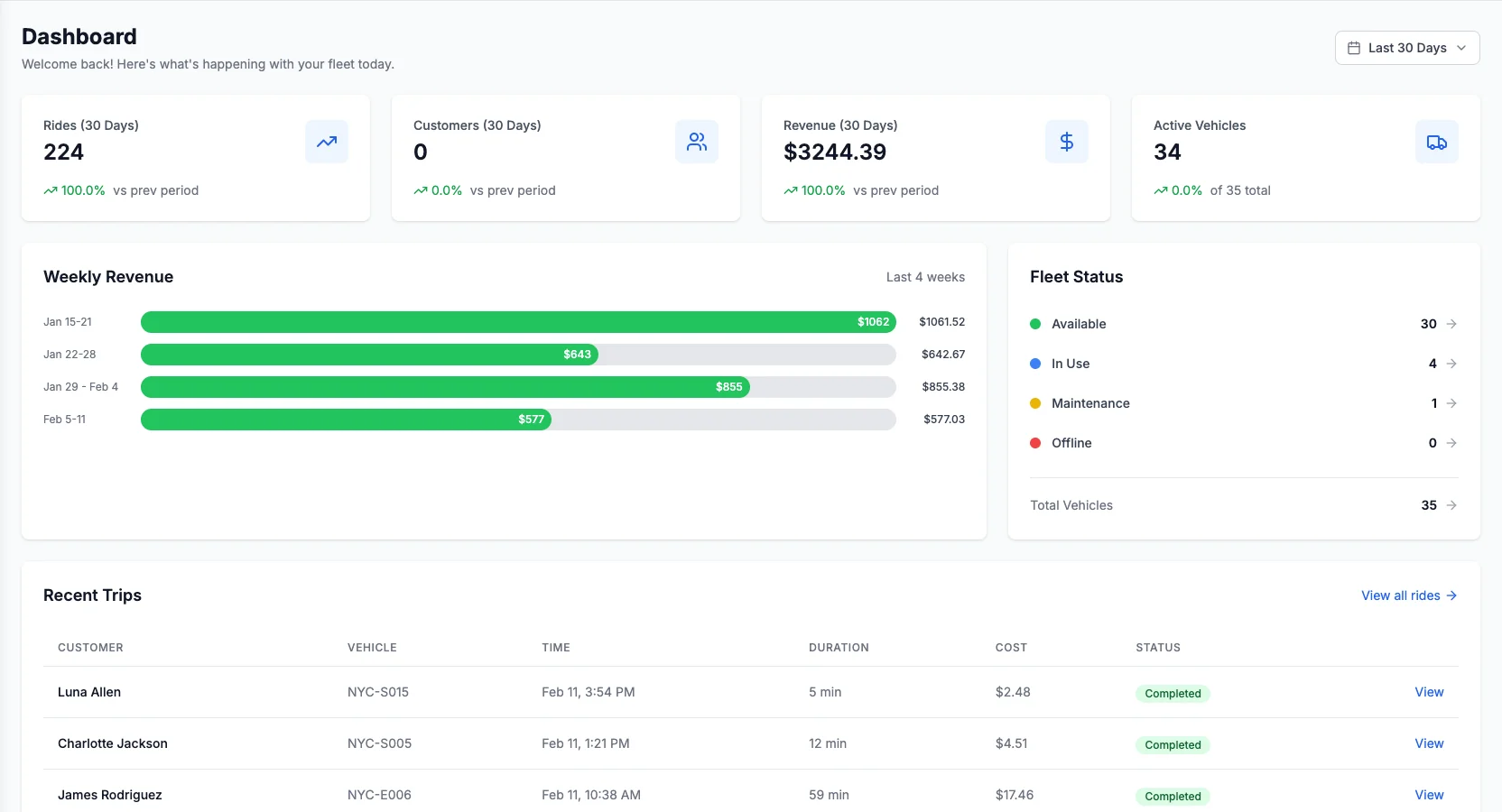
The front desk sees a guest rental become a complete ride.
The property keeps guest and folio context while Levy carries the vehicle, waiver, pickup, return, and any folio-post exception through the operational timeline.
Without the connected workflow
The front desk can record a room charge while still tracking the bike, waiver, key, and return in a separate notebook or spreadsheet.
With the Levy connection
- Room and property context stay on the booking
- Folio failure is visible without stranding the guest
- Vehicle handoff and return remain auditable
Property rental operations
Live Levy Fleets operator interface
Related Integrations
The front desk is one channel. It does not have to be the only one.
A property can take guest demand and marketplace demand at the same time, off the same vehicles. Availability is computed once against the whole fleet, so the channels cannot resell each other's capacity.
Marketplace demand
Viator
The guests upstairs are not the only people who want a bike. A Viator connection sells the same fleet to travellers who never booked a room — and because TripAdvisor Experiences sells Viator inventory, one connection reaches both.
Read moreMarketplace demand
GetYourGuide
A second marketplace on the same live availability. Run it alongside the front desk: capacity is computed once against the whole fleet, so a marketplace cannot resell a bike the concierge just promised.
Read moreLocal discovery
Google Maps
Free discovery for the people already standing near your property. Your vehicles surface to somebody searching for a bike nearby, with no commission attached to the introduction.
Read moreThe full list
All integrations
Every distribution channel, PMS, and IoT platform Levy connects to, in one place — including the OCTO supplier API any conformant reseller can read without a bespoke build.
Read moreSee the Mews integration in action
Tell us how the property runs today. We'll show you the Mews connection — room-folio billing and keyless vehicle handoff.
Levy Fleets is an independent fleet management platform. Mews is a trademark of its respective owner, and Levy Fleets is not affiliated with, certified by, endorsed by, or a partner of Mews. Connecting the integration requires your own Mews account and your property's authorisation.