.svg)
Sell your fleet on Klook.
They land, tap, and ride.
Klook books against live Levy availability over OCTO. The booking becomes a real reservation on its own, and the traveler unlocks a connected scooter, e-bike, or car from their phone—no counter, no key handoff, and nobody sitting at the shop waiting for a flight to land.
Full-Day Scooter
Marketplace booking · Prepaid
Checked In
Agreement signed · Ready
Battery
96%
Zone
In Bounds
Return
7:00 PM
Booked 38 minutes ago
Same-day, from the airport
Reservation created
No one re-keyed it
One connected operating path
Klook to Levy to the vehicle.
OCTO supplier API
Klook
Sells mapped products to an in-destination traveler
Reservation and fleet system
Levy Fleets
Answers OCTO from current fleet state and reserves atomically
Physical fulfillment
Connected vehicle
Is checked in and unlocked on the traveler’s phone
The Integration
Klook consumes OCTO. Levy ships an OCTO supplier API.
OCTO—Open Connectivity for Tourism—is the open standard the major experience marketplaces read. Levy serves it directly, so there is no scraping, no CSV upload, and no nightly sync pretending to be real-time. Levy plays the reservation-system role, the same slot FareHarbor or Bokun would occupy. Your business stays the supplier, with its own contract, its own commission, and its own product codes.
One build, every OCTO reseller
The standard is shared, so the same conformant surface that serves Klook serves the other marketplaces that read OCTO. You map products once.
Only real capabilities advertised
The handshake reports the capabilities Levy actually implements. Nothing is claimed that the API would not then serve.
Both shapes of product
Fixed-duration rentals, where the marketplace sends a start time and your mapping supplies the duration. And per-person timed departures, sold by the seat against a real schedule.
Live Availability
Same-day bookings
are only safe if the
availability is real.
Klook travelers book late—often for today, frequently for tomorrow morning, and very often from a phone in an arrivals hall. That behaviour is only an opportunity if the number the marketplace shows is the number you actually have. A nightly export cannot do it.
Levy computes capacity from your inventory caps, minus overlapping reservations, minus in-flight holds from every other channel and from Levy's own checkout. A traveler mid-checkout on your own website is already subtracted before Klook ever sees the slot.
The reseller's own reference—or an Idempotency-Key header—is the idempotency key, backed by a unique index. A retried call returns the original booking instead of selling a second vehicle.
Reserve
Capacity is taken here, not at confirm. A locked Postgres transaction re-counts reservations and live holds and writes the hold in the same breath, so two marketplaces cannot both pass an availability check for the last vehicle.
Confirm
A real Levy reservation is created, then the hold is consumed—in that order, so no competing request can slip into the gap. Exactly one confirm can win, even if two arrive at once.
Release
A cancel, or an abandoned checkout the reaper sweeps up, hands the capacity straight back. The release is guarded so a double cancel cannot decrement twice and quietly re-sell an occupied seat.
Capacity lives in the database
Reserve, confirm and release each run inside a locked database function rather than as read-then-write in application code. That is the difference between “probably fine” and a fleet that cannot be oversold.
Why Klook
The traveler who books on Klook is a different traveler.
Inbound Asia-Pacific demand does not behave like a domestic walk-up or a package tour booked six months ahead. It is late, mobile, and impatient in a way that rewards operators whose inventory is genuinely live and whose pickup does not depend on someone being at the shop.
They book after they land
Plans firm up on arrival, not months out. A large share of demand is same-day or next-day, which is exactly the demand a stale availability feed loses.
They expect to do it all from a phone
Klook travelers are app-native. Handing them a paper voucher and a counter queue is the point where the experience stops feeling like the one they bought.
They are inbound to your city
Klook is the dominant experiences marketplace across Asia-Pacific—Japan, Korea, Taiwan, Hong Kong, Singapore, Thailand. Being listed is how travelers planning a trip to your city find you at all.
They pay in their own currency
A booking is recorded in the currency the marketplace reports, and statement reconciliation refuses to compare a statement in one currency against bookings in another rather than silently converting at an unstated rate.
They arrive outside your hours
Flights land at 23:40. A booking that becomes a reservation, a check-in link, and a remote unlock without a staff member is a booking you can accept at any hour.
They do not know your city
Geofencing keeps a first-time visitor inside the area you actually serve, and live GPS means “where is my vehicle” has an answer rather than a phone call.
The Flow
From a tap on Klook to an unlocked vehicle.
Eight things have to happen between a traveler starting a checkout in an arrivals hall and riding away on your scooter. OCTO is a true two-phase flow—capacity is committed in phase one, while the traveler is still on the payment screen, and only becomes a reservation in phase two.
- 01
Klook
Marketplace
Phase 1
- 02
Availability
Levy
Phase 1
- 03
Reserve → hold
Levy
Phase 1
- 04
Confirmation
Marketplace
Phase 2
- 05
Reservation
Levy
Phase 2
- 06
Check-in
Traveler
Phase 2
- 07
Vehicle unlock
Pickup
Later
- 08
Reconciliation
Money
Later
Steps 01–03 are the reserve call. Steps 04–06 are the confirm call. Steps 07 and 08 happen later, on their own.
A traveler picks a slot on Klook
Klook reads the OCTO surface Levy serves and asks what is bookable for the dates it is showing. Nothing is synced overnight and nothing is cached — the answer is computed when the question is asked.
POST /api/octo/v1/availabilityLive capacity, computed at request time
Your inventory caps minus overlapping reservations minus every in-flight hold — from other marketplaces and from Levy's own checkout. A requested start must also match a slot your calendar actually publishes.
Capacity is taken while the traveler pays
OCTO is a genuinely two-phase flow, and the hold is placed here rather than at confirm. It is written inside a locked Postgres transaction that re-counts reservations and live holds in the same breath.
POST /api/octo/v1/bookingsPayment clears and the reseller confirms
The reserved-to-confirming transition is claimed under a row lock, so exactly one confirm can ever create a reservation — even if two arrive in the same second.
POST /api/octo/v1/bookings/{uuid}/confirmA real reservation lands on your calendar
The same calendar your walk-ups and website checkouts use, with gross, commission, and net recorded on it. The hold is consumed only after the reservation exists, so no competing request can slip into the gap.
Levy chases what the marketplace did not forward
A check-in link collects the missing email and phone number and gets your rental agreement signed before pickup. It never turns away a traveler who has already paid.
The vehicle unlocks from their phone
No counter, no key handoff, and no staff member waiting for a delayed flight. Live GPS, geofencing, and automatic ride billing run for the rest of the rental.
The statement is matched line by line
Weeks later the remittance arrives. Every line is matched, flagged as a variance, or surfaced as a confirmed booking the statement left out entirely.
Capacity decisions live in the database
Reserve, confirm, and release each run inside a locked database function rather than as read-then-write in application code. That is the difference between an oversell that is unlikely and one that cannot happen.
A retry returns the original booking
The reseller's own reference, or an Idempotency-Key header, is the idempotency key, backed by a unique index. A retried reserve hands back the booking that already exists rather than selling a second vehicle.
Abandoned holds are swept back
Plenty of checkouts are abandoned in phase one. A sweep running every few minutes returns that capacity to inventory, guarded so overlapping runs cannot release the same hold twice.
The Difference
Every other booking system stops at the booking.
FareHarbor, Bokun and Rezdy hand you a confirmed reservation and a customer name, and there the software ends. What happens next is your problem: somebody has to be at the shop, find the right vehicle, hand over a key, and hope it comes back. Levy is the only platform where the booking is attached to a connected vehicle—so the rest of the rental runs itself.
A traveler lands in your city and unlocks a scooter with their phone.
That entire chain—marketplace booking, reservation, check-in, unlock, ride, return, lock—is one system. A booking can become a completed rental without a staff member touching it, which is what makes a 23:40 arrival a customer instead of a missed one.
Remote unlock at pickup
The traveler taps their phone. No counter, no key handoff, no staff required.
Live GPS and telemetry
Location, battery, speed, and vehicle health streaming while the rental is out.
Geofencing
Define where the vehicle may go. Get alerted the moment it leaves the zone.
Automatic ride billing
Overtime, extensions, and per-minute usage bill themselves against the rental.
Return proof
Timestamped end-of-ride photos and location, so return disputes have an answer.
Remote lock
Close out the rental from the dashboard. The vehicle secures itself.
This is the part a pure booking system structurally cannot add. It is not a feature they have not built yet—it requires owning the vehicle's hardware connection, the rider app, the ride billing, and the reservation record at the same time. Levy already runs all four for 127+ fleets.
The Money
Know exactly what
you are owed.
A marketplace booking is paid—just not through your card processor. The traveler pays Klook, Klook keeps its commission, and the rest arrives later on a statement. Levy records all three numbers on every single booking, so the gap between what the traveler paid and what lands in your account is never a mystery.
Gross, commission and net always reconcile to the cent. Commission is rounded and net is derived by subtraction—never both rounded independently—and the identity is enforced by a database constraint, not merely by the code that writes it.
A commission percentage, or a fixed net rate per unit. Whichever your contract actually says.
A confirmed booking the statement left out is the line that quietly costs you money. It gets flagged.
Two opposing errors that net to zero would look perfect on a total. Each line is judged on its own.
If a figure has to be normalised for the books, the original is kept so a dispute is argued from what they really sent.
Gross
traveler paid
S$6,240
Commission
marketplace retains
S$1,560
Net
you are owed
S$4,680
KLK-88214
Full-Day Scooter
KLK-88231
Old Town E-Bike Tour, 2 pax
KLK-88245
4-Hour E-Bike
KLK-88260
Full-Day Scooter
2
Matched
1
Variance
0
Unmatched
1
Missing
Control
A marketplace should
not run your fleet.
Distribution is only worth having if you stay in charge of it. Levy gives you the guardrails: how much inventory a channel may touch, exactly what each product code sells, which start times exist, and what a traveler must complete before a vehicle unlocks.
Traveler check-in that never blocks
Marketplaces forward very little — often a first name and nothing else. Levy issues a check-in link that collects the missing contact details and gets the rental agreement signed before pickup. It chases the missing data; it never turns away a traveler who has already paid, because that strands a customer and invites a chargeback.
Every traveler is a real record
When a marketplace sends no email at all, Levy mints a distinct guest identity per booking rather than collapsing every inbound traveler onto one shared profile — and knows not to mail an address it invented.
Per-channel inventory ceiling
Cap how much of the fleet a single marketplace may consume, enforced against what that channel is already holding rather than merely clamping the number displayed. Your walk-ups and your own website keep the inventory you set aside for them.
Explicit product mapping
Every product code maps to a specific vehicle model or tour schedule. An unmapped code is refused outright rather than guessed — because guessing hands a traveler the wrong vehicle.
Only offered start times are bookable
A requested start must match a slot the calendar actually publishes. A marketplace cannot invent a 03:00 departure for a product that opens at 09:00.
A trip under way is not the channel's to cancel
Once a traveler has checked in or is riding, a channel cancel is refused rather than silently voiding a rental you already delivered. That is an operator decision, not an API call.
How It Works
Three steps to distribution
Connect the channel
Open Distribution channels in your dashboard, add the connection, and set the commission your contract specifies. Levy mints an API key for your account alone — shown once, stored only as a hash.
Map your products
Point every product code at a vehicle model or a tour schedule, set the duration and start times for rentals, and add an inventory ceiling if you want one. Nothing sells until the mapping exists, which is deliberate.
Go live and stay hands-off
The marketplace reads live availability and books against it. Reservations, check-in links, unlock, ride billing, and the money trail all run without anyone re-typing a thing.
Reach
Klook covers Asia.
Cover the rest too.
Klook is where inbound Asia-Pacific demand lives. It is not where every traveler in your city comes from. Because the OCTO surface is shared, the product mappings and the single live availability feed you set up once also serve the other marketplaces Levy connects—so adding a channel is a mapping exercise, not another integration project.
Viator integration
The largest experiences marketplace, and the source of TripAdvisor Experiences inventory.
TripAdvisor integration
Trip-planning traffic at the top of the funnel, sold through Viator inventory.
GetYourGuide integration
Deep European coverage, and a two-phase booking flow Levy already serves.
The rest of the platform
Marketplace bookings land in the same fleet you already run on Levy. Same vehicles, same zones, same dashboard, same rider app—now with an extra sales channel attached to it. Plans start at $250/mo.
Your website, your counter, and every connected marketplace read the same capacity. There is no second calendar to keep in step, because there is no second calendar.
Operator implementation snapshot
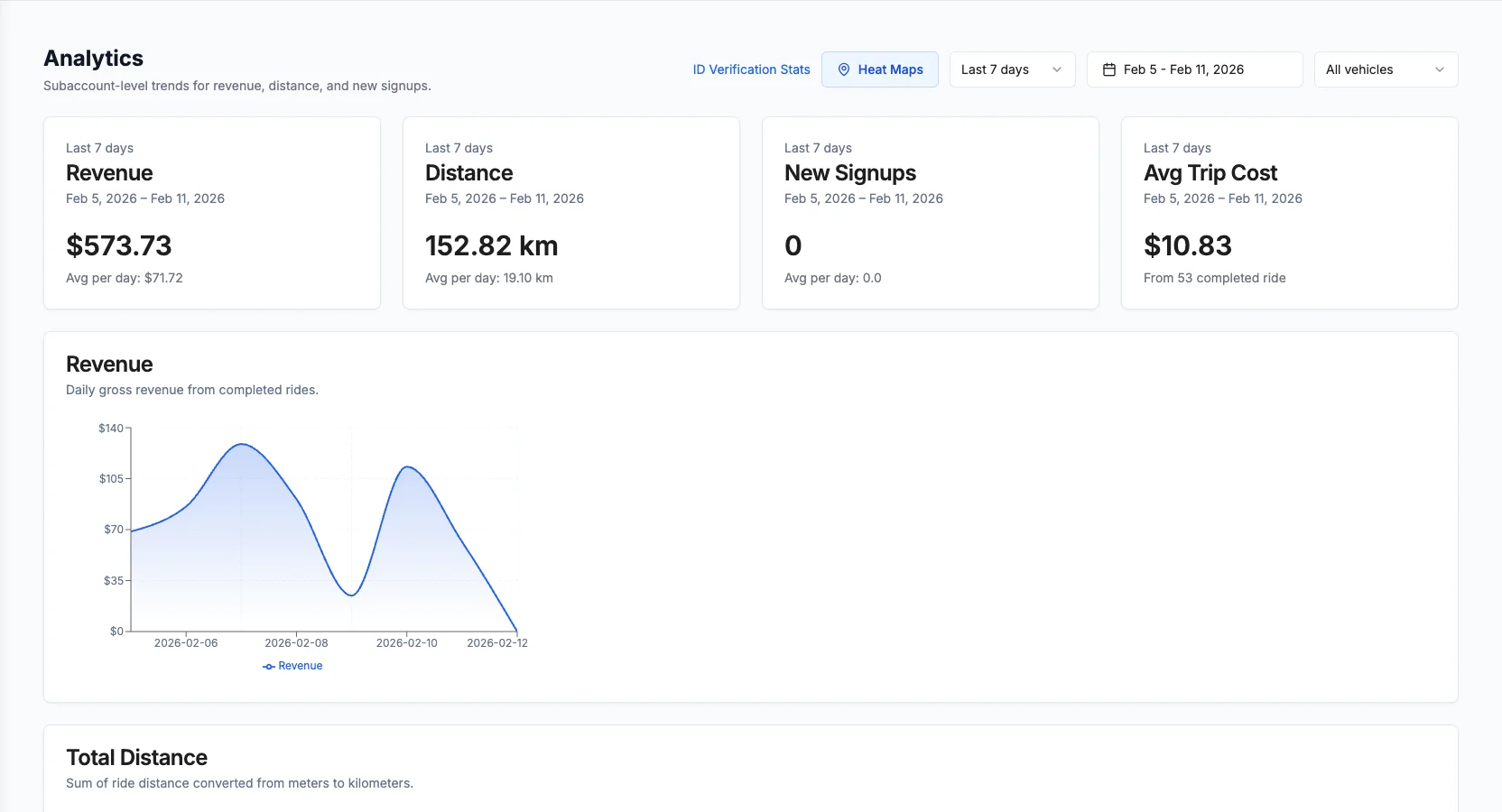
Same-day Klook demand is visible while it is still actionable.
Operators see a new booking against current vehicles and current ride state, rather than discovering it through a delayed export.
Without the connected workflow
A last-minute booking creates pressure at the counter if inventory, guest check-in, and vehicle readiness live in different systems.
With the Levy connection
- OCTO request reads live fleet state
- Reservation carries marketplace context
- Pickup can remain completely self-service
Live operations and demand
Live Levy Fleets operator interface
Related Integrations
Where operators go next.
Every channel runs on the same availability, the same holds, and the same money model. Adding one more is a mapping exercise, not another integration project.
Viator
The largest experiences marketplace, on a single-call booking flow rather than a two-phase one. Connecting it also reaches TripAdvisor Experiences.
TripAdvisor
TripAdvisor Experiences sells Viator inventory, so one Viator connection covers both. Trip-planning traffic at the very top of the funnel.
GetYourGuide
The strongest European coverage, on the same two-phase reserve-then-confirm flow this page describes.
Google Maps
Free discovery with no marketplace commission. Travelers searching for a rental nearby book you direct instead.
Mews
Hotel demand. Guests add a scooter or e-bike to the room folio at the front desk, with no marketplace in the middle.
All integrations
Every marketplace, PMS, OEM, and IoT connection Levy speaks, in one directory.
See the Klook integration in action
Tell us how you sell today. We'll walk you through the Klook connection — live availability, automatic reservations, and keyless handoff.
Levy Fleets is an independent fleet management and reservation platform. Klook, Viator, TripAdvisor, GetYourGuide, FareHarbor, Bokun and Rezdy are trademarks of their respective owners, named here only to describe how Levy connects to or compares with those services. Levy Fleets is not affiliated with, endorsed by, or certified by any of them. Connecting a marketplace requires your own supplier account and contract with that marketplace.