.svg)
Sell on TripAdvisor. Sell on Viator.
One connection does both.
TripAdvisor Experiences is powered by Viator—so a single Levy connection puts your scooters, e-bikes, and guided tours in front of both audiences. Live availability that cannot oversell, and every booking lands as a real reservation.
Coastal E-Bike Rental
Tomorrow · 10:00 AM
4-hour rental · 2 travelers
Left
6 bikes
Confirm
Instant
Pickup
Phone
Levy reservation created
automatically
Check-in link sent
agreement signed
Vehicle unlocks at pickup
from their phone
One connected operating path
TripAdvisor to Levy to the vehicle.
Experiences via Viator
TripAdvisor
Surfaces Viator inventory while the traveler plans the trip
Reservation and fleet system
Levy Fleets
Keeps both marketplace surfaces on one availability pool
Physical fulfillment
Connected vehicle
Is ready for self-service pickup when the traveler arrives
Why This Integration Is Worth More Than One
TripAdvisor Experiences is powered by Viator.
Viator is TripAdvisor's experiences brand. The same inventory that appears under “Things to do” on a TripAdvisor city page is Viator inventory. That is why connecting Levy once is the whole job—your products reach travelers on two of the largest travel audiences on the internet without you maintaining two of anything.
Reach travelers before they land
TripAdvisor is one of the most visited travel sites in the world, and people arrive there in planning mode—reading reviews, comparing neighborhoods, deciding what a Tuesday afternoon looks like. Your rental or tour shows up at exactly that moment, bookable on the spot.
Intent, Not Impressions
Nobody browses “things to do in Charleston” by accident. This is top-of-funnel discovery with a credit card already out.
What The Integration Does
Levy is the reservation system
behind your listing.
You are the supplier. Levy holds the inventory, answers the marketplace's availability calls, accepts the booking, and turns it into a reservation on your own calendar—the same role FareHarbor or Bokun plays, with a connected fleet underneath it.
Availability That Cannot Oversell
Capacity is your inventory caps minus confirmed reservations minus every in-flight hold, including your own website checkout. It is taken at reserve, not at confirm, so two channels cannot sell the last scooter in the same second.
Bookings Become Reservations
A marketplace booking lands as a real Levy reservation with a vehicle, a time window, and a customer record. No re-keying, no exported spreadsheet, no second calendar to maintain.
Rentals And Tours
Sell fixed-duration rentals like a 4-hour e-bike, and per-person timed tour departures with real seat counts. Both product shapes are native, not bolted on.
Money Tracked Correctly
Gross, commission, and net are recorded separately on every booking. Commission-percentage and fixed net-rate contracts are both supported, and the three always reconcile to the cent.
Per-Channel Inventory Ceiling
Cap how much of the fleet this channel may ever consume. Published availability is already net of that ceiling, so the channel simply never sees what you held back.
Explicit Product Mapping
Every product code maps to a specific vehicle model or tour schedule. An unmapped code is refused, never guessed—because guessing hands a traveler the wrong vehicle.
The Flow
From a tap on TripAdvisor to an unlocked vehicle.
Eight things have to happen between a traveler paying on a marketplace and riding away on your e-bike. On Levy all eight are one system—and because this connection books in a single call, the first six of them are one HTTP request.
- 01
TripAdvisor
Marketplace
- 02
Availability
Levy
- 03
Hold
Levy
- 04
Confirmation
Same call
- 05
Reservation
Levy
- 06
Check-in
Traveler
- 07
Vehicle unlock
Pickup
- 08
Reconciliation
Money
Steps 01–06 all happen inside that single request. Steps 07 and 08 happen later, on their own.
A traveler books under Things to do
TripAdvisor Experiences is Viator inventory, so the booking arrives on the Viator Supplier API connection Levy already serves. It is a single call — there is no separate reserve step — and the booking reference doubles as the idempotency key.
POST /api/channels/viator/v1/bookingThe slot is re-checked, never assumed
The requested start must match a slot your calendar actually publishes. Capacity is your inventory caps minus overlapping reservations minus every in-flight hold — including Levy's own checkout.
Capacity is taken at reserve
The hold is written inside a locked Postgres transaction that re-counts reservations and live holds in the same breath. Two requests for the last vehicle cannot both pass.
channel_reserve_pooled_capacity()Reserve and confirm collapse into one step
Because no second call is coming, confirmation runs immediately after the hold and the traveler gets an answer on the spot. A retried booking reference returns the original booking rather than selling a second vehicle.
A real reservation lands on your calendar
The same calendar your walk-ups and website checkouts use, with gross, commission, and net recorded on it. The hold is consumed only after the reservation exists, so nothing can slip into the gap.
Levy chases what the marketplace did not forward
A check-in link collects the missing email and phone number and gets your rental agreement signed before pickup. It never turns away a traveler who has already paid.
The vehicle unlocks from their phone
No counter, no key handoff. Live GPS, geofencing, and automatic ride billing run for the rest of the rental, and the vehicle locks itself at the end.
The statement is matched line by line
Weeks later the remittance arrives. Every line is matched, flagged as a variance, or surfaced as a confirmed booking the statement left out entirely.
Capacity decisions live in the database
Reserve, confirm, and release each run inside a locked database function rather than as read-then-write in application code. That is the difference between an oversell that is unlikely and one that cannot happen.
A stalled booking never strands a vehicle
If the confirm half of that call cannot complete, the booking is handed back to reserved instead of being left in limbo, and a guarded sweep returns the capacity to inventory minutes later. It runs every few minutes, and it cannot release the same hold twice.
The Difference
Every other booking system stops at the booking.
FareHarbor, Bokun, Rezdy and the rest hand you a confirmed booking and a name on a list. What happens next—keys, paperwork, a person waiting at a counter—is your problem. Levy is the one where the booking is attached to a connected vehicle.
A booking-only system
- Traveler books online, then queues at a counter
- Staff member checks ID and hunts for a key
- Paper agreement signed on a clipboard
- Nobody knows where the vehicle went
- Return is whenever someone walks back in
The same booking on Levy
- Traveler books on TripAdvisor and walks straight to the vehicle
- They unlock a scooter with their phone
- Agreement was already signed at check-in
- You watch the ride on a live map
- Return is proven, then the vehicle locks itself
Traveler Check-In
Marketplaces forward
almost nothing.
A traveler arrives with a booking reference, a first name, and no signed rental agreement. Levy issues a check-in link on confirmation that collects the missing contact details and gets the agreement signed before pickup.
Check-in is never a wall. The traveler already paid the marketplace—so a missing phone number chases them, it does not strand them at your counter.
Fills The Gaps
Collects the email, phone, and party details the marketplace never passed along.
Agreement Signed
Your rental agreement is signed digitally before the traveler touches a vehicle.
Real Customer Record
Each traveler gets their own customer profile instead of collapsing into a shared guest account.
Never A Blocker
Prepaid travelers are never asked to pay again and never refused for missing data.
Gross
$4,180
Commission
—
Net to You
—
4-Hour E-Bike
BR-48219
Sunset Scooter Tour
BR-48244
Full-Day Moped
BR-48301
Harbor E-Bike Tour
BR-48355
Illustrative view. “Missing” means Levy holds a confirmed booking the statement left out.
The Money
Know what you are owed
The traveler pays the marketplace. The marketplace remits net of commission weeks later on a statement. Levy records gross, commission, and net separately on every booking, so the amount you are owed is a number you already have before the statement arrives.
Both contract shapes
Commission-percentage and fixed net-rate agreements are both first-class. The split always reconciles to the cent.
Line-by-line reconciliation
Import a statement and every line is matched against a booking, with variances flagged rather than quietly absorbed.
It catches omissions
The line that costs operators money is the one that is not there. Confirmed bookings a statement skipped are surfaced, not lost.
How It Works
Three steps to a bookable listing
Connect The Channel
Add the channel from your Levy dashboard and set the commission your marketplace contract specifies. Levy mints an API key for your connection and shows it once.
Map Your Products
Point each product code at a vehicle model or a tour schedule, with duration, start times, and an inventory ceiling. Unmapped codes are refused rather than guessed.
Go Live
Availability answers in real time, bookings arrive as reservations, travelers check in, and vehicles unlock at pickup. You keep running one calendar.
Standards-based, not a one-off
Levy speaks OCTO, the open connectivity standard the travel industry uses for tourism inventory, alongside marketplace-native formats. That means the work you do to reach TripAdvisor and Viator is the same work that reaches the next channel you add.
Questions
What operators ask first
Does listing on TripAdvisor also list me on Viator?
Yes. TripAdvisor Experiences is powered by Viator, so the products you distribute through Levy surface across both. You build one connection, map your products once, and maintain one calendar.
Can a marketplace booking oversell my fleet?
No. Availability is calculated live from your inventory caps minus confirmed reservations minus every in-flight hold — from other channels and from Levy's own checkout. Capacity is taken at reserve, not at confirm, so two marketplaces cannot sell the same vehicle in the same second.
Do I have to re-key bookings into my calendar?
No. A marketplace booking becomes a real Levy reservation automatically, on the same calendar your walk-ups, phone bookings, and website checkouts use. There is no second system to reconcile.
Can I sell tours as well as rentals?
Both. Levy sells fixed-duration rentals such as a four-hour e-bike, and per-person timed tour departures with real seat counts. Each product maps explicitly to a vehicle model or a tour schedule.
How do I know the marketplace paid me correctly?
Every booking records gross, commission, and net separately. When the remittance statement arrives, Levy reconciles it line by line — flagging variances and, just as importantly, confirmed bookings the statement left out entirely.
What stops one channel from consuming my whole fleet?
A per-channel inventory ceiling. You decide how many vehicles or seats this channel may ever consume, and availability is published net of that cap.
Operator implementation snapshot
Two discovery surfaces resolve to one operator workflow.
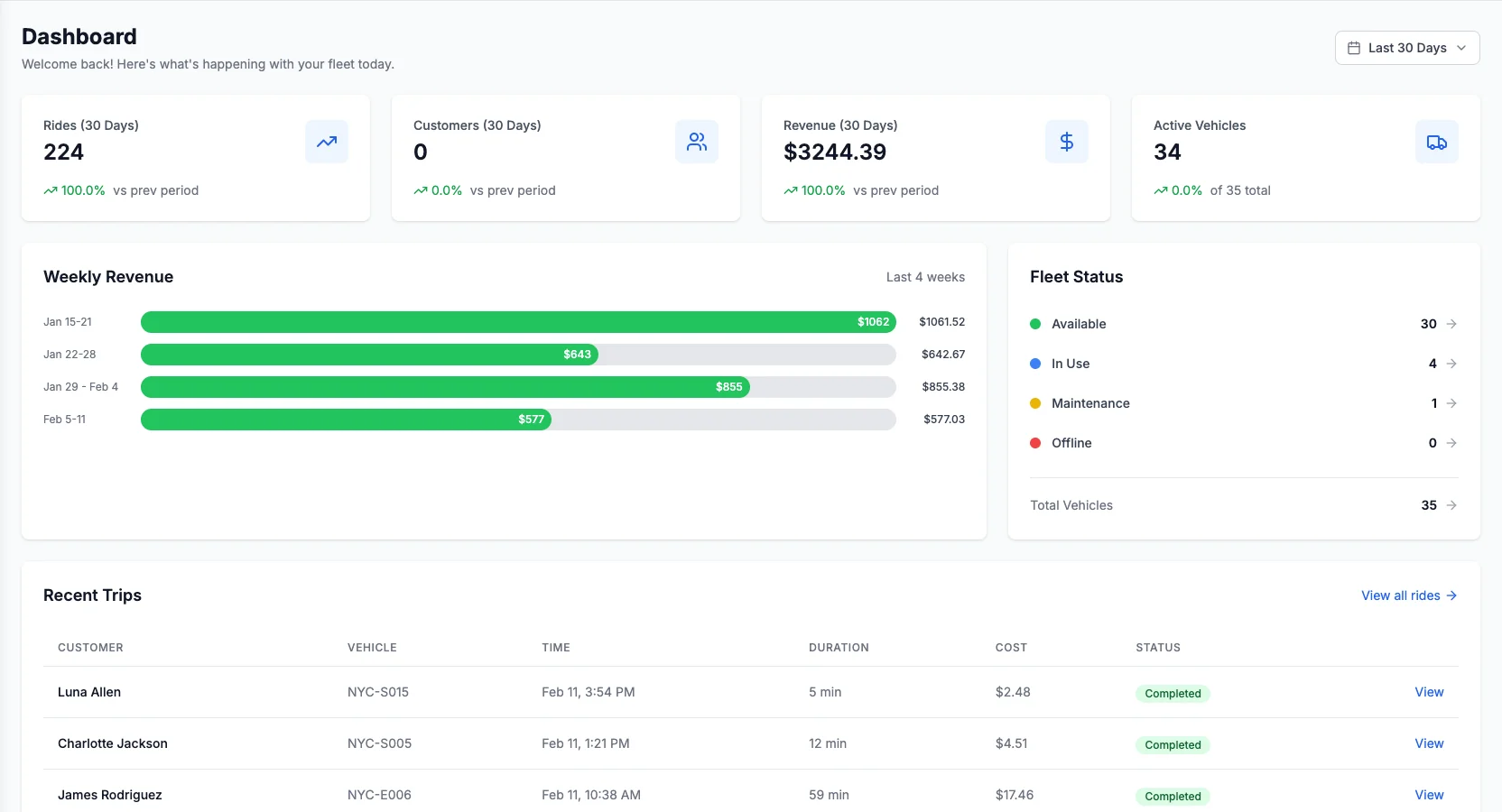
TripAdvisor and Viator demand lands in the same reservation view, so staff do not have to distinguish between two handoff processes at pickup.
Without the connected workflow
The source marketplace can become an operational distinction even though the same inventory, staff, and pickup location fulfill the ride.
With the Levy connection
- One product mapping for the shared inventory
- One reservation and check-in workflow
- One vehicle handoff and money trail
Unified operator dashboard
Live Levy Fleets operator interface
Related Integrations
Where operators go next.
Every channel runs on the same availability, the same holds, and the same money model. Adding one more is a mapping exercise, not another integration project.
Viator
The same inventory behind this page. TripAdvisor Experiences is powered by Viator, so one connection already reaches both — the Viator page covers the supplier API in detail.
GetYourGuide
Deep European coverage on a true two-phase flow, where the vehicle is held while the traveler is still paying.
Klook
Inbound Asia-Pacific travelers who book same-day, served from the same live availability engine.
Google Maps
Free discovery with no marketplace commission. Travelers searching for a rental nearby book you direct instead.
Mews
Hotel demand. Guests add a scooter or e-bike to the room folio at the front desk, with no marketplace in the middle.
All integrations
Every marketplace, PMS, OEM, and IoT connection Levy speaks, in one directory.
See the TripAdvisor integration in action
Tell us how you sell today. We'll walk you through the TripAdvisor connection — live availability, automatic reservations, and keyless handoff.
Levy Fleets is an independent fleet management and reservation platform. TripAdvisor and Viator are trademarks of their respective owners, and this page describes Levy's own integration capability only.