.svg)
Sell on Headout.
Booked on the walk over. Unlocked on arrival.
Headout travelers are already in the city, deciding in the moment. Levy is your reservation system and your vehicle platform at once: Headout reads live Levy availability over OCTO, the booking becomes a real reservation the instant it is confirmed, and the traveler unlocks a connected scooter, bike, or car with their phone when they get there—no counter, no queue, no key handoff.
2-Hour E-Bike Rental
Booked 14 minutes ago · Prepaid
Checked In
Agreement signed · Ready
Battery
92%
Zone
In Bounds
Return
4:19 PM
Availability checked
Live, not a nightly file
Capacity held at reserve
Before the card cleared
Reservation created
No staff, no re-keying
One connected operating path
Headout to Levy to the vehicle.
OCTO supplier API
Headout
Confirms a curated, last-minute product in destination
Reservation and fleet system
Levy Fleets
Checks the actual fleet, maps the product, and starts fulfillment
Physical fulfillment
Connected vehicle
Is ready when the traveler finishes walking to pickup
Why This Channel Is Different
Last-minute only works
if availability is live.
Headout is built for the traveler who is already in the destination and books hours—sometimes minutes—before they use what they bought. That compresses the whole funnel, and it breaks every integration that syncs on a schedule.
A nightly availability export would happily sell a vehicle that rolled out of the yard an hour ago. Levy computes availability on the request itself, so the number Headout shows a traveler at 2:05 PM is the number that is actually free at 2:05 PM.
A traveler pays, walks over, and there is no vehicle. On a last-minute channel there is no lead time to fix it quietly—you are refunding someone standing in front of you, and the marketplace hears about it.
Standing three blocks from your shop, phone in hand.
Caps minus confirmed reservations minus in-flight holds. Computed now, not exported last night.
Held inside a locked transaction, before the traveler’s card is even charged.
A real Levy reservation exists. Check-in link goes out with it.
From their phone, on arrival. Nobody was waiting at a counter for them.
Nobody on your team touched any part of that. Which is the point—a booking that lands while your shop is shut still turns into a completed rental.
The Difference
Every other booking system stops at the booking.
FareHarbor, Bokun, Rezdy and the rest hand you a confirmed reservation and a customer name. Everything after that is your problem: somebody has to be at the shop, find the right vehicle, hand over a key, and hope it comes back. Levy is the only reservation system where the booking is attached to a connected vehicle—so the rest of the rental runs itself.
For a last-minute channel, the connected vehicle is not a feature. It is the whole product.
A traveler who books ninety minutes ahead has no patience for a pickup process. Booking, reservation, check-in, unlock, ride, return and billing are one system on Levy, so the traveler goes from tapping “book” to riding without a single human handoff—and a booking that lands at 2 a.m. still works.
Remote unlock at pickup
The traveler taps their phone and the vehicle opens. No counter, no key handoff, no staff standing by.
Live GPS and telemetry
Location, battery, speed and vehicle health streaming for the whole rental, not just at the start and end.
Geofencing
Define where the vehicle may go. Get alerted the moment a visitor who does not know the city leaves the zone.
Automatic ride billing
Overtime, extensions and per-minute usage bill themselves against the rental instead of being chased later.
Return proof
Timestamped end-of-ride photos and location, so a return dispute with someone already on a flight home has an answer.
Remote lock
Close the rental out from the dashboard. The vehicle secures itself wherever it was left.
The Integration
Levy speaks OCTO. You stay the supplier.
Headout connects over OCTO—Open Connectivity for Tourism, the open standard the modern experiences marketplaces read. Levy implements the supplier side of it: the supplier handshake, the product catalogue, live availability, two-phase booking, confirmation and cancellation. Levy occupies the reservation-system slot; your business remains its own supplier with its own account, its own contract and its own product codes.
Live availability that cannot oversell
Capacity is your inventory caps, minus confirmed reservations, minus in-flight holds from every other channel and from Levy's own checkout. Capacity is taken at reserve, not at confirm, inside a locked Postgres transaction—so two marketplaces cannot sell the same vehicle in the same second.
Two-phase reserve → confirm
The seat is held the moment the traveler starts checkout, and released automatically if they abandon it. An unconfirmed hold never strands inventory.
Idempotent retries
The reseller's reference is the idempotency key. A retried call returns the original booking instead of reserving a second vehicle.
No double entry
A marketplace booking becomes a real Levy reservation automatically. Nobody re-keys it into a second system, so nothing gets mistyped, delayed or missed.
Sells both shapes of product
Fixed-duration rentals—a “2-hour e-bike” where the marketplace sends only a start time and your mapping supplies the duration. And per-person timed tour departures, sold by seat against a real recurring schedule. Most operators run both out of the same shopfront, so both are first class.
Handshake and advertised capabilities
Your mapped catalogue, nothing else
Live slots with real capacity and price
Reserve — capacity held immediately
Reservation created, check-in issued
Cancel — capacity returns to the pool
The Technical Flow
Marketplace tap to reconciled money, in eight steps.
This is the actual sequence, not a marketing abstraction of one. Two-phase OCTO booking commits the capacity while the traveler is still paying, and every step below either holds inventory, hands it back, or turns it into a rental that runs itself.
Traveler books on the marketplace
Already in the city, phone in hand, picking a start time an hour or two out. Nobody on your team is in the loop yet — which is exactly why a booking that lands while your shop is shut still turns into a rental.
Marketplace checkoutLevy answers availability live
Your inventory caps, minus overlapping confirmed reservations, minus every in-flight hold — from other marketplaces and from Levy’s own checkout. Computed on the request. A nightly export would happily sell a vehicle that rolled out an hour ago.
POST /api/octo/v1/availabilityReserve takes the capacity
Reserve, not confirm. The recount and the hold are written inside one locked Postgres transaction, so two marketplaces racing for the last vehicle cannot both win. The booking now carries its own expiry.
POST /api/octo/v1/bookingsConfirm, once and only once
The traveler has paid the marketplace. Levy claims the reserved-to-confirming transition under a row lock, so exactly one confirm can ever create a reservation. Confirming twice returns the same booking unchanged.
POST /api/octo/v1/bookings/{id}/confirmA real Levy reservation exists
With the money split recorded on it — gross, commission, net. The hold is consumed only after the reservation exists, so nothing can slip into the gap between releasing one and creating the other.
Reservation + channel bookingCheck-in goes out
A link that collects the contact details the marketplace never forwarded and gets your rental agreement signed before pickup. Deliberately best-effort: the traveler has already paid, so a check-in that fails must never fail the booking.
/checkin/{token}The vehicle unlocks
They walk over and their phone is the key. Same connected vehicle, same telemetry, same geofences and the same ride billing your direct rentals already run on.
Rider app → vehicleThe statement reconciles
Weeks later the remittance arrives. Every line is checked against the booking it claims to pay for, and a confirmed booking the statement left out entirely is flagged rather than quietly lost.
Matched · Variance · Unmatched · MissingGET
/supplier
GET
/products
POST
/availability
POST
/availability/calendar
POST
/bookings
POST
/bookings/{id}/confirm
GET
/bookings/{id}
DELETE
/bookings/{id}
Inside a locked Postgres transaction — the recount happens in the same transaction as the write, not as read-then-write in application code.
An Idempotency-Key header, or the reseller’s own reference, keys the booking. A retried reserve hands back the booking that already exists.
Never before. Releasing first would open a window where a competing request could take the capacity you just sold.
A hold that is never confirmed expires on its own and a scheduled sweep returns its capacity to inventory. On a same-day channel every hour of stranded inventory is a sale.
Control
A curated shelf
has to be exactly right.
Headout does not list everything in a city. It carries a tight, curated set of experiences, which means your listing is not one of five hundred results—it is one of a handful a traveler actually sees. That is enormous leverage, and it cuts both ways: with few listings and no lead time, one wrong number is visible immediately.
So Levy makes the inventory side explicit rather than convenient. Nothing sells until you have said exactly what it is, how much of it a channel may take, and what the traveler has to complete before a vehicle unlocks.
Per-channel inventory ceiling
Cap how much of the fleet any single marketplace may consume. Your walk-ups, your own website and your other channels keep the inventory you set aside for them — a curated listing does not get to quietly eat the whole yard on a busy Saturday.
Explicit product mapping
Every marketplace product code points at one specific vehicle model or tour schedule, with its own duration, start times, pricing tier, pickup location and rental agreement. An unmapped code is refused outright, never guessed — because guessing hands a traveler the wrong vehicle.
Cancellations release capacity
A cancelled booking hands its capacity straight back to the pool, immediately. On a same-day channel, a seat that frees up at noon is a seat you can still sell at one — but only if the release is instant.
Abandoned checkouts self-heal
A hold that is never confirmed expires on its own and returns the capacity. Nothing sits reserved forever because a traveler closed the tab, which matters most on the channel where every hour of inventory is being sold.
The Money
Know exactly what
you are owed.
A marketplace booking is paid—just not through your card processor. The traveler pays the marketplace, the marketplace keeps its commission, and the rest arrives weeks later on a statement. Levy records all three numbers on every single booking, so the gap is never a mystery and the statement is never the first time you see it.
A commission percentage, or a fixed net rate per unit. Whichever your contract actually says.
The conservation identity is a CHECK constraint, not a convention. A split that does not reconcile cannot be stored.
A confirmed booking the statement left out is the one that quietly costs you money. It gets flagged.
When a reported figure disagrees with your contract, the original is preserved so a dispute is argued from what they really sent.
Gross
traveler paid
$3,640
Commission
marketplace keeps
$—
Net
you are owed
$—
Commission and net are set by your own contract with the marketplace. Levy records whatever it says.
HD-91204
City E-Bike, 2 hr
HD-91218
Old Town Tour, 2 pax
HD-91233
Scooter, half day
HD-91247
City E-Bike, 2 hr
Illustrative view. Reference numbers and amounts are examples.
Traveler Check-In
Collect what you need.
Never block a paid traveler.
Marketplaces forward very little—often a first name and nothing else. No phone number, no signed rental agreement, no account. Levy issues a check-in link the moment the booking confirms, collects the missing contact details, and gets your agreement signed before the vehicle unlocks.
And it is deliberately not a gate. Someone who has already paid and is standing next to your bike does not get turned away over a missing field. Check-in chases the data; it never refuses the traveler. It also never asks for payment—a channel booking is prepaid, and asking twice is the fastest route to a dispute.
What check-in handles
Contact details
Phone and email the marketplace never sent, so you can actually reach the traveler mid-rental.
Rental agreement
Signed digitally before pickup, against the agreement template mapped to that product.
A real customer record
Every traveler gets their own record instead of collapsing onto one shared guest profile.
A ready-to-unlock vehicle
Once check-in is done, the traveler’s phone is the key. Nothing else has to happen.
Never a blocker. A traveler with a missing phone number still rides. Stranding a paying customer over a form field is worse than the gap in your data.
How It Works
Three steps to distribution
Connect the channel
Open Distribution channels in your dashboard and add the connection. Levy mints an API key scoped to your account alone — shown once, stored only as a hash — plus the OCTO base URL to hand over.
Map your products
Point every product code at a vehicle model or a tour schedule: duration, start times, pricing tier, pickup location, agreement template, and an inventory ceiling if you want one. Nothing sells until the mapping exists, which is deliberate.
Go live and stay hands-off
Availability is read live, bookings become reservations, check-in links go out, vehicles unlock, rides bill themselves, and the money trail reconciles — without anyone re-typing a thing.
Reach
One standard,
every shelf.
OCTO is an open standard, which is the reason it is worth building against properly. The same conformant supplier API that makes your fleet bookable on Headout makes it bookable on the other marketplaces that read OCTO—from one set of product mappings and one live availability feed.
Headout is the in-destination, same-day end of that spectrum. Pair it with a plan-ahead channel and the same fleet fills both the trip a traveler booked months ago and the two hours they suddenly have free.
The rest of the platform
Marketplace bookings land in the same fleet you already run on Levy. Same vehicles, same zones, same dashboard, same rider app—now with an extra sales channel attached to it, and no second system to keep in sync.
Questions
What operators ask first
How does Levy connect a fleet to Headout?
Headout is one of the marketplaces built on OCTO, the open connectivity standard for tours, activities and rentals. Levy ships a conformant OCTO supplier API — supplier handshake, product catalogue, live availability, two-phase booking, confirmation and cancellation — so your fleet is readable and bookable over the same wire format Headout already speaks. Levy plays the reservation-system role, the slot FareHarbor or Bokun would occupy. Your business stays its own supplier with its own Headout account, contract and product codes.
Can a last-minute Headout booking oversell my fleet?
No. Availability is computed live on every request: your inventory caps, minus overlapping confirmed reservations, minus in-flight holds from every other channel and from Levy’s own checkout. Capacity is taken at reserve rather than at confirm, inside a locked Postgres transaction, so two marketplaces cannot sell the same vehicle in the same second. There is no nightly export to go stale.
What happens if Headout retries a booking call?
The reseller’s own reference is the idempotency key, enforced by unique indexes on the connection. A retried call returns the original booking rather than reserving a second vehicle, so a flaky mobile network on the traveler’s side never turns one booking into two.
Does the traveler have to visit a counter?
No. The booking is attached to a connected vehicle, so the traveler unlocks it from their phone on arrival. Levy issues a check-in link that collects the contact details the marketplace did not forward and gets the rental agreement signed before pickup. Check-in chases the missing data; it never blocks a traveler who has already paid.
How is marketplace revenue tracked?
Every booking records gross (what the traveler paid the marketplace), commission (what the marketplace retains) and net (what you are owed). Commission-percentage and fixed net-rate contracts are both supported, and the identity gross = commission + net is enforced by a database CHECK constraint, not just application code. When a remittance statement arrives, Levy reconciles it line by line and flags variances, unmatched lines, and confirmed bookings the statement omitted entirely.
Can I stop one marketplace from consuming my whole fleet?
Yes. Every product mapping can carry an inventory ceiling, so a channel only ever sees the slice of the fleet you allotted it. Walk-ups, your own website and your other channels keep the inventory you reserved for them.
What happens to a product code Levy does not recognise?
It is refused with PRODUCT_NOT_FOUND. Mapping is explicit: every marketplace product code points at a specific vehicle model or tour schedule. An unmapped code is never guessed, because guessing hands a traveler the wrong vehicle.
Does Levy sell both rentals and tours?
Both are first class. Fixed-duration rentals — a "4-hour e-bike" where the marketplace sends only a start time and your mapping supplies the duration — and per-person timed tour departures sold by seat against a real recurring schedule. Most operators run both shapes, often out of the same shopfront.
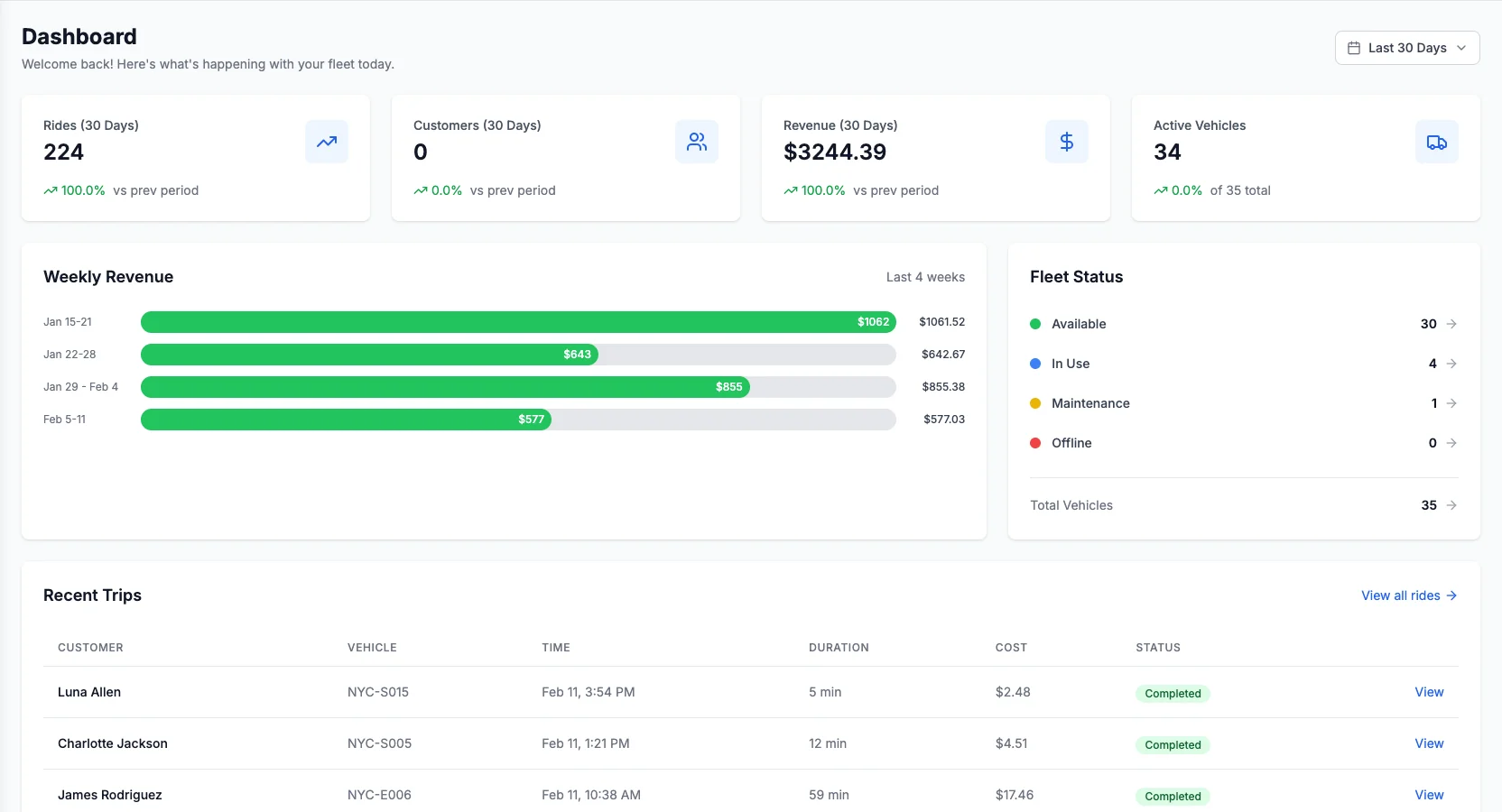
Operator implementation snapshot
Last-minute demand arrives with enough context to fulfill itself.
The operator sees which product sold, which inventory it consumed, and whether the traveler is ready—without introducing a new counter workflow.
Without the connected workflow
A booking made minutes before arrival leaves little time to copy details, find inventory, collect a waiver, and hand over a key.
With the Levy connection
- Explicit mapping identifies the right inventory
- Check-in begins as soon as booking confirms
- Vehicle state remains visible through return
Last-minute booking operations
Live Levy Fleets operator interface
Related Integrations
One OCTO connection reaches all of them.
Headout, Expedia Group, Tiqets, Klook and GetYourGuide all read OCTO. That is the point of building against the standard properly rather than one marketplace at a time: the same conformant supplier API, the same live availability and the same money model serve every one of them. Adding the next channel is a mapping exercise, not another integration project.
The same OCTO supplier API at the other end of the funnel: trip-context demand, booked months before the traveler lands.
Mobile-ticket buyers in museum quarters and old towns, deciding on the spot and riding within the hour.
Also an OCTO consumer, with its strongest reach across Asia-Pacific travel demand.
Two-phase booking over the same standard, for planned trips and same-day bookings alike.
The free complement to this page. A published GBFS feed puts your vehicles in trip-planning apps with no commission and no marketplace in the path — walk-up discovery next to prebooked demand.
Hotel demand at the source. Guests already on property book a vehicle and bill it to the room folio — the same in-destination traveler, reached before they open a marketplace at all.
Marketplaces, channel managers, property systems and open data feeds — the full list, and which one fits the way you already sell.
See the Headout integration in action
Tell us how you sell today. We'll walk you through the Headout connection — live availability, automatic reservations, and keyless handoff.
Levy Fleets is an independent fleet management and reservation platform. Headout, Viator, TripAdvisor, GetYourGuide, Klook, FareHarbor, Bokun and Rezdy are trademarks of their respective owners; Levy Fleets is not affiliated with, endorsed by, or certified by any of them, and this page describes Levy's own integration capability only. Connecting a marketplace requires your own supplier account and contract with that marketplace, which sets your commercial terms.