.svg)
Distribute through Rezdy.
Travelers unlock with their phone.
Rezdy moves your inventory across an independent reseller network. Levy is the part nobody else does—the booking lands on a connected vehicle that the traveler unlocks from their phone at pickup. Turn the connection on from your dashboard and Rezdy starts reading live availability off your real fleet.
Coastal E-Bike, Half Day
Reseller booking · Prepaid
Checked In
Agreement signed · Ready
Battery
91%
Zone
In Bounds
Return
1:00 PM
Sold by a reseller
Capacity held instantly
Reservation created
No manual entry
One connected operating path
Rezdy to Levy to the vehicle.
RezdyConnect
Rezdy
Sends reseller availability, order, and cancellation requests
Reservation and fleet system
Levy Fleets
Commits the order once, releases cancellations, and records money
Physical fulfillment
Connected vehicle
Is prepared and unlocked through the normal Levy ride flow
The Difference
Channel managers move bookings.
None of them touch the vehicle.
Rezdy, Bokun, FareHarbor—they are very good at getting a confirmed booking and a customer name from one system into another. Then the software stops and the work starts: somebody has to be at the shop, find the right vehicle, hand over a key, and hope it comes back. Levy is the reservation system where the booking is attached to a connected vehicle, so the rest of the rental runs itself.
The rental starts when the traveler taps their phone, not when someone hands over a key.
Distribution, reservation, check-in, unlock, ride, return—one system, one record. A booking can become a completed rental without a staff member touching it, which is what makes an 11 p.m. reseller booking for a 7 a.m. pickup survivable.
Remote unlock at pickup
The traveler taps their phone. No counter, no key handoff, no staff required.
Live GPS and telemetry
Location, battery, speed, and vehicle health streaming while the rental is out.
Geofencing
Define where the vehicle may go. Get alerted the moment it leaves the zone.
Automatic ride billing
Overtime, extensions, and per-minute usage bill themselves against the rental.
Return proof
Timestamped end-of-ride photos and location, so return disputes have an answer.
Remote lock
Close out the rental from the dashboard. The vehicle secures itself.
Why Rezdy
A distribution layer
that is not also
a competitor.
Most channel managers were bought by the marketplaces they distribute to. Rezdy was not. For an operator building a direct brand alongside third-party demand, that independence is the reason to run distribution through it rather than through a marketplace-owned tool.
Levy's job is to make that reach land on real vehicles. Independence in your distribution is worth very little if every booking still ends with someone standing at a counter with a key.
One connection, many resellers
Rezdy's value is the network behind it. You maintain one set of products and one availability feed, and the resellers who pick you up all read the same source of truth instead of each getting a spreadsheet.
Agents and B2B distribution, not just OTAs
Inbound tour operators, hotel concierges, DMCs, visitor centres, activity desks. This is the distribution that consumer marketplaces do not reach, and it books at a different rhythm — earlier, in blocks, and often on someone else's behalf.
Independent of the marketplaces
Bokun is owned by Tripadvisor. FareHarbor is owned by Booking Holdings. Rezdy is not owned by a marketplace, which matters if you would rather your distribution layer not be run by a company that also competes with you for the same traveler.
Strong where independent operators are
Rezdy was founded in Sydney and has deep roots across Australia and New Zealand and among independent tour and activity operators — which is the same profile as a lot of the rental fleets we work with.
The Core
The hard part is already built and running.
The RezdyConnect adapter is a thin translation onto the same engine that serves Levy's conformant OCTO supplier API and its native Viator and GetYourGuide adapters: connection management, explicit product mapping, hold-aware availability, capacity claimed under a database lock, money tracking, remittance reconciliation, and traveler check-in. Rezdy speaks its own wire format on the outside and shares that core on the inside, which is why a Rezdy booking is subject to exactly the same oversell and accounting guarantees as every other channel.
Live availability that cannot oversell
Rezdy polls your sessions and gets back true remaining seats—your inventory caps, minus confirmed reservations, minus in-flight holds from every other channel and from Levy's own checkout, minus this channel's inventory ceiling. Availability that ignores in-flight holds is exactly how a fleet gets sold twice, so the channel engine runs its own hold-aware calculation rather than borrowing the simpler one.
Capacity taken under a lock
Rezdy commits an order in one call, so Levy reserves and confirms back to back—capacity claimed at reserve, inside a locked database transaction. Two resellers cannot sell the same vehicle in the same second.
Idempotent by design
Rezdy's own orderNumber is the idempotency key, enforced by a unique index. A retried order returns the original booking instead of selling a second vehicle.
Explicit product mapping
Every Rezdy product code maps to a specific vehicle model or tour schedule. An unmapped code is refused outright rather than guessed—because guessing hands a traveler the wrong vehicle.
Refused, never half-fulfilled
A Rezdy order carrying several items is rejected explicitly with the item count, not silently booked in part. A partially fulfilled order is worse than a refused one, because nobody finds out until pickup.
Sells both shapes of product
Fixed-duration rentals—a “half-day e-bike” where the channel sends only a start time and your mapping supplies the duration. And per-person timed tour departures, sold by seat against a real schedule with its own capacity. Most operators run both, so both are first-class in the engine already.
Abandoned holds expire
A reserve that never gets confirmed hands its capacity back on a timer. An abandoned checkout somewhere else should not quietly shrink tomorrow's inventory.
An open standard underneath it all
Levy's primary surface is OCTO, the open connectivity spec the tourism industry built so suppliers stop writing one integration per reseller. Every channel-specific adapter Levy adds sits on the same OCTO-shaped core, which is why a new one is a translation rather than a rebuild.
The Money
Know exactly what
you are owed.
A distributed booking is paid—just not through your card processor. Someone else collected, someone else kept a margin, and the rest arrives later on a statement. Levy records all three numbers on every channel booking, and the database refuses to store a split where gross does not equal commission plus net. The identity is a constraint, not a convention.
Commission-percentage or a fixed net rate per unit. Whichever your agreement actually says.
A confirmed booking the statement left out is the one that quietly costs you money.
Gross
traveler paid
$5,240
Commission
channel retains
$1,310
Net
you are owed
$3,930
RZ-88104
Coastal E-Bike, half day
RZ-88119
Harbour Tour, 2 pax
RZ-88126
Scooter, full day
RZ-88140
Coastal E-Bike, half day
Control
A channel should
not run your fleet.
Distribution is worth having only if you stay in charge of it. Levy gives you the guardrails: how much inventory a channel can touch, exactly what each product code sells, and what a traveler has to complete before a vehicle unlocks.
Traveler check-in that does not block
A booking that came through a reseller often arrives with a first name and nothing else — sometimes the agent's details rather than the traveler's. Levy issues a check-in link that collects the missing contact details and gets the rental agreement signed before pickup. It chases the missing data; it never turns away a traveler who already paid.
Per-channel inventory ceiling
Cap how much of the fleet any one channel may consume. Your walk-ups, your own website, and your direct bookings keep the inventory you reserved for them — which is the whole reason to hold distribution at arm's length.
You stay the supplier
Levy plays the reservation-system role, the same slot a booking system occupies today. Your business keeps its own account, its own agreements, and its own product codes. Levy implements the API surface underneath them.
Cancellations release capacity
Rezdy cancels by its own order number and Levy hands the capacity straight back to the pool, immediately. A cancelled seat is sellable again instead of stranded on a departure that nothing else decrements.
Turn It On
Three endpoints.
That is the whole surface.
Open Dashboard → Distribution channels, add Rezdy, and Levy issues the channel key. Map your Rezdy product codes to vehicle models or tour schedules, hand the key and the endpoints to Rezdy, and RezdyConnect is talking to a live supplier that already knows what your fleet is doing.
Live sessions, true remaining seats
Rezdy asks for a product across a date range and gets back only bookable sessions. The seat count on each one is what is genuinely left after confirmed reservations, in-flight holds from every other channel, and this channel's inventory ceiling.
One call books the order
Rezdy commits in a single call, so reserve and confirm run back to back inside a locked transaction. The order number is the idempotency key. Multi-item orders and unmapped product codes are refused with a reason rather than half-fulfilled or guessed.
Cancel releases capacity immediately
Rezdy addresses the order by its own order number. Levy resolves it to your supplier reference, voids the reservation, and hands the capacity straight back to the pool, so the seat is sellable again in the same second.
Every order that comes through those endpoints becomes a real Levy reservation on a real vehicle—check-in link, signed rental agreement, remote unlock at pickup, telemetry while it is out, and the gross, commission, and net recorded against it.
The Flow
One order, followed all the way through.
From an agent you have never met, to a vehicle unlocking in your city, to the line on a statement six weeks later. This is the whole path, in the order it happens.
- Step 1
A reseller in the network makes the sale
An inbound tour operator, a hotel concierge, a DMC, a visitor centre, an activity desk. Somebody you may never have spoken to sells your half-day e-bike at 11 p.m. for a 7 a.m. pickup.
- Step 2
Rezdy is the one system talking to Levy
Whoever sold it, RezdyConnect is the counterparty on the wire, reading only the products you explicitly mapped for this connection. One feed, one source of truth, however many resellers sit behind it.
- Step 3GET /api/channels/rezdy/v1/availability
Levy answers with true remaining seats
Your inventory caps, minus confirmed reservations, minus in-flight holds taken by every other channel and by Levy's own checkout, minus this channel's inventory ceiling. Only bookable sessions come back.
- Step 4POST /api/channels/rezdy/v1/booking
Reserve and confirm, in one call
Rezdy commits an order rather than holding first, so Levy runs reserve and confirm back to back. Capacity is taken at reserve, not at confirm — waiting until confirm is exactly how two resellers sell the same vehicle to two travelers.
- Step 5
It becomes a real Levy reservation
No re-keying into a second system. The order lands as a reservation against a specific vehicle model at a pickup location, with gross, commission, and net recorded on it. A cancel by order number releases the capacity immediately.
- Step 6
Check-in chases what the channel did not send
A reseller booking often arrives with a first name and nothing else — sometimes the agent's details rather than the traveler's. Levy issues a check-in link that collects the missing contact details and gets the rental agreement signed before pickup, without blocking someone who has already paid.
- Step 7
The vehicle unlocks at pickup
The traveler taps their phone. Live GPS, telemetry, and geofencing run for the length of the rental, overtime bills itself, and return is proven with a timestamp, a location, and a photo.
- Step 8
The statement reconciles line by line
Weeks later the remittance arrives. Levy reconciles it into matched, variance, unmatched — and the one that quietly costs money every month, a confirmed booking the statement left out entirely.
Capacity is taken inside a locked Postgres transaction
The recount and the write happen in the same transaction, at reserve. Read-then-write in application code is what once let two requests for the last vehicle both pass the availability check before either wrote a hold.
The idempotency key is Rezdy's orderNumber
Enforced by a unique index. A retried order returns the booking that already exists rather than selling the vehicle a second time.
Multi-item orders are refused outright
An order carrying several items is rejected explicitly, with the item count, instead of being booked in part. A half-fulfilled order is worse than a refused one, because nobody finds out until pickup.
The selling reseller is recorded per booking
Rezdy fronts a whole network, so the reseller that actually made the sale is stored on every booking. You can tell which agent is producing rather than seeing one undifferentiated Rezdy bucket.
Every Channel
Rezdy, Viator,
TripAdvisor, GetYourGuide.
They all connect.
Rezdy covers the agent and reseller side. Levy connects to Viator directly, and because TripAdvisor Experiences sells Viator inventory, one connection covers both. GetYourGuide has its own native adapter, and any reseller that speaks OCTO can read your availability straight from Levy's supplier API.
Run one or run all of them. The product mappings, the inventory ceilings, and the money model are identical across channels, and availability is computed once against the whole fleet—so a second channel cannot resell what a first one already took.
The rest of the platform
Channel bookings land in the same fleet you already run on Levy. Same vehicles, same zones, same dashboard, same rider app—now with an extra sales channel attached to it.
Levy Fleets starts at $250/mo. Distribution channels are part of the platform, not a separate module.
Questions
The honest answers
How do I connect Rezdy to Levy Fleets?
Open Dashboard → Distribution channels, add Rezdy, and Levy issues your channel key. Map your Rezdy product codes to the vehicle models or tour schedules they sell, hand the key and the endpoints to Rezdy, and RezdyConnect starts reading live availability off your fleet. You use your own Rezdy account and your own product codes; Levy implements the supplier side underneath them.
What does the Rezdy connection actually do?
Three things. Availability returns your live sessions with the seats genuinely remaining on each one. Booking commits an order in a single call, reserving and confirming back to back inside a locked transaction. Cancellation, addressed by Rezdy's own order number, releases the capacity immediately. Every confirmed order becomes a real Levy reservation on a real vehicle.
What happens if Rezdy retries an order?
Nothing is double-sold. The Rezdy order number is the idempotency key, enforced by a unique index, so a retried order returns the original booking rather than selling a second vehicle. An order carrying multiple items is refused explicitly instead of being partially fulfilled, and a product code you have not mapped is refused rather than guessed — because guessing hands a traveler the wrong vehicle.
What else can Levy connect to?
Rezdy, Viator, and GetYourGuide each have a native adapter, and Levy ships a conformant OCTO supplier API that any OCTO-speaking reseller can read. TripAdvisor Experiences sells Viator inventory, so a Viator connection reaches both. Run one channel or all of them against the same fleet — availability is computed once, so channels cannot resell each other's capacity.
What makes Levy different from a channel manager?
A channel manager moves a booking between systems and stops. Levy's booking is attached to a connected vehicle: remote unlock at pickup, live GPS and telemetry, geofencing, automatic ride billing, return proof, and remote lock. The rental starts when the traveler taps their phone, not when someone hands over a key.
Can a Rezdy booking oversell my fleet?
No. The seats Rezdy sees are computed from your inventory caps, minus confirmed reservations, minus in-flight holds from every other channel and from Levy checkout, minus this channel's own inventory ceiling. Capacity is claimed at reserve rather than at confirm, inside a locked database transaction, so two sellers cannot take the same vehicle in the same second.
How is channel revenue tracked?
Every channel booking records gross (what the traveler paid), commission (what the channel retains), and net (what you are owed). Both commission-percentage and fixed net-rate agreements are supported, and the database enforces that gross always equals commission plus net. Remittance statements reconcile line-by-line, flagging variances and — the one that matters — confirmed bookings the statement omitted.
Does an agent booking still work if nobody is at the shop?
That is the point of attaching the booking to a connected vehicle. Levy issues a check-in link that collects the contact details the channel did not forward and gets the rental agreement signed before pickup, without blocking a traveler who has already paid. At pickup the traveler unlocks from their phone.
Operator implementation snapshot
Rezdy distribution lands inside the operation operators already run.
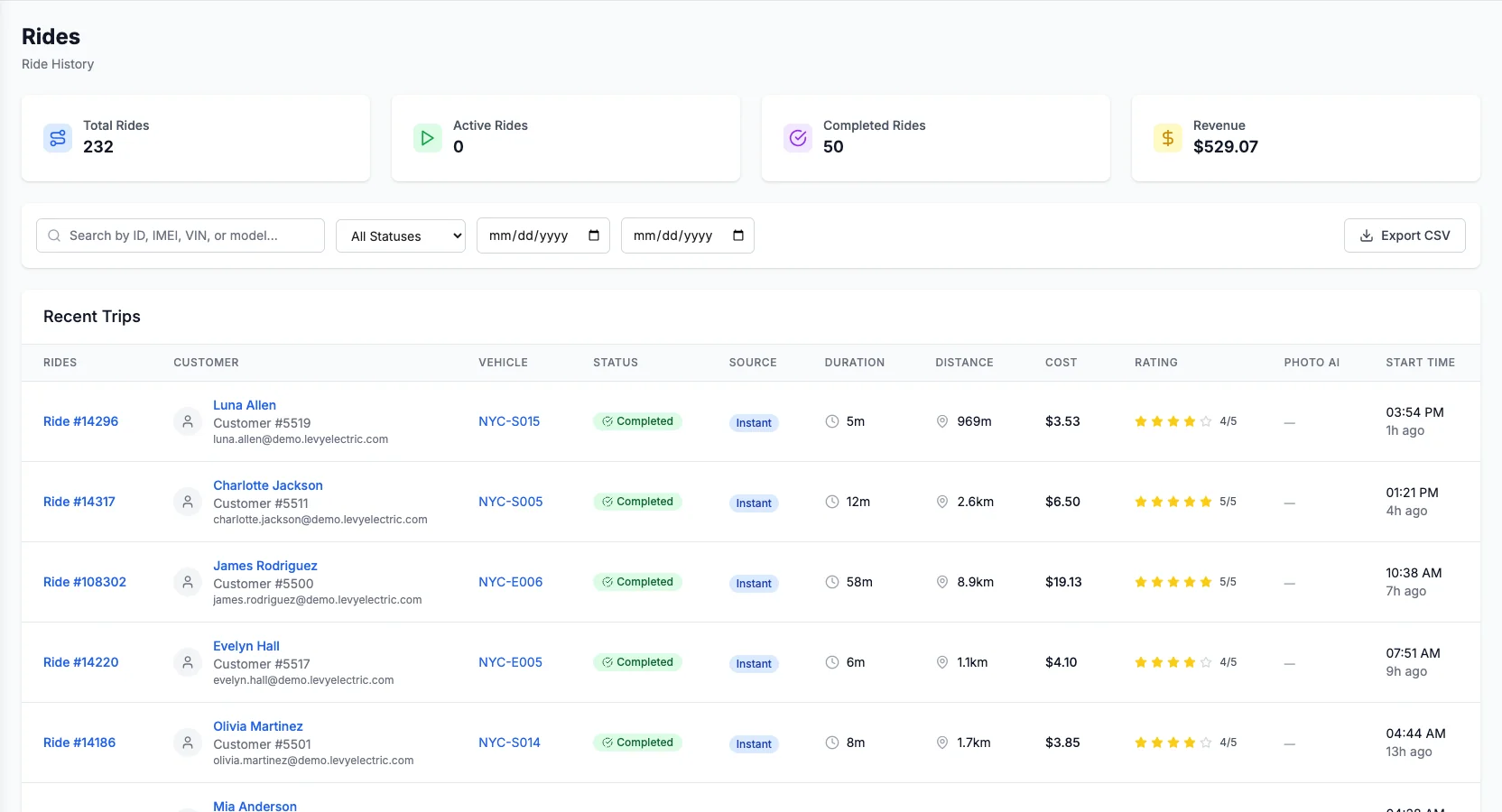
The external order number, product mapping, traveler, vehicle, and cancellation state stay attached to one record from booking through return.
Without the connected workflow
Reseller distribution can end at a confirmed order, leaving the actual vehicle and pickup process to be reconstructed elsewhere.
With the Levy connection
- Order number prevents duplicate reservations
- Cancellation releases capacity immediately
- Pickup and return use the normal ride workflow
Reseller orders and rides
Live Levy Fleets operator interface
Related Integrations
Rezdy is one way in. It is not the only one.
Levy connects to the big marketplaces directly as well, so an operator can run a channel manager and a direct connection at the same time. The product mappings, the inventory ceilings, and the money model are shared, and availability is computed once against the whole fleet.
Direct alternative
Bokun
Bokun solves the same problem Rezdy solves: one inventory, many resellers, one place to change a price. Both are good at it, and Levy connects to both the same way — so if your rates and reseller agreements already live in Bokun, nothing here changes except the adapter.
Compare the Bokun connectionDirect connection
Viator
Levy connects to Viator natively as well, so you can reach it through Rezdy or straight from Levy. Same fleet, same availability calculation either way.
Read moreDirect connection
TripAdvisor
TripAdvisor Experiences sells Viator inventory, so the direct Viator connection reaches both marketplaces without a second integration.
Read moreDirect connection
GetYourGuide
A native GetYourGuide adapter on the same core. Run it through your channel manager or beside it — availability is computed once against the whole fleet either way.
Read moreThe full list
All integrations
Every distribution channel, PMS, and IoT platform Levy connects to, including the conformant OCTO supplier API any OCTO-speaking reseller can read.
Read moreSee the Rezdy integration in action
Tell us how you distribute today. We'll show you the Rezdy connection and exactly what changes on your side.
Levy Fleets is an independent fleet management platform. Rezdy, RezdyConnect, Viator, TripAdvisor, GetYourGuide, Bokun, and FareHarbor are trademarks of their respective owners; Levy Fleets is not affiliated with, certified by, or endorsed by any of them.