.svg)
A pro forma is the one document that tells you, before you spend a dollar on hardware, whether this fleet makes money. It is the model you argue with, not the spreadsheet you show a lender. This worksheet walks you through building your own, line by line: revenue drivers at the top, the cost stack underneath, a realistic ramp curve, and a 12-month projection at the bottom. Because Levy runs on a revenue-share model with $0 upfront software cost, your platform fee is a variable line that scales with GMV instead of a fixed bill, which changes how you build the model. Work through the six steps, then plug your inputs into the Fleet Estimator to sanity-check every number against Levy's live projection.
Operator education, not professional advice
This worksheet is educational only. It is not financial, tax, accounting, legal, or insurance advice, and the numbers in the worked example are illustrative, not a forecast of your results. Before you commit capital, review your model with a qualified accountant or financial advisor, confirm tax treatment with a tax professional, and check local permits, insurance requirements, and micromobility rules with your local authorities.
What you need before you start
A blank spreadsheet with 12 monthly columns, your target city, a rough vehicle count, and your average price per ride. If you do not know your price yet, use a placeholder. Every figure in the worked example is illustrative; replace it with your own.
Step 1: Set your revenue drivers
Fleet revenue reduces to four inputs. Get these right and the rest of the model follows.
- Deployed vehicles. The count on the street and earning, not the count you own. Vehicles on a charger, in the repair queue, or in storage generate no rides. Note that "active vehicles" in Levy's pricing and plan tiers is a separate billing concept, the count used for tier eligibility, not the same as your deployed, earning count.
- Rides per vehicle per day (RVD). Total daily rides divided by deployed vehicles. As a planning range, many urban scooter operators aim for roughly 3 to 5 RVD at steady state, but this is an industry rule of thumb that varies widely by city density, season, pricing, and how hard the fleet is worked. Campus and tourism fleets swing higher in peak season and lower off-season. Treat any RVD you have not measured as an assumption to test, and model your own in the Fleet Estimator.
- Average revenue per ride. Unlock fee plus per-minute charges, net of discounts. Levy supports dynamic pricing, subscriptions, packages, and promotions, so this number moves as you tune the product.
- Days in month. Use 30 for planning, or trim for a seasonal market where you pull vehicles in winter.
Your core revenue formula is:
Monthly GMV = deployed vehicles x RVD x average revenue per ride x days in month
GMV means gross rider payments before taxes, government fees, refunds, and tips. That is the same definition Levy uses to calculate your platform fee, so build your model on GMV from the start.
Step 2: List your cost lines
Model cost as a per-vehicle-per-month stack plus a few platform lines. Break it out so you can see which lever moves your margin. Example figures are placeholders; source your own.
| Cost line | What it covers | Illustrative monthly cost |
|---|---|---|
| Hardware amortization | Landed vehicle cost over useful life. A $900 scooter over 18 months is $50 per month. | $50 per vehicle |
| Charging or battery swap | In-house swapping, swap-station power, or Juicer and Charger bounties | $10 per vehicle |
| Maintenance and parts | Repairs and consumables (tires, pads, cables). Levy stocks common OKAI and Segway parts in the US, so they ship in days, not weeks. | $12 per vehicle |
| Connectivity (IoT SIM) | Cellular data that keeps each vehicle online | $8 per vehicle |
| Field labor | Rebalancing, cleaning, and inspections | $15 per vehicle |
| Payment processing | Stripe at 2.6% plus $0.20 per transaction (Levy's volume rate) | Scales with GMV |
| Levy platform fee | Revenue share or per-vehicle software fee (Step 3) | Scales with plan |
The per-vehicle lines total roughly $95 per month in this example ($50 hardware plus $45 operating). The two variable lines, payment processing and the Levy fee, scale with revenue, so they belong in every monthly column, not as a flat number.
Small tickets get eaten by fixed fees
Stripe's $0.20 per transaction is fixed, so on a $2.50 ride it stings more than the 2.6% rate. This is why rider wallet top-ups matter: a rider who loads $20 once collapses many $0.20 charges into one. Model processing on the number of charges, not the number of rides.
Step 3: Choose your Levy plan and model the platform fee
Your platform fee is a modeled line, not a fixed subscription. Pick the plan that matches how you intend to operate, then encode its formula in every monthly column.
| Plan | Fee | When it fits |
|---|---|---|
| Managed | 20% of GMV (15% of GMV at 100 to 249 active vehicles on an annual or approved term) | Levy runs support, payments, disputes, and collections. You pay when riders pay. |
| Software-Only | $14 per vehicle per month | 100 to 249 active vehicles, in-house operations, annual commitment |
| Enterprise | Custom | 250+ vehicles, multi-market, hybrid ops, or custom SLAs |
Two rules to hard-code into your model:
- $0 upfront. There is no software cost to start. On the Managed plan you keep 80% of the revenue base and Levy keeps 20%, so the fee scales with GMV instead of arriving as a fixed bill. It is not literally zero in a slow month, though: the $250 monthly platform minimum below can still apply when volume is low.
- $250 monthly platform minimum. If a month's fees come in under $250, Levy invoices the difference. Once your GMV clears roughly $1,250 per month on Managed, 20% overtakes the minimum and the floor stops binding.
If you want an operator-branded app on iOS and Android, add the one-time $2,750 white-label fee as a Month 1 capital line. Launching on the Levy-branded app under Levy Label carries no setup fee.
Step 4: Build your ramp assumptions
The biggest mistake in a fleet pro forma is assuming you hit target utilization in Month 1. You will not: riders discover the service slowly, you learn vehicle placement by doing, and word of mouth compounds over time. Model three ramps explicitly:
- Vehicle deployment ramp. You rarely deploy the whole fleet at once. Stage it as supply and demand allow. This worksheet holds the fleet flat at 40 vehicles to keep the math clear, but a real plan often adds vehicles in waves.
- Utilization ramp. Step RVD up over the first two to three quarters. A realistic curve might run 1.5 RVD in Month 1, cross breakeven around Month 3, and settle near 4 to 5 by Month 9 to 12.
- Seasonality. If your market has a real winter, taper RVD in the cold months and pull vehicles off the street to cut per-vehicle cost.
Anchor the ramp on breakeven
Find the RVD where a vehicle's revenue per day clears its daily cost stack, then mark the month your ramp crosses it. Everything before is investment, everything after is contribution. That crossover turns a hopeful spreadsheet into a plan.
Step 5: Assemble the 12-month projection
Now stack it into a month-by-month table. Below is an illustrative 40-vehicle scooter fleet at $4.50 per ride, 30 days per month, with $3,800 in monthly fleet costs (40 vehicles at $95 each). It shows representative months. Fill in all 12 in your own model.
| Month | Vehicles | RVD | GMV | Payments | Levy fee (20%) | Fleet costs | Vehicle-level contribution |
|---|---|---|---|---|---|---|---|
| 1 | 40 | 1.5 | $8,100 | $571 | $1,620 | $3,800 | $2,109 |
| 3 | 40 | 2.5 | $13,500 | $951 | $2,700 | $3,800 | $6,049 |
| 6 | 40 | 3.5 | $18,900 | $1,331 | $3,780 | $3,800 | $9,989 |
| 9 | 40 | 4.0 | $21,600 | $1,522 | $4,320 | $3,800 | $11,958 |
| 12 | 40 | 4.5 | $24,300 | $1,712 | $4,860 | $3,800 | $13,928 |
This is contribution, not profit
The last column is vehicle-level contribution: GMV minus payment processing, the Levy fee, and the per-vehicle fleet cost stack. It is not your business net profit. It does not yet subtract the whole-business costs every operator carries: liability and vehicle insurance, city permits and per-vehicle fees, warehouse or storage rent, marketing and rider acquisition, a theft, vandalism, and total-loss reserve, income and sales taxes, and your own admin and owner overhead. Subtract those in a separate block below the table to get to real net. Treating contribution as profit is the most common way a fleet pro forma flatters itself.
Read the shape, not just the endpoints. Month 1 is thin because RVD is low while fixed fleet costs are already at full weight. By Month 3 the fleet clears its per-vehicle cost stack, and from there vehicle-level contribution grows with every point of utilization. That slow start that inflects once RVD ramps is the normal signature of a fleet finding its market.
This model is deliberately conservative
The table charges the full gross Stripe fee to the operator. On the Managed plan, Levy and you share processing costs proportionally, so your real payment cost is a bit lower than shown. Modeling costs high is the safe direction for planning.
Step 6: Pressure-test, then validate in the Estimator
A single-scenario pro forma is a guess. Turn it into a decision tool by flexing your riskiest inputs:
- Utilization. Re-run at 70% of your target RVD. If the fleet still clears breakeven by Month 6, you have a durable plan. If it only works at your optimistic RVD, you are betting the business on one assumption.
- Average revenue per ride. Drop it by $1 and watch contribution. This shows how much pricing power you actually need.
- Ramp speed. Push the inflection month out by two months. Slower adoption is the most common surprise, so make sure the model survives it.
Here is that discipline applied to the Month 12 steady state from Step 5 ($13,928 vehicle-level contribution). Each row changes only the one labeled input and holds the rest at base. The per-vehicle cost stack is held flat, which is conservative, because some operating costs fall with volume.
| Downside scenario | What changes | Monthly GMV | Vehicle-level contribution | Change vs base |
|---|---|---|---|---|
| Base (Month 12 steady state) | RVD 4.5, $4.50 fare, $95 per vehicle | $24,300 | $13,928 | baseline |
| Rides per vehicle down 30% | RVD 4.5 to 3.15 | $17,010 | $8,610 | down $5,318 |
| Average fare down $1 | $4.50 to $3.50 | $18,900 | $9,749 | down $4,179 |
| Maintenance up 50% | parts line $12 to $18 per vehicle | $24,300 | $13,688 | down $240 |
| Theft and loss reserve added | plus $8 per vehicle set aside for theft, vandalism, and total loss | $24,300 | $13,608 | down $320 |
Seasonality is a calendar effect, not a monthly rate, so model it separately: if your earning season runs about 10 months instead of 12, drop roughly two steady-state months of contribution (on the order of $27,900 at the Month 12 rate) from your annual total. That figure is partly offset by the operating costs you avoid while vehicles are pulled, but hardware amortization keeps accruing year round, so an off-season month is a small loss, not a break-even. The lesson to take from the table: a 30% utilization miss is far more dangerous than a maintenance or theft shock, so spend your planning energy on demand, not on shaving pennies off the cost stack.
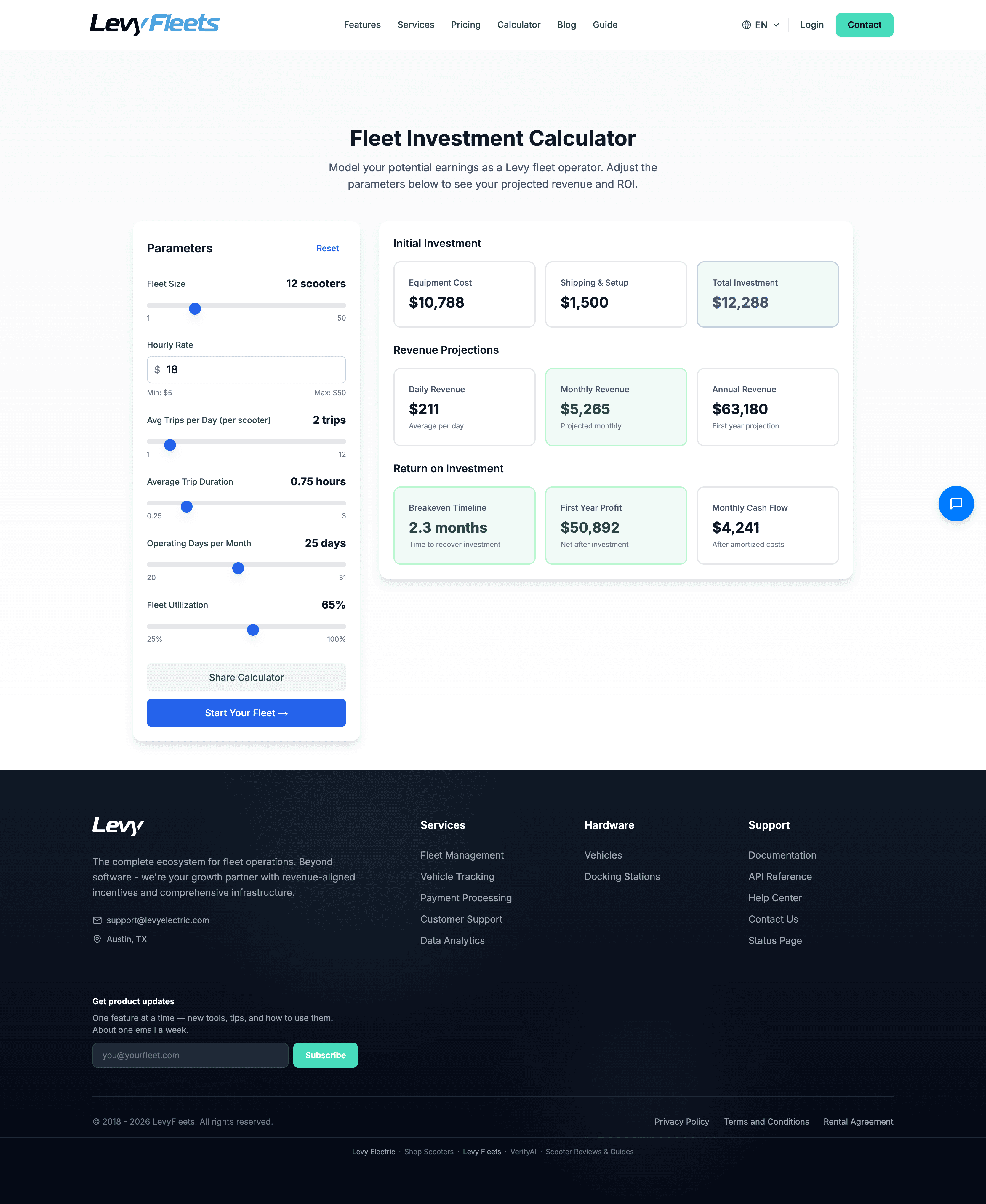
Once your numbers hold up, validate them against Levy's live model. Enter your city, fleet size, and pricing into the Fleet Estimator to get projected utilization, revenue, and breakeven, then compare it to your pro forma. Where they diverge, an assumption is off, and that gap is what you want to find before you commit capital. For the reasoning behind those projections, read the full scooter rental profitability breakdown.
Frequently asked questions
Build it, then check it
A good pro forma is never finished on the first pass. Build it, ramp it honestly, break it, then confirm the numbers in the Estimator.
Validate your model in the Fleet Estimator
Enter your city, fleet size, and pricing to see projected utilization, revenue, and breakeven, then compare it against the pro forma you just built.