.svg)
Software runs your fleet, but people run your streets. Every vehicle on Levy is connected, so the platform handles payments, disputes, identity checks, and 24/7 rider support. What it cannot do is plug in a dead battery, true a bent wheel, or carry a scooter from a quiet cul-de-sac to a busy transit exit. That physical work is your field team, and it is almost certainly your single largest controllable cost line. This lesson shows you how to structure it: the roles you need, employee versus contractor, how the gig charger marketplace and its bounties work, how to schedule crews around demand, and how to hold labor cost per vehicle down without starving the fleet.
This matters so much on Levy because of the pricing model. Levy Fleets runs on $0 upfront and revenue share: you pay when riders pay. On the Managed plan that fee is 20% of GMV (15% of GMV at 100 to 249 active vehicles on annual or approved term), with a $250 per month platform minimum credited against fees. Because Levy runs support, payments, disputes, and collections for you on Managed, the money you spend to operate is overwhelmingly field labor. Get the team right and it scales cleanly with rides; get it wrong and it quietly eats your margin. If you have not mapped where your money goes, read the unit economics of a scooter rental business first, then staff against those numbers.
This is planning guidance, not legal, tax, or insurance advice
Hiring decisions in this lesson touch worker classification, payroll taxes, and liability coverage, and the rules vary by state and change over time. Treat everything here as an operations starting point, not a professional opinion. Confirm classification, tax, and insurance questions with a qualified attorney, accountant, or licensed broker for your market before you act, and model your own costs in the Fleet Estimator rather than relying on the illustrative figures below.
Why your field team is a profit-and-loss decision
Think of field labor the way you think about a rebalancing move: it has a cost and it should earn a return. A charger who tops up a vehicle before it strands keeps an asset earning. A mechanic who catches a worn brake pad on a scheduled check prevents a refund, a claim, and days of downtime. A rebalancer who seeds the morning commute unlocks rides you would never see. The work is invisible when it goes right and expensive when it goes wrong, which is exactly why undisciplined operators overspend on it.
Two levers set your labor bill: how much work the fleet creates for you (dead batteries, breakdowns, drift), and how cheaply you clear it (employees versus contractors, batched runs versus one-off rescues, paid labor versus rider behavior you nudge for free).
On Managed, your team is physical, not administrative
Because Levy runs 24/7 rider support, payments, disputes, chargebacks, and collections on the Managed plan, you do not staff a call center or a billing desk. Your headcount goes almost entirely to the street: charging, repair, and rebalancing. Spend your labor budget on keeping vehicles safe, charged, and in the right place, and let the platform absorb the back office.
The core field roles
Most shared micromobility operations run three kinds of field work. At small scale one person does all three. As you grow, they specialize.
Chargers and juicers
Chargers (also called juicers) keep the fleet powered. On a fixed-battery fleet that means collecting low units, charging them, and redeploying them, because a fixed-battery vehicle takes several hours to recharge (roughly 4 to 8 hours is a common planning range, though it varies by vehicle, battery size, and charger, so measure your own) and earns nothing the whole time. On a swappable-battery fleet it means running fresh packs out to vehicles in place, which keeps the unit on the street. This is the highest-volume, most repetitive field role, and the one most suited to a gig marketplace (covered below).
Mechanics and technicians
Mechanics keep the fleet safe and rentable. They run your weekly and monthly inspections, replace the wear items that actually break (tires and tubes, brake pads and cables, folding stems, batteries), and turn around the repair queue. This role needs more skill and trust than charging, which usually makes it an employee role, not a gig one. Levy gives this crew Work Orders: task management, technician dispatch, parts tracking, and vendor invoicing, so every repair is a tracked task tied to a specific vehicle, assigned to a person or an outside shop, with parts and labor booked against it.
Rebalancers
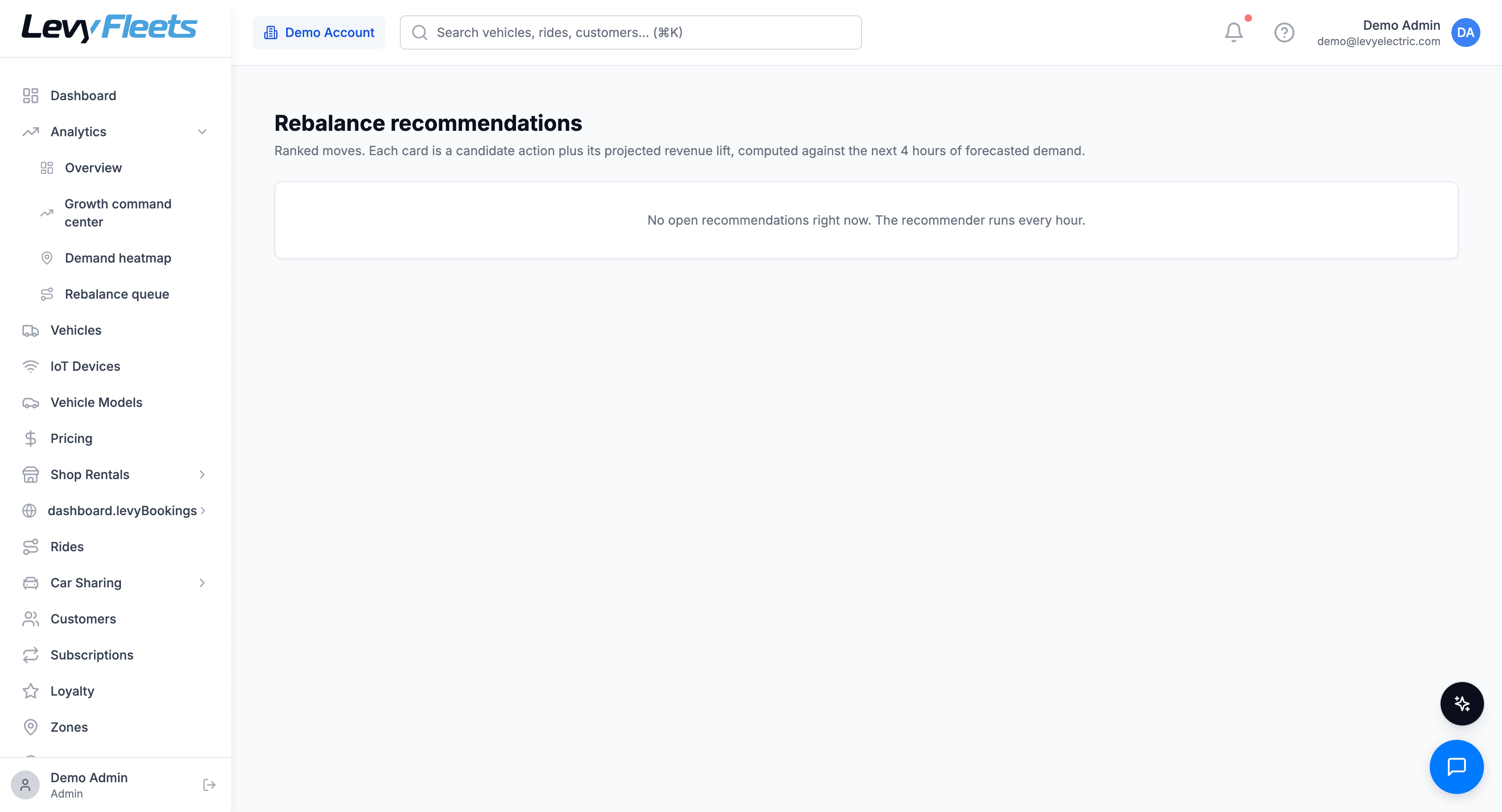
Rebalancers keep the fleet where riders are. They seed the morning commute, run a light midday reset, and reposition for the evening. This role overlaps heavily with charging, because a van already out collecting low batteries can drop those units in a hot zone on the way back. Levy leans into that overlap: AI Ops recommends joint battery-swap and rebalance technician routing in the operator app, so one crew can run one efficient loop instead of two. AI Ops forecasts demand and ranks the moves by projected ROI, but it never dispatches on its own: your crew decides which recommendations to run.
Combine roles until volume forces you to split them
Below a few dozen vehicles, one or two people can charge, wrench, and rebalance. Do not hire a specialist for each function before volume justifies it. The natural first split is to pull repair out into a dedicated mechanic (it needs skill and a stocked shelf), then push charging out to a gig marketplace (it is repetitive and location-dense), leaving your salaried crew on rebalancing and the repair queue.
Employee versus contractor
The biggest structural decision about your team is how you classify it. Employees give you control, consistency, and a crew that wears several hats, at the cost of fixed payroll, taxes, and overhead that bites hardest when demand dips. Contractors and gig workers give you variable per-task cost that flexes with your fleet, at the cost of less control over timing and quality. Most operators end up hybrid: a small salaried core for skilled, trust-heavy work, plus a variable gig layer for high-volume charging.
| Dimension | Employees | Contractors / gig |
|---|---|---|
| Cost shape | Fixed payroll, taxes, benefits | Variable, per task, scales with fleet |
| Best fit | Mechanics, lead rebalancers, shop | High-volume charging and light repositioning |
| Control over timing | High (you set the schedule) | Lower (workers self-select tasks) |
| Management overhead | Higher (scheduling, supervision) | Lower (marketplace handles dispatch) |
| Risk in a downturn | Payroll continues when rides fall | Cost falls with the work |
Worker classification is a legal question, not just a cost one
Whether a charger can legally be a contractor depends on where you operate. Some states apply strict tests that treat gig workers as employees, which changes your tax, insurance, and liability exposure. Before you launch a gig charging model in a new market, confirm the classification rules for that state and make sure your insurance actually covers gig activity. This is a get-it-in-writing decision, not a hunch, so coordinate it with Levy before you flip the marketplace on.
The gig charger marketplace and how bounties work
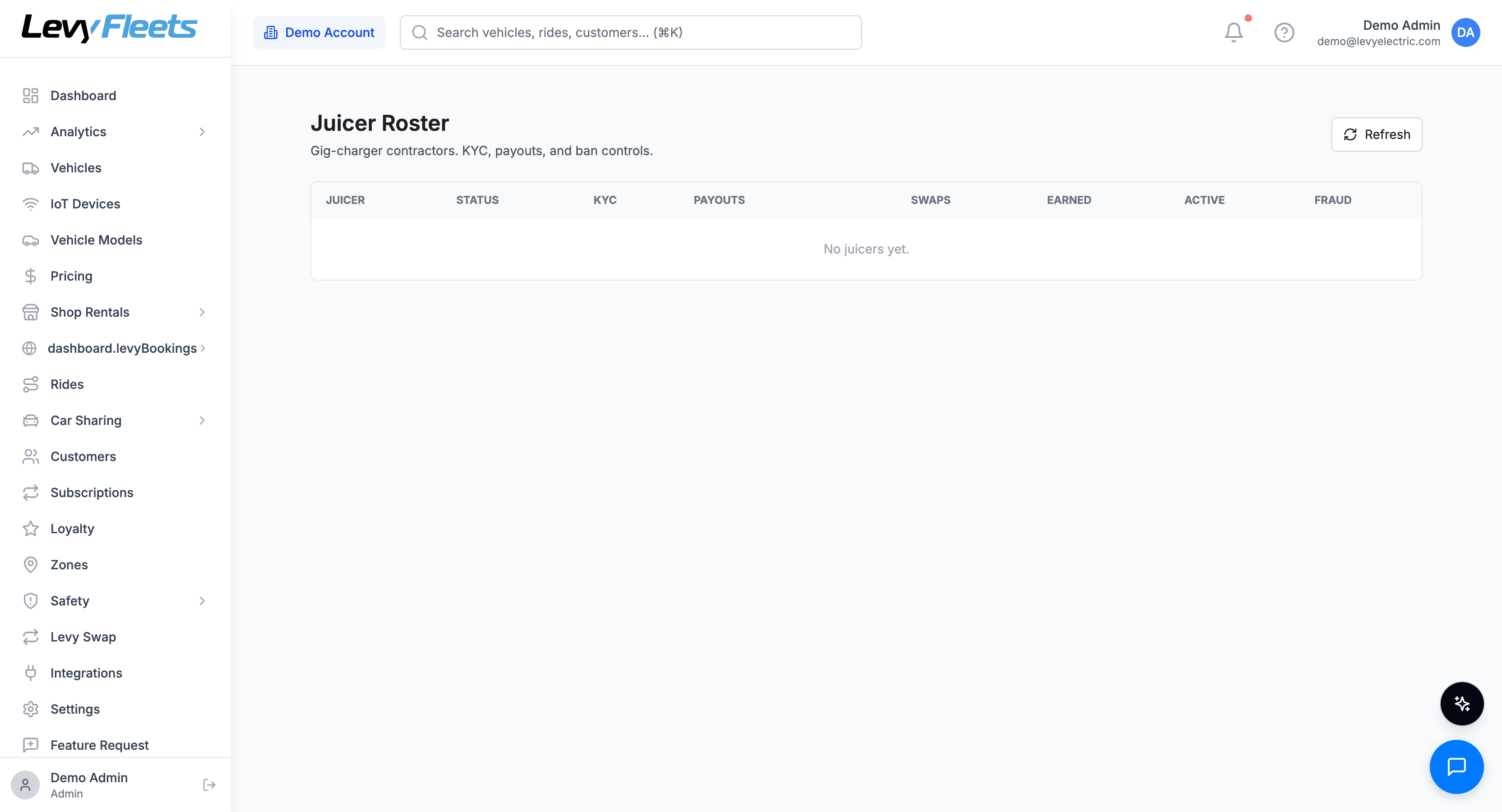
Levy ships a built-in gig marketplace for charging, the same model the large operators proved at scale. Independent contractors (Juicers, or Chargers depending on the city) pick up low-battery vehicles, charge them, and drop them back inside zones you define, for a per-vehicle bounty you set. The platform side is fully built: identity checks and onboarding, bounty discovery and claim, payouts, predictive bounty pricing, and fraud detection. For the full mechanics, pack health tracking, and swap-station tooling, see the Battery Swap and Juicer marketplace documentation.
Here is the loop a charger runs:
See and claim a bounty
The charger opens the app to a map of nearby low-battery vehicles and claims one to charge, at the per-vehicle bounty you set for it.
Pick it up
The charger collects the claimed vehicle. Because every charger is identity-verified at onboarding, each pickup is tied to a known person.
Charge it
The vehicle goes home to a standard wall charger and comes back with a full pack.
Drop it back in zone
The charger returns the charged vehicle to one of the drop zones you define in your zone setup.
Get paid
The bounty pays out through the platform's Stripe payout rails. You control the roster and payouts from the dashboard: suspend or remove a charger, and hold or claw back a payout.
Two capabilities are worth calling out. Predictive bounty pricing lets your bounties vary by vehicle instead of flat-rating every charge, so you can weight your labor spend toward the vehicles you want cleared first. Fraud detection is built into the marketplace to help you keep payouts tied to work that was actually done.
The in-house alternative is the swap workflow: your own salaried crew swaps packs on a route you plan. In-house gives you tighter control and no marketplace fee; the gig model gives you variable cost and coverage without a fixed headcount. Many operators run both, with employees handling dense scheduled routes and the gig layer mopping up scattered long-tail vehicles.
Schedule your crew around the demand clock
A field team is only as good as its timing. Charging and rebalancing track the same daily demand curve, so schedule them together.
- Morning seed (roughly 6 am to 10 am). Your highest-leverage window. Finish placing vehicles at residential origins and transit exits by about 6:30 am to 7 am, and seed the units you charged overnight. A charged vehicle in the wrong place and an uncharged one in the right place are both dead inventory.
- Midday reset (roughly 11 am to 2 pm). Demand is flattest, so moving a vehicle now costs the least in lost rides. Pull low-battery and long-dwell units, run maintenance swaps, and let mechanics work the repair queue.
- Evening reposition (mid-afternoon into the night). Let the outbound commute rebalance part of the fleet for free, top up dining, nightlife, and event zones, then stage overnight charging so packs are full before tomorrow's seed.
Make the fleet do some of the labor for free
The cheapest field task is the one you never dispatch. Configure parking rewards in your zones to nudge riders to end rides where you want vehicles restocked, and use out-of-zone parking rules to discourage drop-offs where units go to die. Rider behavior will not cover a full morning commute, but it can quietly handle a real slice of your charging and rebalancing drift at zero labor cost. Every task riders absorb is a bounty or van run you never pay for.
Control labor cost without starving the fleet
The discipline here is the same one you use for rebalancing: price the work per task, and only fund the tasks that pay.
Track cost per task, not just total spend. Your two headline numbers are cost per charge (or swap) and cost per rebalancing move, all in: labor, fuel or van time, and the downtime while the vehicle is off the street. A gig bounty gives you that number directly, because it is a fixed per-vehicle price you set. An in-house run gives it to you when you divide loaded crew cost across the vehicles touched. As an illustration only, if a technician spends 45 minutes swapping 8 packs and your loaded cost lands around $4 to $8 per vehicle, that is the hurdle a gig bounty has to beat before you outsource that route. A few habits keep the bill honest:
- Batch, never rescue one at a time. Sending a van across town for a single scooter destroys your cost per task. Group pickups and drops into tight loops, and pair charging collection with rebalancing drops so one trip earns twice.
- Kill deadhead miles. An empty return leg is pure cost. Plan routes that collect low units in a dead zone on the way to dropping charged units in a hot zone.
- Let predictive bounties target the spend. Predictive bounty pricing lets your payouts vary by vehicle, so lean on it instead of flat-rating every charge and overpaying to top up packs that did not need the priority.
- Measure labor per 100 vehicles. Watch total field hours (paid crew plus bounties) against fleet size. If that number climbs while utilization stays flat, your routing or scheduling has slipped, and it will hit margin before it shows up anywhere else.
Every field dollar you save drops to your bottom line, so cost per task deserves the same attention you give pricing and utilization.
What changes by vehicle type
The team structure is the same across vehicles, but the physical constraints shift, and those constraints drive your labor cost.
Kick scooters are the ideal case for a gig charging marketplace: light, easy to transport in a personal vehicle, and clustered in predictable spots, so bounties get claimed and cleared fast. A single van carries many units, so in-house rebalancing batches cheaply too. Weight mechanic time toward tires, brakes, and the folding stem, the parts that drive most scooter downtime.
The unit economics behind your labor budget
Where field labor sits in a scooter rental P&L, and why utilization and cost per task decide whether the fleet makes money.
Frequently asked questions
Put the team on the board
Your field team is the part of the operation the platform cannot automate, and it is where you either compound margin or leak it. Structure it around the three jobs that matter (charge, repair, rebalance), classify each role deliberately for your market, lean on the gig marketplace for high-volume charging while keeping a skilled core for repair, and price every task so labor scales with rides instead of running ahead of them. To model how field labor, fleet size, and utilization shape your margin, run your numbers in the Fleet Estimator or book a demo and we will walk through how the marketplace, Work Orders, and joint routing fit your operation.