.svg)
Every ride your fleet completes is a small payment event, and the money only reaches you if that event clears, holds, and survives any dispute the rider's bank might raise weeks later. Get payments right and you keep the operator share of a growing pile of clean revenue. Get them wrong and you leak margin to failed charges, uncollected balances, and lost chargebacks you never fought. This lesson walks the full money path: how a ride turns into a charge, where the rider wallet and auto-top-up fit, how to recover a charge that fails, what actually happens when a rider disputes a ride, and which fraud detection tools the platform gives you to screen accounts up front.
The good news for operators is that Levy runs payments for you. Levy Fleets provides managed payments on Stripe as part of the stack, alongside the rider wallet, disputes and chargebacks handling, and collections and dunning, and on the Managed plan Levy runs support, payments, disputes, and collections on your behalf. You still need to understand the machinery, because your choices about wallets, auto-top-up, and identity checks are the main levers you have over payment throughput and fraud exposure.
Not financial, tax, or legal advice
This lesson explains how Levy's payment stack works and how to reason about payment economics. It is not financial, tax, accounting, or legal advice. Collections practices, chargeback and dispute rights, and revenue recognition are governed by rules that vary by market and change over time, so confirm your specific approach with a qualified professional before you rely on it. Figures and outcomes here are illustrative, your results will differ, so model your own numbers in the Fleet Estimator.
How ride payments actually flow, end to end
Start with the money path, because everything else in this lesson is a variation on it. Levy's payment rail is Stripe, one of nine software platforms included on every plan at no extra cost. A completed ride generates a charge, Stripe processes it, and the funds settle into the managed payment flow that Levy reconciles into your revenue share.
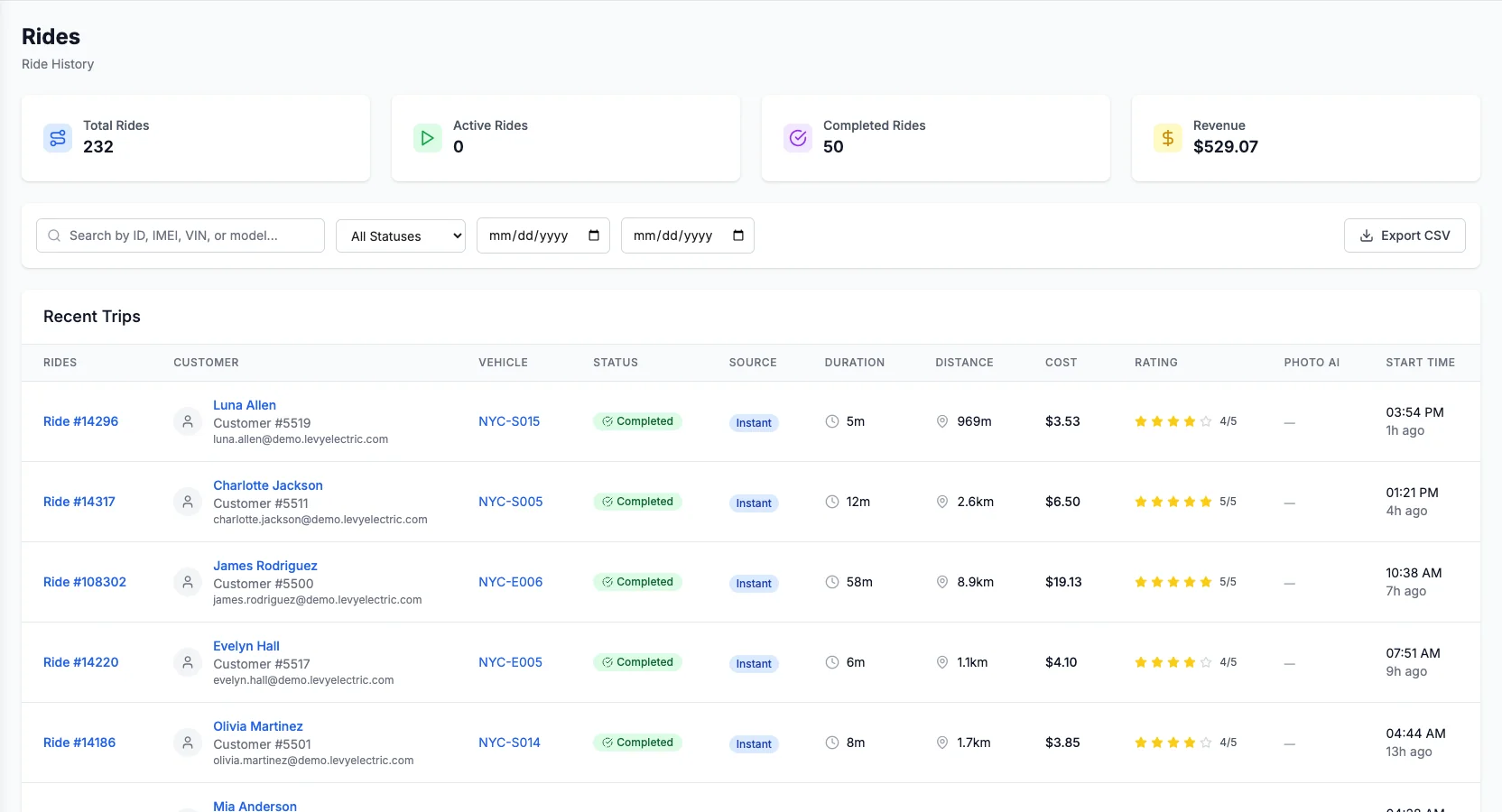
Two numbers govern the economics of that flow, and you should have both memorized:
- Stripe processing: Levy has volume pricing of 2.6% + $0.20 per transaction, versus the standard 2.9% + $0.30. Your revenue share is calculated on net revenue after Stripe processing fees, and operator and Levy share those processing costs proportionally. Fewer, larger transactions therefore keep more money in the system than many tiny ones, which is one reason the wallet model below matters.
- Your plan fee: On Managed you pay 20% of GMV (15% of GMV at 100 to 249 active vehicles on qualifying annual terms), with a $250 per month platform minimum credited against fees. GMV here means gross rider payments before taxes, government fees, refunds, and tips. There is $0 upfront and you pay when riders pay, so Levy only earns when you do.
Two different money flows, do not blend them
The plan fee is quoted as a percent of GMV (gross rider payments). The operator payout base is net revenue after Stripe processing fees. These are two separate calculations, not one number. When you model unit economics, keep them in different columns: the GMV percent sizes Levy's platform fee, and the net-of-Stripe figure sizes what actually lands in your payout. Partner share defaults to 80% for a subaccount without an explicit value, the complement of Levy's 20% Managed fee.
The rider wallet is the core of the model
Levy's payment design is wallet-first, and understanding why explains much of what follows. Instead of charging a rider's card at the end of every single ride, riders load funds into a prepaid rider wallet, and rides draw down that balance. This changes the failure math in your favor:
- Fewer card transactions. A rider who tops up once and takes ten rides is one Stripe transaction, not ten. That lowers total processing drag (remember, you share those fees) and cuts the number of moments a card can decline mid-flow.
- Money is captured before the ride, not chased after it. The riskiest moment in any payment is asking a card to pay for value the customer already consumed. A funded wallet flips that: the balance is already sitting there when the ride ends.
- Cleaner disputes posture. Prepaid, authorized top-ups leave a stronger evidence trail than a scatter of small post-ride captures, which matters when you fight a chargeback later.
The tradeoff is that the point of failure moves from "the ride charge" to "the top-up." If a rider's wallet runs dry and their card cannot refill it, that is where you lose money. Auto-top-up exists to close exactly that gap.
Auto-top-up keeps the wallet funded
Auto-top-up automatically refills a rider's wallet from their saved payment method when the balance runs low, so you can keep riders funded rather than chasing a post-ride balance. Configured well, it is one of the main levers you have on payment throughput:
- Set your auto-top-up amount to comfortably cover a typical ride.
- Larger, less frequent top-ups mean fewer transactions and less proportional processing cost.
- A saved, pre-authorized card on file is a card you have already validated.
For the full configuration walkthrough, wallet mechanics, invoicing, and Stripe setup, send your team to the billing and payments help center, which documents wallet payments, auto-top-up, outstanding-balance collection, and refunds in detail.
When a charge fails: failed-charge recovery
Cards fail. They expire, hit limits, get flagged by the issuer, or the rider simply loses the card. Because Levy is wallet-first, a failure surfaces at top-up time rather than interrupting a ride in progress, and leaves a rider carrying an outstanding balance. Your job is to recover that balance without burning the customer relationship. Levy's collections and dunning handles this as part of managed payments, and on the Managed plan Levy runs collections for you.
Here is the recovery ladder to understand, from softest to firmest:
Automatic retry (dunning)
When a top-up or balance charge fails, the system retries the card on a schedule rather than giving up on the first decline. A large share of failed charges are temporary (a momentary limit, an issuer hiccup) and clear on a later attempt with zero human effort.
Notify the rider to fix the payment method
If retries keep failing, the rider is prompted to update their card. Riders who want to keep riding will fix a card fast when the app tells them exactly what is wrong, so a clear, timely notification recovers more revenue than any aggressive tactic.
Carry the balance and gate the next ride
An unpaid balance follows the rider's account. Requiring the outstanding amount to be cleared, and a working payment method to be on file, before the next unlock turns natural repeat demand into your collection mechanism.
Formal collections on stubborn balances
For balances that never resolve, Levy's managed collections and dunning pursues recovery so you are not writing off revenue by default. This is included in the Managed plan rather than a separate service you assemble yourself.
Prevention is cheaper than recovery
The cheapest failed charge is the one you prevented. Requiring auto-top-up with a validated card on file gives riders a funded wallet and a known-good payment method on file, so you address failures at their source rather than after the fact. Recovering a bad charge costs you time, notifications, and goodwill. Keeping the wallet funded is a one-time configuration.
Disputes and chargebacks: what really happens
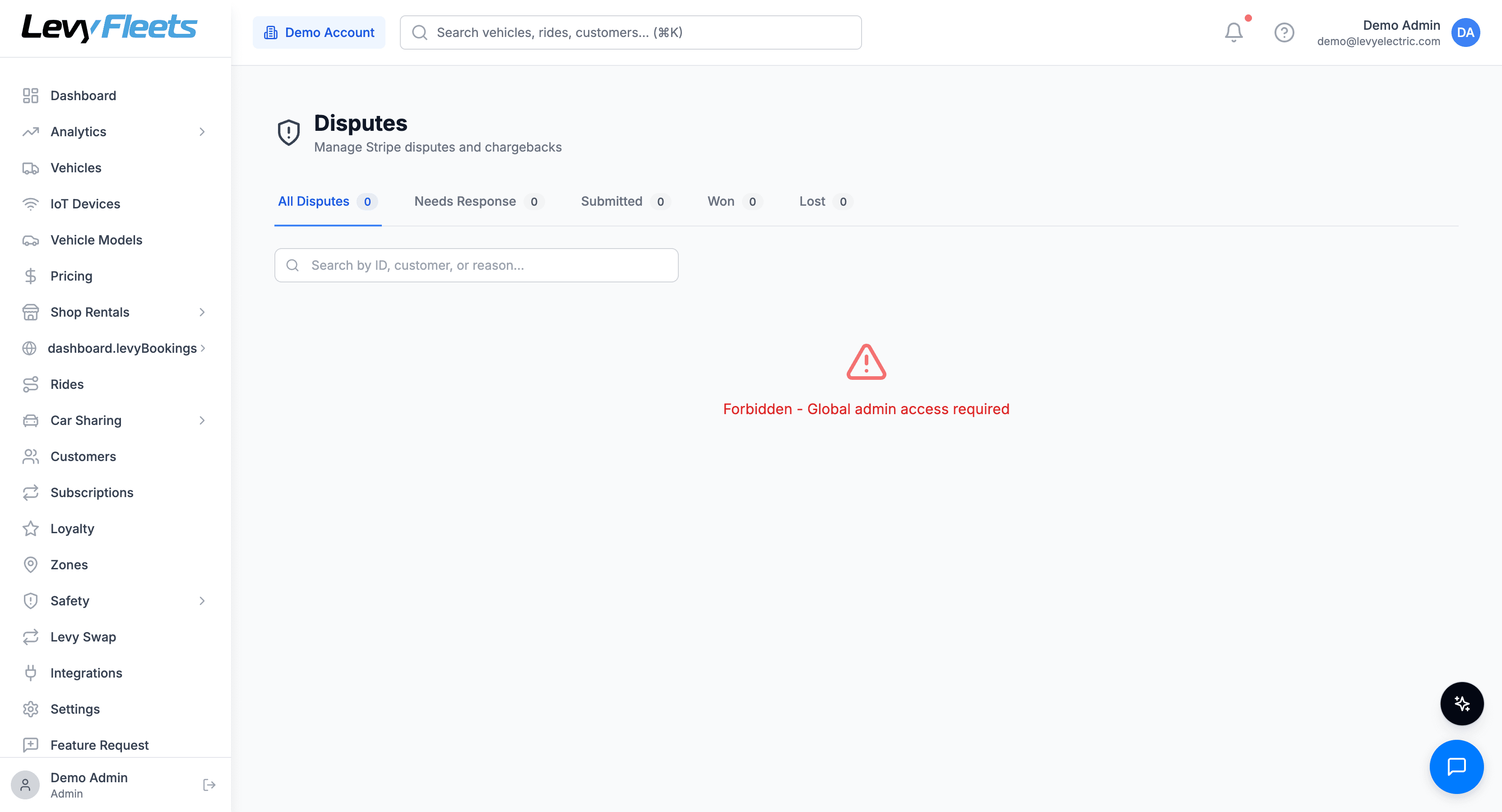
A chargeback is different from a failed charge. A failed charge never paid you. A chargeback claws back money you already collected, because the rider went to their card issuer and disputed the transaction. Levy provides disputes and chargebacks handling inside managed payments, and on the Managed plan Levy runs disputes for you, but you should know the lifecycle so you can supply good evidence and read outcomes correctly.
The chargeback lifecycle
- The rider disputes. They tell their bank they do not recognize the charge, did not authorize it, or believe the service was not delivered. The issuer provisionally pulls the funds back, often plus a fee, before anyone reviews the merits.
- Evidence is assembled. The dispute is answered with a case: the ride record, timestamps, GPS trail, the wallet and top-up history, identity verification on the account, and the terms the rider agreed to. A funded-wallet model with verified identity gives you a fuller evidence package to assemble than loose, anonymous post-ride captures.
- The issuer decides. The rider's bank, not Levy and not you, rules on the dispute. This is the part operators often misread: you can present a flawless case and still lose, because the decision sits with the issuing bank.
How Levy handles it, and what stays your job
On the Managed plan, disputes are Levy's responsibility to fight, so you are not manually filing evidence for every contested ride. Your job shifts to feeding the machine clean inputs and reducing the disputes that arise in the first place:
- Keep identity verification on. A verified identity on the account gives you evidence to answer an "I never authorized this" dispute.
- Let the wallet and auto-top-up do their work. Pre-authorized top-ups and a clear ride history give you evidence to submit. Do not disable the mechanics that create your paper trail.
- Resolve legitimate complaints in-app first. Giving a rider a fair refund through your support flow offers a resolution before they reach for their bank. The refund path exists for exactly this reason: use it before a complaint escalates into a chargeback.
You will not win every chargeback, and that is normal
Chargeback outcomes are decided by the rider's issuing bank, so treat some loss rate as a cost of doing business rather than a failure of your process. The winning strategy is prevention and clean evidence, not chasing a perfect record. Focus your energy where it compounds: verified riders, funded wallets, and fast in-app refunds that give riders a resolution before they dispute. Refunds and fare corrections should always be handled through the proper billing flow so your accounting stays correct, never by hand-editing balances.
Fraud detection and dispute protection
Fraud is the failure mode that never shows up as a decline, because the transaction succeeds, then reverses or vanishes. Levy bundles identity verification and fraud prevention into the platform through three of the nine included software platforms, so you are not sourcing and paying for these tools separately:
- SoCure for ID verification at signup, screening accounts before they can ride.
- Experian for credit and identity signals on riders.
- Stripe Identity as an additional identity-verification layer on top of the managed Stripe payment rail.
Layered on top is Rider Score, Levy's behavior-based safety scoring with rewards and an intervention ladder. While its primary job is safety, behavior scoring is also a fraud and risk signal you can factor in, and the intervention ladder gives you a graduated response instead of a blunt ban.
Put together, this is defense in depth. Identity verification screens accounts at signup. The wallet model captures funds up front. Behavior scoring flags risky riders over time. And because payments run on managed Stripe, the transaction-level protections of a major processor sit under the whole thing. For managing the rider accounts, wallets, and verification status behind all of this, use the customer management help center, which covers customer accounts, wallets, verification, and communications.
Who does what, by plan
How much of this you run versus Levy runs depends on your plan. The mechanics are the same either way, the ownership differs.
| Responsibility | Managed (20% of GMV, 15% at 100 to 249 vehicles) | Software-Only ($14 per vehicle per month, 100 to 249 vehicles) |
|---|---|---|
| Payment processing (Stripe) | Included and run by Levy | Included platform, you operate it |
| Rider wallet and auto-top-up | Configured and managed | Configured and managed |
| Failed-charge recovery, collections, dunning | Levy runs it for you | You run it in-house |
| Disputes and chargebacks | Levy fights them for you | You handle disputes in-house |
| Identity verification and fraud tooling | Included and managed | Included, you operate it |
| Support (24/7) | Levy provides it | In-house operations |
The through-line: Managed is the turnkey option where Levy runs support, payments, disputes, and collections, ideal if you want to focus on the street operation. Software-Only puts the same included tooling in your hands for in-house teams on an annual commitment. Either way there is $0 upfront, and geofencing, dynamic pricing, and analytics are included for everyone rather than gated behind tiers. To see how payment throughput ties into overall margin, read our guide on scooter rental business profitability.
A weekly payments routine
Payments are not a set-and-forget system. A short weekly review catches leaks before they compound.
Review failed charges and outstanding balances
Scan for riders carrying unpaid balances and for a rising decline rate. A spike usually points to auto-top-up settings that are too conservative or a card-validation gap, both fixable in minutes.
Check auto-top-up coverage
Confirm the share of active riders on auto-top-up with a validated card. The higher this number, the more of your riders have a funded wallet and a known-good card on file. Nudge or require it where adoption is thin.
Read your dispute activity
Look at what riders are disputing and why. Patterns (a confusing fee, a parking charge riders contest) point to product fixes, not just individual cases to fight. Address the root cause rather than fighting each case one by one.
Reconcile revenue against rides
Spot-check that completed rides map to clean payments and that your net-of-Stripe payout lines up with GMV. Catching a reconciliation drift early is far cheaper than untangling a month of it.
Frequently asked questions
Related help center guides
Billing and payments
Wallet payments, auto-top-up, Stripe setup, invoicing, outstanding-balance collection, and refunds.
Customer management
Rider accounts, wallets, identity verification, and customer communications.
Put it into practice
Clean payments are not luck, they are a system: a funded wallet, auto-top-up on a validated card, fast in-app refunds, and identity verification at signup. The platform gives you the tools to recover failed charges, manage disputes and chargebacks, and screen accounts, and on the Managed plan Levy layers its own recovery, collections, and chargeback handling on top while you focus on the street. Want to see how this plays out for your fleet? Run the numbers in the estimator and model your revenue, processing cost, and operator share before you commit a dollar.