.svg)
Rebalancing is the gap between a fleet that keeps its vehicles earning (a well-run urban fleet is often modeled at roughly 4 to 5 rides per vehicle per day) and one that strands half its inventory in dead zones while riders in the busy part of town open your app to an empty map. It is also one of your largest controllable cost lines: every vehicle you touch costs field labor, van miles, and downtime while that unit is off the street. So the job is not to move the most vehicles. The job is to move the fewest vehicles that unlock the most rides. This lesson shows you how to read demand, work the daily flows, target your hot zones, and price each move so it earns back more than it costs.
The stakes are direct on Levy's revenue-share model. On the Managed plan you pay 20% of GMV (15% at 100 to 249 active vehicles on qualifying annual terms), with a $250 per month platform minimum. You pay when riders pay, so every extra ride a smart move unlocks is revenue you keep the operator share of, and Levy only earns when you do. That alignment is why rebalancing deserves the same rigor you give pricing. New to the business? Read how to start an electric scooter rental business first, then turn this into a daily routine.
This is operator education, not professional advice
This lesson is general education for fleet operators. It is not financial, tax, accounting, or legal advice. Every ride count, cost, and revenue figure here is an illustrative planning range, not a guarantee, and your real numbers will differ by market, season, and how hard you run the fleet. Model your own case in the Fleet Estimator, and confirm anything that affects your books with a qualified accountant or financial professional.
Why rebalancing is a profit-and-loss decision, not a chore
Think of every vehicle as a small asset that only earns when it sits where riders are, charged and unlocked, at the moment they want it. A vehicle parked in a quiet cul-de-sac at 8 am is losing you money against its daily cost stack (hardware amortization, connectivity, charging, and maintenance labor). Rebalancing fixes three specific failures:
- Supply in the wrong place. Vehicles pile up where rides end (transit stops, the bottom of a hill, the edge of your zone) and drain out of where rides start.
- Supply that cannot earn. A dead battery or a unit stuck outside your service zone is inventory you paid for that riders cannot rent.
- Demand you never see. When a hot corridor runs empty, riders do not wait. They walk, or they open a competitor. That lost ride never shows up in your data, which is why forecasting matters as much as reacting.
The discipline is to treat each proposed move as a tiny investment: it has a cost (the trip) and an expected return (the extra rides it unlocks). Move only when the return clears the cost. The rest of this lesson gives you the inputs to make that call.
Read your demand patterns before you move anything
You cannot rebalance toward demand you have not mapped. Start by learning the shape of your own market, because a campus fleet, a downtown commuter fleet, and a tourism-beach fleet have completely different clocks.
Two tools in the operator dashboard do the reading for you:
- The demand heat map shows where rides are actually starting and ending, so you can see supply drift as it happens and spot the corridors that empty out first.
- AI Ops demand forecasting predicts rides per hex zone over 1, 4, and 24 hour horizons, conditioned on weather and local events, so you can pre-position for demand that has not arrived yet instead of chasing it after the fact.
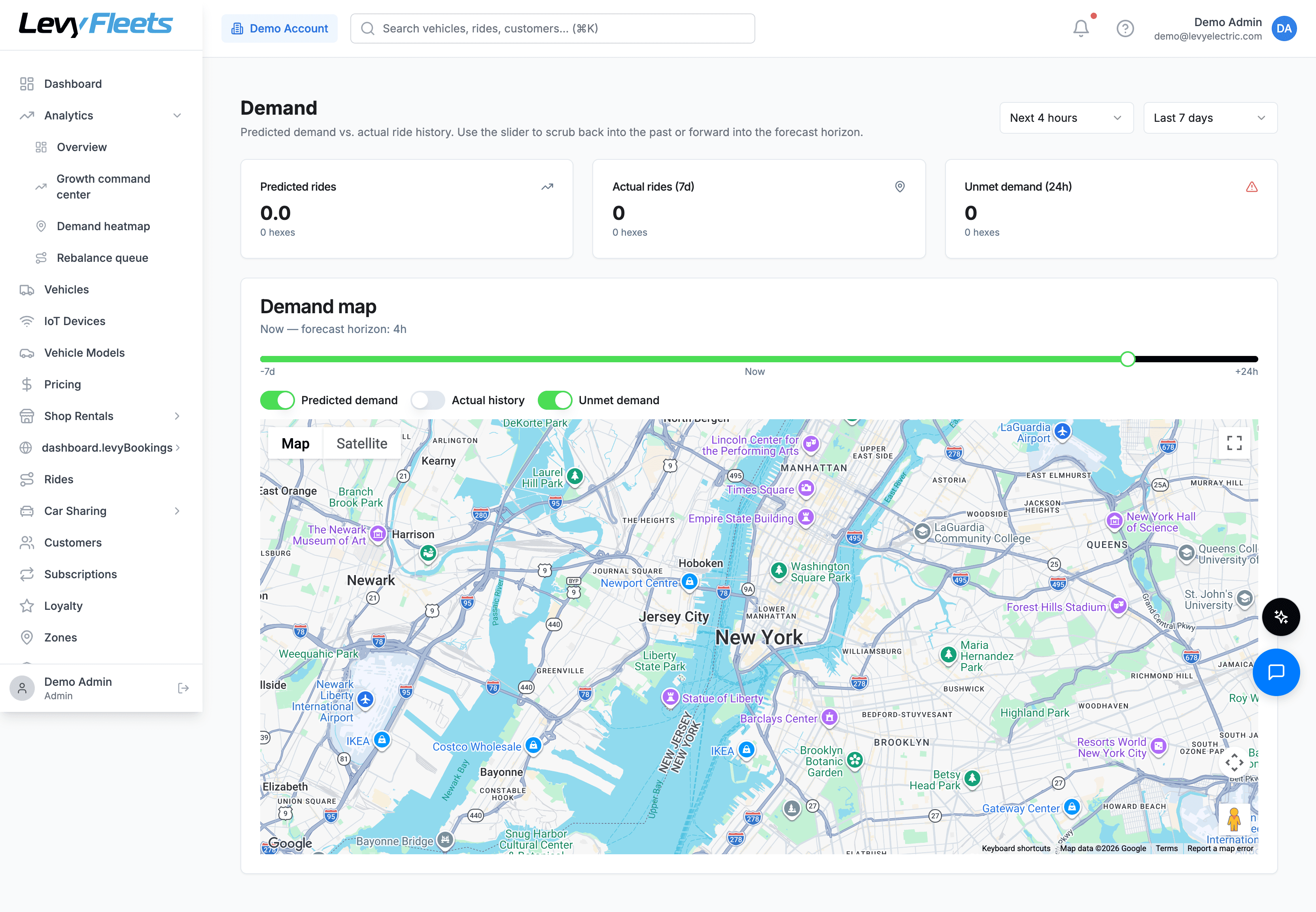
Pull two weeks of history and look for the repeatable patterns below. They will not all apply, but the ones that do become your rebalancing calendar.
Morning flows (roughly 6 am to 10 am)
Mornings pull vehicles from where people sleep toward where they work and study. In a commuter market that means residential neighborhoods drain into business districts, transit hubs, and campus gates. Your move here is a pre-dawn seed: stage vehicles at the residential origins and the transit exits before the wave starts, ideally finishing your placement by 6:30 am to 7 am so units are waiting when the first riders unlock.
Evening flows (roughly 4 pm to 8 pm)
Evenings reverse the morning. Vehicles that rode into the business core now need to be either left for the outbound commute or pulled back toward nightlife, dining, and residential corridors. Do not fully undo your morning work at 4 pm. Let the natural outbound commute rebalance a share of the fleet for free, then top up the entertainment districts for the dinner and night crowd.
Midday, weekends, and weather
Midday demand is flatter and more errand-driven, which is your best window for maintenance swaps and battery collection because you are moving vehicles that are earning the least. Weekends flip the whole map: commuter corridors go quiet, while parks, waterfronts, shopping districts, and event venues spike. Weather is a multiplier on all of it. A clear, mild day lifts demand across the board, while rain can cut it sharply, which is exactly why the forecast is weather-conditioned. Do not run a full weekday rebalance into a rainstorm.
Let the fleet rebalance itself where you can
The cheapest move is the one you never make. Configure parking rewards in your zones to nudge riders to end rides in the spots you want restocked, and use out-of-zone parking rules to discourage drop-offs where vehicles go to die. Crowd-sourced redistribution will not cover a big morning commute, but it can quietly handle a meaningful slice of your drift for zero labor.
Find your hot zones (and your dead zones)
A hot zone is any area that consistently generates more ride starts than the supply sitting there can serve. A dead zone is the opposite: vehicles arrive and sit. Your entire rebalancing effort is moving supply from dead zones to hot zones at the right time.
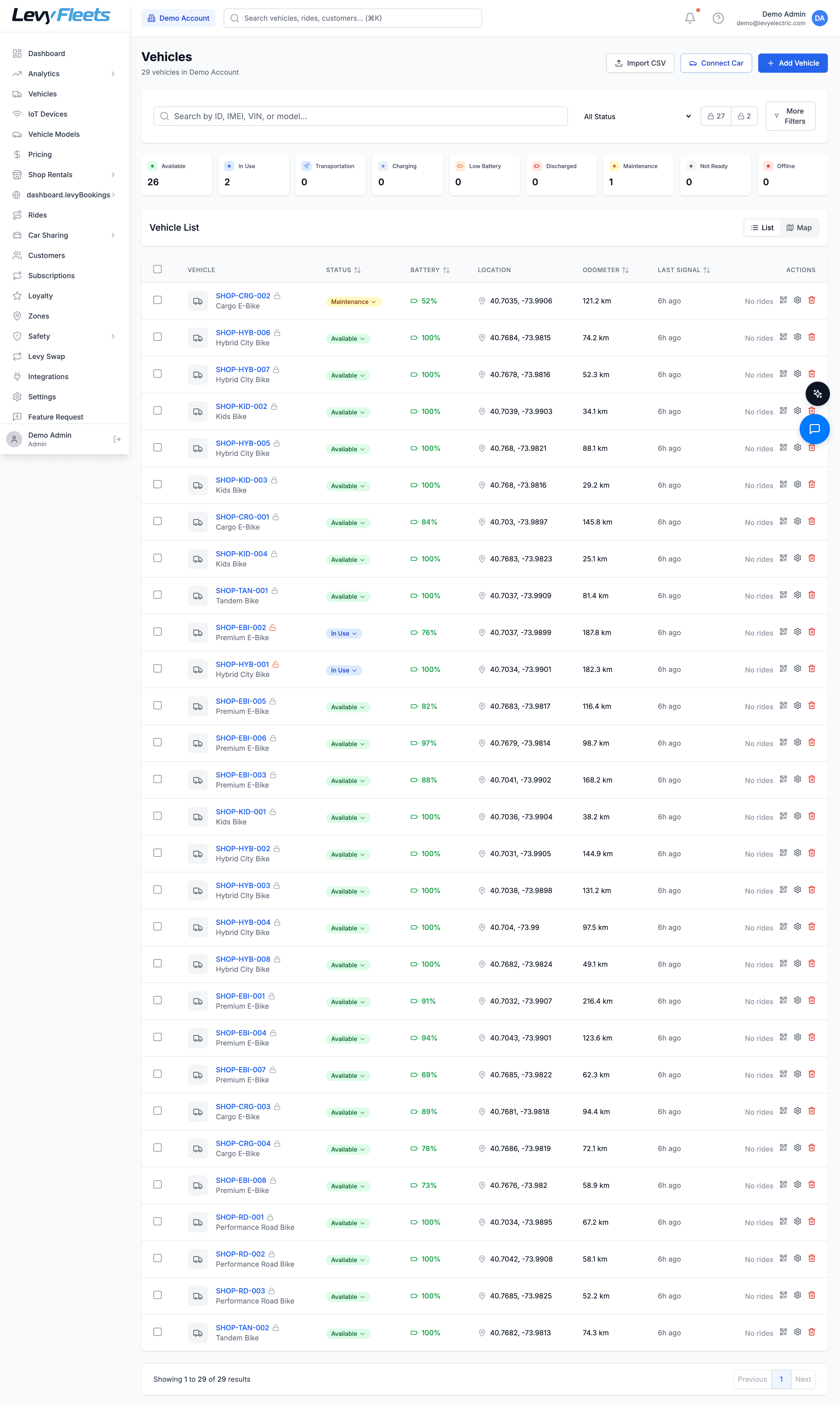
To rank them, look at four signals per area:
- Ride starts per vehicle. High starts with low supply is your top priority. That is unmet demand you can capture today.
- Empty-map events. Stretches where an area had riders opening the app but no available vehicles nearby. This is demand you are currently losing.
- Dwell time. How long the average vehicle sits between rides. Long dwell flags a dead zone or an oversupplied one.
- Time of day. A zone can be hot at 8 am and dead at 8 pm. Rank hot zones by hour, not as a static list, or you will keep solving yesterday morning's problem.
The payoff is a short, ranked list of "from" zones (oversupplied, long dwell) and "to" zones (undersupplied, high starts) for each part of the day. AI Ops builds this list for you and attaches a projected dollar lift to each move, so you are not ranking by gut.
The cost-aware move: does this trip pay for itself?
This is the part most operators skip, and it is where the margin lives. Before a van rolls, run the move through a simple test.
For any proposed relocation, estimate:
- Loaded cost per vehicle moved. Your all-in field cost (labor, fuel or van time, and the vehicle downtime while it is picked up and dropped) divided across the vehicles on the run. As an illustration, if a tech spends 45 minutes relocating 8 vehicles and your loaded cost works out to $3 to $6 per vehicle, that is your hurdle.
- Expected extra rides. How many additional rides those vehicles will get in the destination zone that they would not have gotten where they were.
- Net revenue per ride. Your average revenue per ride after discounts, and remember the money flows through Stripe at Levy's volume pricing of 2.6% + $0.20 per transaction, with your revenue share calculated on net revenue after processing.
The rule is blunt: move only when expected extra rides times net revenue per ride clears your loaded cost per vehicle, with margin to spare. If relocating a vehicle costs you $5 all in and it earns two extra rides at a few dollars each of net revenue, the move pays. If it earns half a ride, you just paid to lose money. Rank every candidate move by that ratio and work the list top down until the next move no longer clears its cost. That is your stopping point for the day, not an arbitrary vehicle count.
Beat the batching trap and the deadhead trap
Two habits quietly burn your rebalancing budget. First, one-off single-vehicle rescues: batch pickups and drops into efficient loops instead of sending a van across town for one scooter. Second, deadheading: an empty return leg is pure cost, so plan routes that pick up in a dead zone on the way to dropping in a hot zone. Pairing battery swaps with the same run, which the operator app can route jointly, means one trip earns its keep twice.
How Levy AI Ops helps you decide (it recommends, you dispatch)
AI Ops is Levy's demand and rebalancing brain, available as a paid add-on. It does three things that map exactly onto this lesson:
- Demand forecasting. It predicts rides per hex zone over 1, 4, and 24 hour horizons, conditioned on weather and events, so you can pre-position instead of react.
- ROI-ranked rebalance recommendations. It turns the forecast into concrete, ranked moves of the form "move N vehicles from hex A to hex B by time T, projected lift $X." That projected lift is the cost-aware test from the last section, done for you and sorted so the highest-return moves rise to the top.
- Joint routing. In the operator app it plans battery-swap and rebalance technician routing together, so your crews run one efficient loop rather than two overlapping ones.
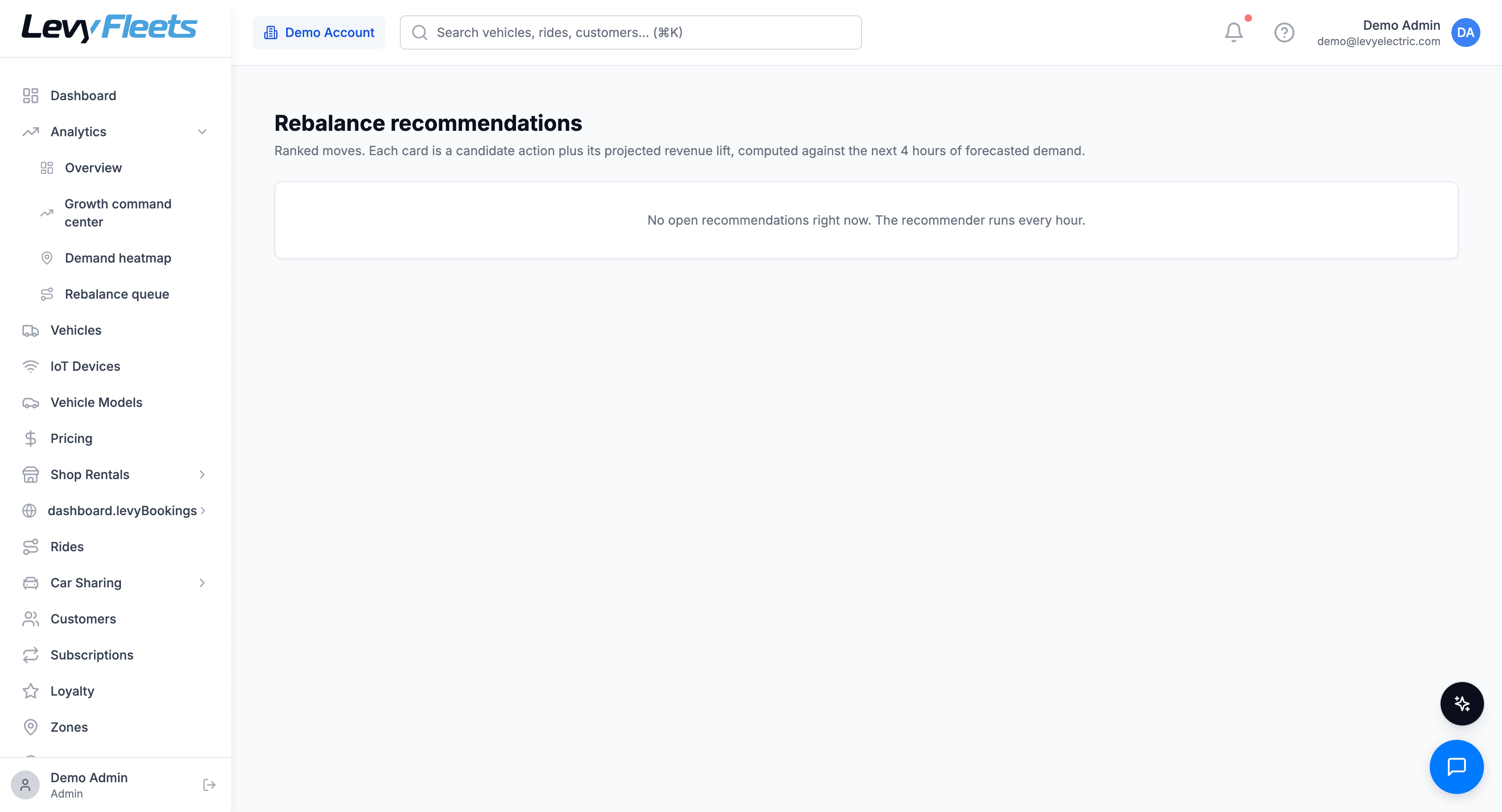
Here is the boundary that matters, and it is a hard one.
AI Ops recommends and forecasts. It does not move vehicles for you.
AI Ops does not auto-execute moves, does not auto-dispatch crews, and is not a real-time engine (its smallest time bucket is one hour). It is not dynamic pricing or surge pricing, and it will never change your published rates. It hands your team a forecast and a ranked, ROI-scored move list. A human reads it, decides, and dispatches. Think of it as the analyst that tells you the best moves, not the driver that makes them.
That division of labor is the point: the model does the pattern-finding and the dollar math across thousands of hexes and hours, and your crew keeps judgment over what happens on the street. For the full breakdown of what it forecasts and recommends, see the AI Ops demand forecasting and rebalancing recommendations guide.
Build a repeatable rebalancing routine
Turn all of this into a daily rhythm your crew can run without you in the room.
Seed before the morning peak
Finish your first placement by roughly 6:30 am to 7 am. Stage vehicles at residential origins and transit exits based on yesterday's pattern and today's forecast. This is your highest-leverage move of the day.
Run a light midday reset and collect batteries
Between roughly 11 am and 2 pm, when demand is flattest, pull low-battery and long-dwell units, run maintenance swaps, and top up any hot zone that emptied out. You are moving the vehicles that are earning the least, so the downtime is cheap.
Reposition for the evening and night
From mid-afternoon, let the outbound commute do part of the work for free, then top up dining, nightlife, and event zones. Check the 4 hour forecast and any local events before you commit the van.
Score the day and tune tomorrow
Each evening, compare where you moved vehicles against where rides actually happened. Which moves cleared their cost, and which did not? Feed that back into tomorrow's plan so your placement gets sharper every week.
By vehicle type: what changes
The strategy is the same, but the constraints differ by vehicle. Levy is hardware-agnostic across 30+ IoT vendors, so whatever mix you run, GPS, remote lock and unlock, battery monitoring, and real-time status are standard for reading and moving the fleet.
Kick scooters are the easiest to rebalance in volume: a single van can carry many units, so batching is cheap and your loaded cost per vehicle drops fast on a well-planned loop. They also drain and dwell in predictable clusters (transit exits, the bottoms of hills), so morning seeding and pairing pickups with battery swaps pays off. Swappable-battery models let you refresh a hot zone in place instead of hauling units back to charge.
Frequently asked questions
Put it into practice
Great rebalancing is not about hustle, it is about sequencing and math. Map your demand, seed the morning before the peak, let the commute and parking rewards do the free work, and fund only the physical moves that clear their own cost. Layer AI Ops on top so a forecast and an ROI-ranked move list guide every decision, while your crew keeps the wheel. Want to see how the numbers play out for your city, fleet size, and vehicle mix? Book a demo and we will walk your demand map, your hot zones, and a rebalancing plan built to earn.