.svg)
Every hour a vehicle spends broken is an hour you already paid for and did not earn back. You bought the hardware and you are amortizing it over its useful life, and a dead scooter keeps burning that amortization whether it sits on the street or in the corner of your shop. Preventive maintenance is the discipline that keeps the asset earning. It is the difference between a fleet that quietly compounds margin and one that bleeds availability one flat tire at a time.
The economics are cleaner on Levy than on most platforms. Levy Fleets runs on a $0-upfront, revenue-share model: you pay when riders pay, so the platform fee scales with your rides, not with how many vehicles you own. There is a $250 per month platform minimum credited against fees, so the cost floor is low, not zero, but it is not a per-vehicle license that keeps billing you for a scooter sitting broken in the corner. Every extra day of availability you recover shows up as incremental revenue that is mostly yours to keep after the revenue-share fee and payment processing, before the wider operating costs (insurance, permits, storage, staffing, taxes) that every operator carries. This lesson gives you the full program: how often to inspect, what actually wears out, how to run brake, tire, and battery checks, how to pull a vehicle out of service cleanly with maintenance mode, and how to set mean-time-to-repair targets.
Why preventive maintenance is a margin decision
Reactive maintenance means you fix a vehicle after a rider reports it broken, or after it fails mid-ride. By then you have already eaten a bad ride, a possible refund, a safety exposure, and the downtime while it sits waiting. Preventive maintenance catches the worn brake pad or the soft tire on a scheduled check, before it becomes a failure, a complaint, or a claim.
The math is simple. If a vehicle earns a few dollars a day and your program keeps it available a few extra days a month, that recovered availability pays for the inspection labor many times over. Downtime is the tax you control, and the two levers that move it are how early you catch problems (your inspection cadence) and how fast you close them out (your mean-time-to-repair). Treat fleet availability, the share of vehicles ready to rent right now, as a headline operating metric alongside utilization and revenue per vehicle per day.
Build your inspection schedule
A preventive maintenance schedule is a set of checks tied to intervals. The strongest programs layer calendar-based intervals (every week, every month) with usage-based ones (every so many rides or kilometers), because a vehicle ridden hard in a dense downtown wears faster than one on a quiet campus, and a pure calendar schedule misses that. Start with four tiers, and treat the specific distances and days as starting points to tune against your own wear data, not as fixed law.
| Tier | Cadence | What it is | Time per vehicle |
|---|---|---|---|
| Touch check | Every field visit | Fast visual: tires, brakes, lights, damage, cleanliness | Under 60 seconds |
| Weekly check | Every 7 days, or each battery-swap cycle | Tire pressure and tread, brake lever travel, fasteners, stem play, throttle response | 3 to 5 minutes |
| Monthly service | Every 30 days | Full safety inspection, brake pad and cable wear, wheel bearings, battery state-of-health, firmware | 15 to 20 minutes |
| Deep service | By mileage (every 1,000 to 1,500 km) or quarterly | Brake replacement, bearing service, harness and controller inspection, tire replacement | 30 to 60 minutes |
The touch check is the highest-leverage habit you can build, because it costs almost nothing and happens dozens of times a week for free. Every juicer, charger, or rebalancer who lays hands on a vehicle should glance at the tires and squeeze the brakes before walking away, which catches most of the failures that would otherwise become mid-ride complaints.
Let telemetry do the watching between checks
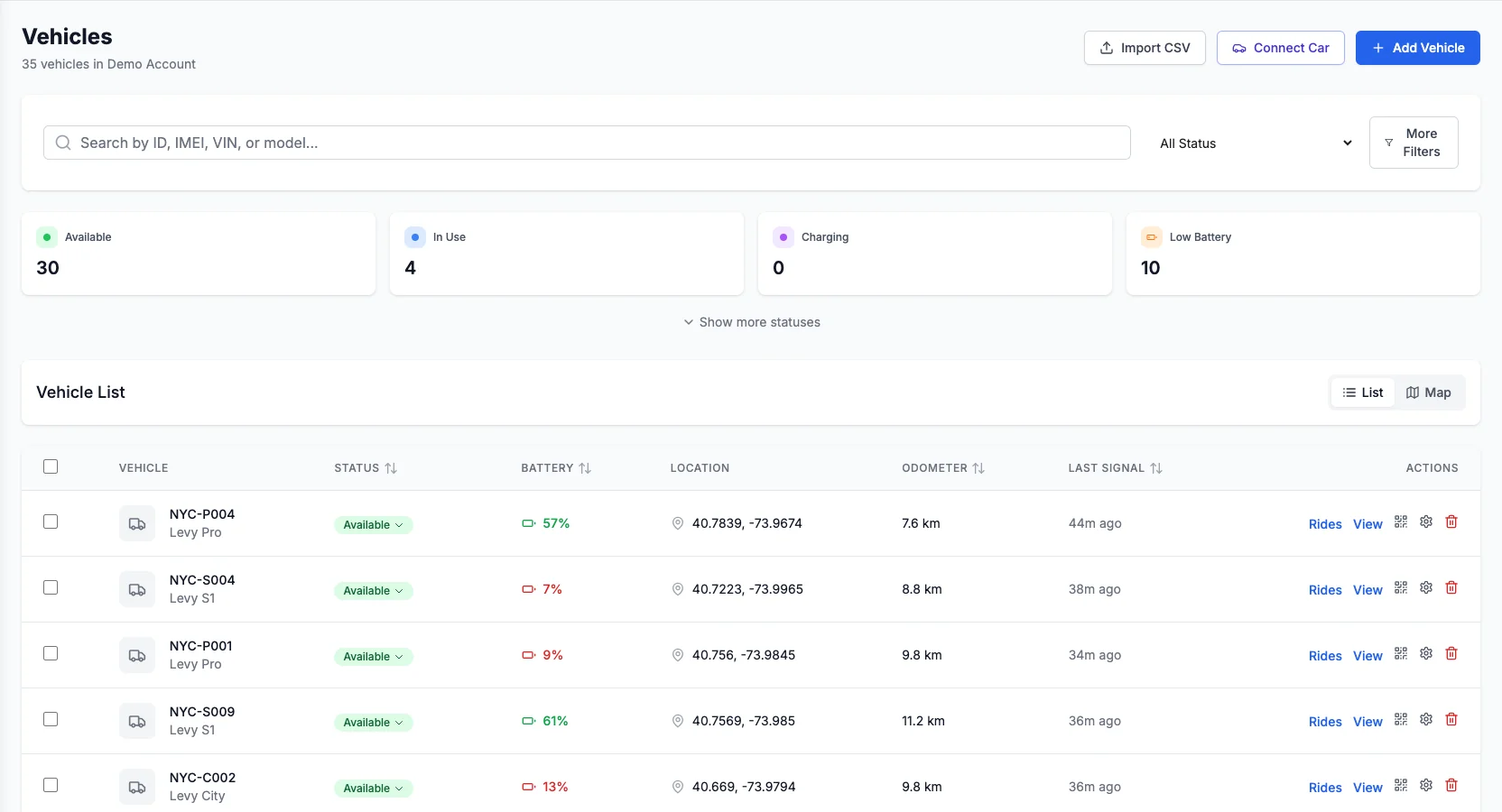
Between physical inspections, live vehicle health data works around the clock. GPS, remote lock and unlock, battery monitoring, speed tracking, geofencing, and real-time status are standard on every connected vehicle. A pack that will not hold charge or a unit that keeps dropping offline is a maintenance signal you can act on before a rider finds it.
The wear items that actually break
You do not need to inspect everything equally. A handful of parts drive the vast majority of downtime on shared micromobility. Know them, stock them, and check them first.
- Tires and tubes. The single most common repair on a shared scooter or bike. Curbs, potholes, and glass punish them daily.
- Brake pads and cables. Safety-critical and high-wear. Cables stretch, pads thin, and hydraulic lines develop soft feel.
- Batteries and packs. Capacity fades with cycles. A tired pack cuts range, strands vehicles, and pulls down utilization.
- Folding stem, headset, and clamp. The folding joint fatigues first on a scooter. Play here becomes a wobble, then a safety failure.
- Throttle and brake levers. Contact points riders yank on all day. Sticky or unresponsive controls end a ride fast.
- Lights, fenders, and fasteners. Vibration loosens bolts and a rattling deck cracks. Lights are cheap to fix and expensive to fail a compliance audit for.
- Display and IoT enclosure. A cracked display or a water-intruded module takes the vehicle offline, which makes it unrentable regardless of the frame.
The advantage here is parts logistics. Levy keeps US stock of common OKAI, Segway, and similar parts: tires and tubes, brake cables and pads, display panels, batteries, fenders, and throttle assemblies. You order through Levy rather than direct from the manufacturer, so parts ship in days instead of the weeks it takes to source overseas. That turns a two-week downtime hole into a two-day one. The cheapest repair, though, is the one durable hardware never needs, which is why the best scooters for a rental fleet are chosen on lifetime cost per ride, not sticker price.
The core safety checks: brakes, tires, and batteries
Three systems decide whether a vehicle is safe and rentable: it has to stop, it has to roll, and it has to hold charge. These get checked on every weekly service without exception.
Brakes
Brakes are non-negotiable and they are the check most likely to prevent an injury and a claim.
- Lever travel and feel. A mechanical lever should engage firmly early in its travel. A lever that pulls near the grip means a stretched cable or worn pads. A spongy hydraulic lever needs a bleed or has a leak.
- Pad thickness. Replace before the pad reaches its wear line, not after. Waiting until it grinds means you are replacing the rotor too.
- Dual-system integrity. Fleet-grade vehicles pair a mechanical brake with an electronic or regenerative brake, so a single failure never leaves a rider with no stopping power. Confirm both work independently, and that the vehicle stops straight under load.
Tires and wheels
- Pressure. Underinflated tires flat more easily, roll poorly, and hurt range. Check pneumatic tires against the sidewall rating every weekly service.
- Tread and cuts. Look for bald patches, embedded glass, and sidewall cuts. A tire one pothole from failure should be replaced now, on your schedule, not on the street.
- Tube type. Tubeless, self-sealing, or solid tires cut flat-repair labor dramatically. If flats dominate your queue, revisit this hardware spec.
- Wheel and bearing play. Check for lateral play. A loose bearing becomes a seized one, and a seized one becomes a tow.
Batteries and packs
- State of health, not just charge. A pack can read full and still deliver a fraction of its rated range once capacity has faded, so track pack state-of-health over time, not just the current percentage. Levy's Battery Swap tooling includes pack state-of-health tracking and lifecycle states, so you can retire a tired pack before it strands a vehicle.
- Charge behavior and contacts. A pack that charges unusually fast, refuses to reach full, or runs warm is flagging trouble. On swappable-battery vehicles, use each swap to inspect the pack, clean the contacts, and seat it fully, which prevents intermittent faults that look like IoT problems but are really connection problems.
- Fixed-battery reality. A fixed-battery vehicle takes roughly 4 to 8 hours to recharge and earns nothing the whole time. If charging downtime dominates your losses, swappable batteries are the structural fix.
The maintenance-mode workflow
When a check finds a problem, the vehicle has to come off the street cleanly. Maintenance mode is the vehicle status that removes a vehicle from rider availability while it is serviced: it is hidden from the mobile app and cannot be scanned or unlocked, so nobody rents a unit you know is unsafe.
Flag the vehicle
The trigger can be a rider issue report, a telemetry signal, or an inspection finding. Capture what is wrong so the technician is not diagnosing from scratch.
Set status to Maintenance
From the vehicle list or detail page, click the status badge and select Maintenance (use Bulk Actions for seasonal prep or a batch of the same issue). The vehicle drops off the rider map immediately.
Document the reason
Add notes with the reason, date, technician, and parts needed. This turns a one-off fix into pattern data you can mine later for recurring failures.
Service the vehicle
Perform the repair or scheduled service. For outsourced work, hand it to a repair partner and track parts and labor against the job.
Run the pre-return checklist
Before it goes back, confirm the repair is complete and tested, the battery is charged, the IoT device is connected and reporting, the vehicle is clean, it is inside your service area, and the notes are updated.
Return to Available
Flip the status back to Available and confirm the GPS shows the correct position. The vehicle reappears to riders and starts earning again.
Maintenance mode also protects the rider experience mid-ride: taking a vehicle out of service waits for any active ride to end rather than cutting someone off. For the full status model and the alerts that flag vehicles stuck in maintenance too long, see the fleet management help center, which documents maintenance mode, vehicle lifecycle, and the status controls in detail.
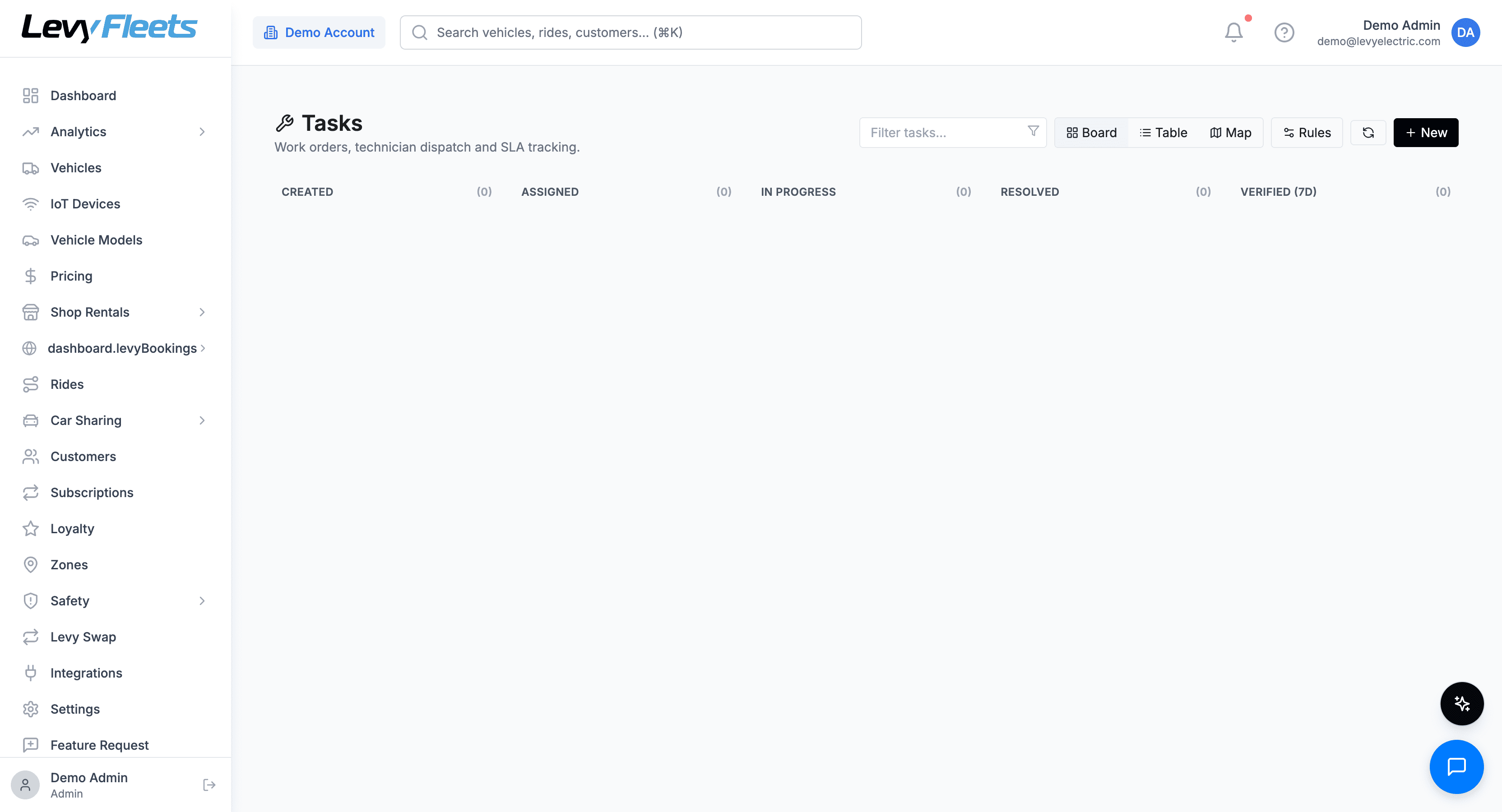
Larger fleets graduate from ad hoc status changes to structured Work Orders, Levy's built-in system for task management, technician dispatch, parts tracking, and vendor invoicing. Each repair becomes a task tied to a vehicle and assigned to a technician or an outside vendor, with parts and labor tracked against it, and scheduled maintenance lives there too, so your monthly and deep-service tiers become recurring tasks instead of things you hope someone remembers. Not every repair is on you either: OKAI hardware carries a 90-day warranty from delivery covering manufacturing defects, and Levy files the claim with the manufacturer on your behalf, so check a young vehicle's warranty before writing off an electronics or controller fault.
Set mean-time-to-repair targets
Mean-time-to-repair (MTTR) is the average time from a vehicle going into maintenance to it coming back into service. It is the single best measure of how well your repair loop runs, and it is a target you set and hold your team to. Calculate it simply: total downtime hours across repairs, divided by the number of repairs, over a period. Then set targets by severity, because a failed brake and a scuffed fender do not deserve the same clock.
| Issue severity | Target response | Target MTTR |
|---|---|---|
| Safety issue (brakes, steering) | Immediate maintenance | Same day |
| Operational failure (dead or offline) | Same day | Under 24 hours |
| Cosmetic damage | Within 48 hours | 2 to 3 days |
Under 24 hours is a reasonable target for critical and operational work once your program is running. Hitting it consistently comes down to boring fundamentals, above all parts on the shelf, which is why Levy stocking common parts in the US matters: MTTR collapses when the part is a two-day ship instead of a two-week one. Track average maintenance duration and fleet availability so a slipping repair loop shows up well before it becomes an availability crater.
Watch for vehicles that never come back
The most expensive maintenance failure is not a slow repair, it is a forgotten one. A vehicle sitting in maintenance mode for weeks earns nothing and still costs amortization. Configure long-maintenance alerts so any unit stuck in service surfaces, and audit your maintenance queue on the same cadence you audit your revenue.
Put the program on paper
A preventive maintenance program is only real when it is written down and someone owns it. Before you scale past your first few dozen vehicles, lock in five things:
- A tiered inspection schedule (touch, weekly, monthly, deep) with the checks for each tier written out.
- A wear-item stock list so the parts that break most are always on the shelf.
- The maintenance-mode workflow as the standard way vehicles come off and go back on the street.
- MTTR targets by severity that you measure and review.
- An owner who audits the queue and the numbers on a fixed cadence.
Best scooters for a rental fleet
The hardware side of maintenance: durable, serviceable vehicles cut downtime before a single repair.
Frequently asked questions
Start with the numbers
Build the schedule, stock the wear items, run every vehicle through maintenance mode cleanly, and hold your team to MTTR targets you actually measure. To see how the uptime you recover moves the economics of your specific fleet, model your city, fleet size, and pricing in the Fleet Estimator.