.svg)
Every vehicle you lose to theft or vandalism hits your books three times: you eat the replacement capital, you lose every ride that unit would have earned while it is gone, and you burn field labor chasing it or fixing it. A single missing scooter can cost you weeks of the revenue it was built to generate before you count the cost to replace it. So treat loss prevention the way you treat rebalancing or pricing: as a controllable line on your profit-and-loss statement, not as bad luck you absorb. This lesson gives you a layered defense (physical plus IoT), a repeatable GPS recovery workflow, a clean way to build an insurance claim, and a practical plan for deterring and responding to vandalism.
The economics reward the effort directly. On Levy's revenue-share model you pay $0 upfront and pay when riders pay (20% of GMV on Managed, 15% at 100 to 249 active vehicles on qualifying annual terms, with a $250 per month platform minimum credited against your fees). Because Levy only earns when your vehicles are earning, every unit you keep in service and every one you recover fast is aligned revenue for both sides. Loss prevention is not overhead here. It protects the asset that funds the whole operation.
Not insurance, legal, or financial advice
This lesson describes how to use platform data to prevent loss and support a claim. It is general operational guidance, not insurance, legal, tax, or financial advice. Coverage terms, deductibles, additional-insured requirements, and what evidence an insurer or court will accept vary by policy and jurisdiction. Confirm your own approach with a licensed insurance broker, attorney, or accountant before you rely on it.
Why theft and vandalism are a P&L line, not bad luck
Think of each connected vehicle as a small income-producing asset that only pays while it is out on the street, charged, unlocked, and available. When it is stolen, stripped, or smashed, three costs stack up at once:
- Replacement capital. Whatever you paid to source and integrate that unit is now sunk, and you have to spend it again to hold your fleet size.
- Lost rides. From the moment a vehicle goes dark to the moment a replacement is live, it earns nothing. Rides per vehicle per day is an industry planning range that varies widely by market, season, pricing, and how hard you run the fleet, so treat "several rides a day of forgone revenue" as a rule of thumb rather than a fixed number, and model your own gap cost in the Fleet Estimator.
- Field cost. Recovery drives, police reports, repair labor, and parts all pull your crew off higher-value work like rebalancing and swaps.
The goal is not to make theft impossible, which no fleet can do. It is to make your vehicles harder to take, faster to find, and cheaper to recover than the effort a thief or vandal is willing to spend. That is a layered problem, so build a layered defense.
Build anti-theft in layers: physical plus IoT
No single lock or sensor stops a determined thief. Overlapping layers do: each one adds cost and time, and the IoT layer means a taken vehicle still reports home.
The physical layer
The physical layer is your first deterrent, and most of it is operator discipline rather than any one product. Levy is hardware-agnostic across 30+ IoT vendors and helps you source the right connected vehicles (Levy does not manufacture hardware; it sources, integrates, and retrofits third-party equipment), so you can spec durability into the fleet from day one. Practical measures that pay for themselves:
- Spec serviceable, hard-to-strip builds. Favor models with secured batteries, tamper-resistant fasteners, and integrated locking where available, so casual theft and part-stripping take real tools and time.
- Make ownership obvious. Clear branding, asset tags, and vehicle numbers lower resale value and make a stolen unit awkward to fence or ride in public.
- Control your staging. Cluster overnight and idle inventory in visible, well-lit, camera-covered spots rather than dark cul-de-sacs. Concentration plus visibility keeps idle units where you and your cameras can see them.
- Stock the wear parts you will replace. Levy keeps US stock of common parts (tires and tubes, brake cables and pads, display panels, batteries, fenders, throttle assemblies) and you order through Levy rather than direct, so the wear parts a vandalized unit needs ship in days, not weeks, instead of waiting on a direct manufacturer order.
The IoT layer
This is where the connected platform earns its keep. Levy Fleets is built IoT-first: every vehicle is connected, and real-time GPS, remote lock and unlock, battery and speed monitoring, geofencing, and real-time status are standard across the fleet. That connectivity turns a stolen vehicle from a lost asset into a tracked one, and it lets you act on a suspicious unit without sending anyone into the field first.
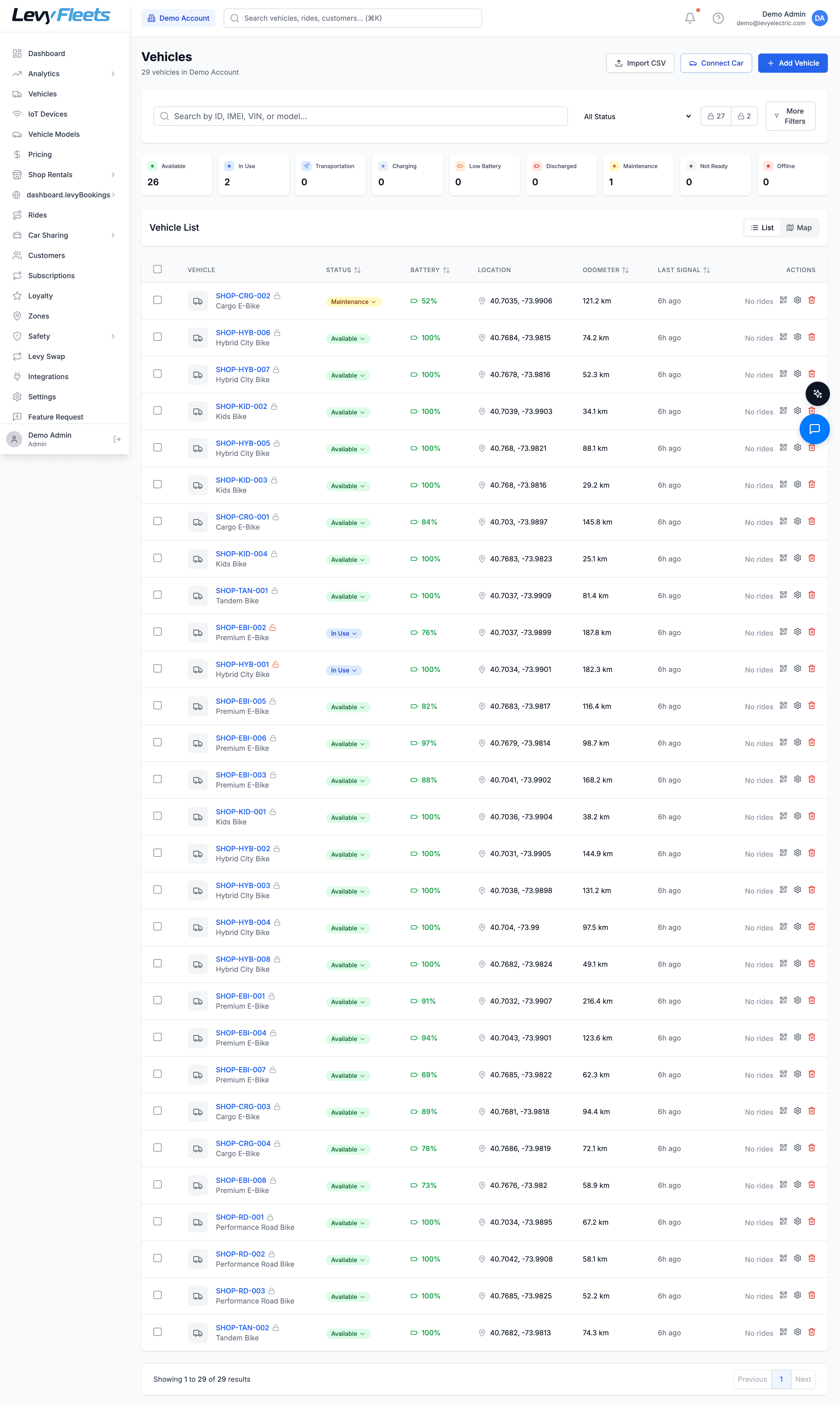
Two more platform capabilities give you leverage before a theft ever happens:
- Know who has the vehicle. Identity verification and fraud prevention (SoCure and Experian, plus Stripe Identity) let you require that a rider is a verified, accountable person before they can unlock. That gives you a lever against anonymous ride-and-abandon and insider abuse: every session is tied to a real, verified identity you can act on, rather than an anonymous account.
- Manage repeat abusers. Rider Score is behavior-based safety scoring with an intervention ladder and reward tiers. Riders who consistently mishandle, dump, or damage vehicles surface in the data, and the ladder gives you a structured, documented way to warn, restrict, or remove a rider whose pattern warrants it.
Geofences and remote immobilization
Your geofencing and remote-control tools are the core of both prevention and recovery. In the operator dashboard you configure zones for service areas, parking, no-go areas, and speed limits, and the platform enforces them in real time with stacked-geofence priority so overlapping rules resolve predictably. Use them deliberately against loss:
- Define no-go areas. Draw no-go zones around known problem spots, property lines you do not have rights to, and edges where vehicles tend to disappear. Real-time geofence enforcement flags rides that push into them.
- Discourage bad drop-offs. Out-of-zone parking rules make it costly to abandon a vehicle outside your service area, which is exactly where units go to get stripped or forgotten.
- Immobilize on command. Remote lock and unlock lets you immobilize a specific vehicle the moment something looks wrong, so a unit that is being tampered with or moved off-network can be locked down while you decide what to do next.
Scope check: what Levy Vision does and does not do
Levy Vision (including the Verify parking check) is a parking, helmet, and sidewalk-compliance system. Its sidewalk detection can cut throttle when a rider is on a sidewalk, which is a compliance-enforcement tool, but Vision is not a damage-inspection, condition-report, or anti-theft product, and it does not assess vandalism. Treat it as a compliance layer, not a loss-prevention one. Your anti-theft levers are GPS, remote lock, geofences, and identity, covered above.
The GPS recovery workflow
When a vehicle goes missing, speed and evidence win, and a calm, repeatable workflow beats a frantic drive across town. Run these steps in order.
Confirm it is actually missing, not just drifted
Before you treat a unit as stolen, rule out the ordinary. Pull its live GPS and recent status. Is it out of zone after a legitimate ride, on private property, or dead-battery where a rider left it? Real-time status and location tell you in seconds whether this is a recovery job or a routine rebalance.
Lock it down and freeze the picture
If it looks taken, remotely lock the vehicle to immobilize it, then capture the evidence while it is fresh: current coordinates, location history, the last ride, and the verified rider identity on that session. This record drives both your recovery and any later claim.
Read the movement, then dispatch
Watch the GPS track. A vehicle sitting still at a residence or a resale yard is a different job from one still moving. Send a crew only when the location is stable enough to act on, and pair the trip with nearby pickups or swaps so the drive is not pure deadhead cost.
Recover safely or escalate to police
If recovery is safe and the unit is on accessible ground, retrieve it. If it is on private property, actively resisted, or clearly part of organized theft, do not send your crew into a confrontation. Escalate to law enforcement with the exact location, the movement history, and the identity on the ride. Documented GPS evidence and a named, verified rider make a police report actionable rather than a shrug.
Close the loop in the platform
Once recovered, move the unit into maintenance to inspect it before it goes back out, and log what happened. For the status model that governs this (maintenance mode that waits for any active ride to end, vehicle lifecycle states, and the alerts that flag units stuck too long), see the fleet management help center, which documents the controls you use to take a vehicle out of service and bring it back cleanly.
Do not chase a moving vehicle by hand
A live GPS dot is tempting, but tailing a moving stolen unit or confronting someone puts your crew at risk and rarely ends well. Lock the vehicle remotely, keep logging its track, and let a stable location and, when needed, the police do the work. Patience plus evidence beats a car chase every time.
Filing an insurance claim
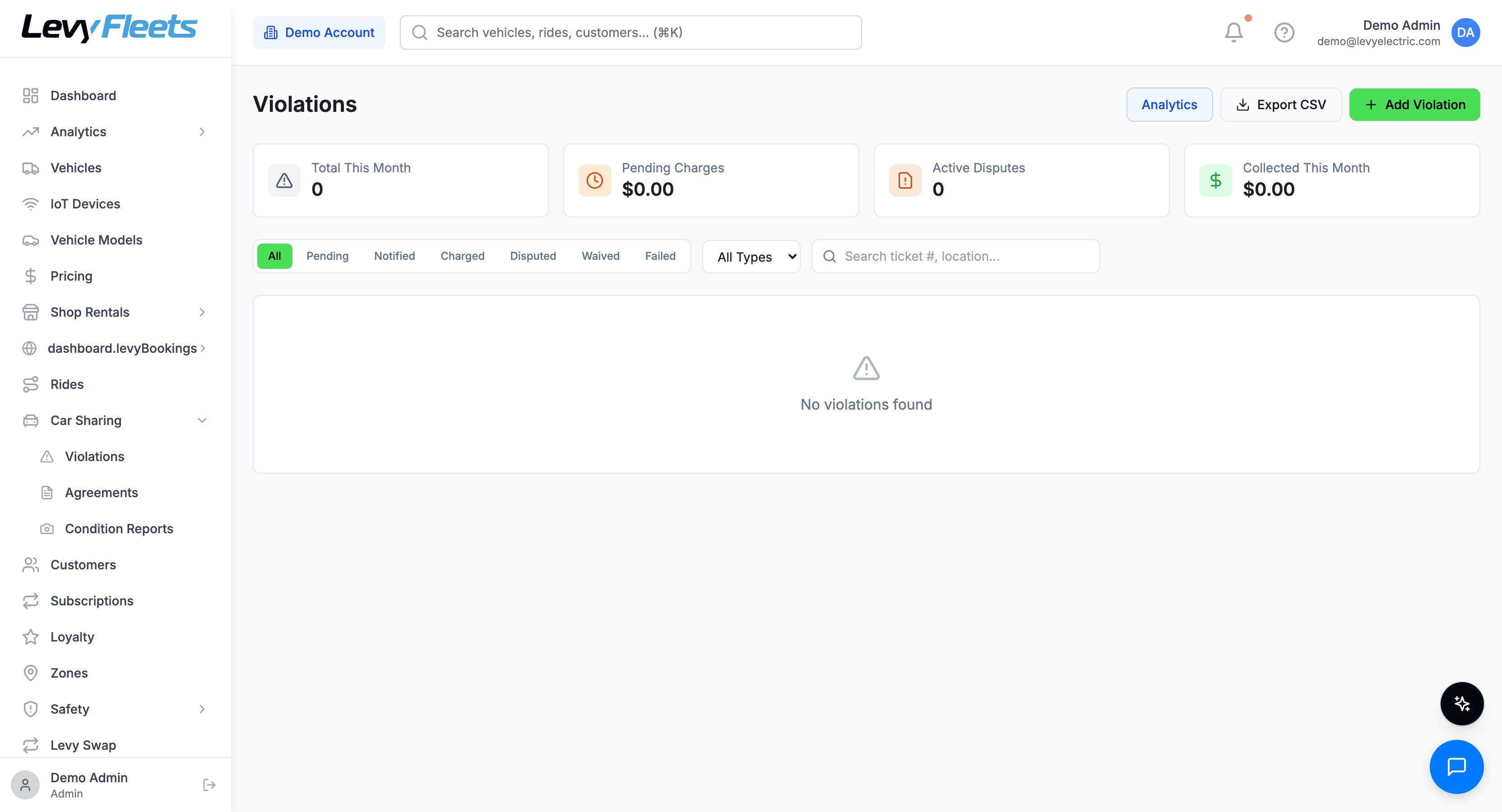
On the Managed plan, Levy handles support, payments, disputes, chargebacks, and collections. Levy does not provide operator or rider insurance. You carry the policy that pays out when a unit is stolen or destroyed, so know its terms before you need them. For how to structure that coverage, deductibles, and additional-insured requirements, read the scooter rental insurance guide.
When you file, the platform is your evidence engine. A clean claim is built from records you already have:
- The vehicle record and value. Which unit, its identifiers, and what it cost to source and integrate.
- The location trail. GPS history showing where it went, when it stopped reporting, and where it was last seen.
- The ride and rider. The last ride session, timestamps, and the verified rider identity tied to it, which matters for both the insurer and the police report.
- The recovery attempt. What you did, when, and the outcome, including any police report number.
Pull that package together as soon as you open the claim rather than reconstructing it weeks later. On Managed, the same disputes and collections machinery that recovers unpaid balances also helps you hold an accountable rider responsible where the facts support it.
Deterring and responding to vandalism
Vandalism is a slower bleed than theft, but over a year it can cost more because it hits many units a little at a time. The tools help you deter and respond to it the same way you handle theft: reduce opportunity, raise accountability, and repair fast.
- Park where damage is least likely. Use zones, parking rewards, and staging discipline to keep idle vehicles in visible, trafficked, camera-covered locations. Vehicles dumped in dark, out-of-the-way spots are the ones that get tipped, stripped, or tagged.
- Make riders accountable. Verified identity plus Rider Score makes repeat offenders identifiable, and the intervention ladder lets you warn, restrict, or remove a rider whose pattern warrants it.
- Repair fast to protect the experience. Work Orders gives you task management, technician dispatch, parts tracking, and vendor invoicing, so a vandalized unit moves from report to repair to back-in-service without slipping through the cracks. Combined with US-stocked common parts that ship in days, not weeks, that gives you the tools to turn units around quickly rather than waiting on a direct manufacturer parts order.
Broken-window discipline pays
Fast, visible repair is one of the cheapest forms of loss-prevention discipline you have. Broken-window thinking applies: a unit that looks cared for signals that someone is paying attention, while a smashed display or a tipped scooter left in place for a week signals that no one is watching that spot.
By vehicle type: what changes
The layered defense is the same across your fleet, but the theft and vandalism profile shifts by vehicle. Whatever mix you run, Levy is hardware-agnostic across 30+ IoT vendors, so GPS, remote lock and unlock, battery monitoring, and real-time status are standard for tracking and immobilizing any of them.
Kick scooters are light and easy to carry off, so casual grab-and-go theft and part-stripping are the main risks. Lean on visible branding, secured batteries where the model allows, and tight staging, and use no-go zones plus out-of-zone parking rules to keep units out of the dark corners where they vanish. Their low replacement cost per unit means recovery economics favor batching: fold pickups into existing rebalancing and swap loops rather than dispatching for one scooter.
Frequently asked questions
Put it into practice
Loss prevention is layered work: spec durable, well-branded hardware and stage it in the light, verify every rider so no one is anonymous, draw your zones and no-go areas deliberately, and keep remote lock and live GPS one click away. When a unit goes missing, run the recovery workflow in order rather than chasing a moving dot, and build the insurance claim from records the platform already keeps. Do that consistently and you turn theft and vandalism from a mystery cost you absorb into a line you actively manage with the platform's tools.
Scooter rental insurance guide
Structure the operator coverage that pays out when a vehicle is stolen or destroyed: policy types, deductibles, and additional-insured requirements.
Want to see how the tracking, remote lock, geofencing, and recovery tools work for your city, fleet size, and vehicle mix? Book a demo and we will walk your zones, your loss exposure, and the workflow that keeps your assets on the street.