.svg)
A single serious injury claim in shared micromobility can run from the low six figures into seven once you add up medical costs, legal defense, and a settlement. You will run thousands of rides before you ever file one, and that is the trap: coverage feels like pure cost right up until the day it is the only thing between one crash and your balance sheet. Insurance is the second line of defense behind your rider agreement, and getting it right is a money decision. This lesson covers how operators actually get covered: the liability policies you need, the additional-insured question that trips up nearly every new operator, how claims and deductibles work, and how the connected-fleet tooling you already run gives your broker a real risk story to work with.
Operator education, not professional advice
This is operator education, not professional legal, tax, insurance, or fire-safety advice. Insurance requirements, coverage terms, limits, deductible ranges, and what is enforceable vary widely by carrier, by state, and by city. Every number in this lesson is an industry planning range, not a quote. Before you bind a policy or rely on any coverage described here, consult a licensed insurance broker, a qualified attorney, or your local authority, and read your own policy language.
Insurance is your second line, not your first
Think of your protection as two layers. Your rider agreement is the first line: a contract every rider accepts before the vehicle unlocks that shapes what claims a rider can bring and who pays. Insurance is the second line: it pays when a claim gets past the contract, when a third party who never signed anything is hurt, or when a court sets the waiver aside. You want both, and in that order. Tighten the agreement first because it is free and scales to infinity, then buy coverage sized to the risk the contract cannot waive (gross negligence, third-party pedestrian injuries, statutory claims, catastrophic losses). Lean only on insurance and you overpay while staying exposed; lean only on a waiver and you learn that a release does not write a check when someone is genuinely hurt. Work through this lesson alongside the deeper scooter and micromobility fleet insurance guide for limits and market specifics.
The coverages every micromobility operator needs
There is no single "fleet insurance" product on a shelf. You assemble a program from several policies, each covering a different failure mode. Here is the core stack and what each part pays for.
| Coverage | What it pays for | Typical trigger |
|---|---|---|
| Commercial general liability (CGL) | Third-party bodily injury and property damage | A rider or a pedestrian is hurt, or property is damaged, and points at your operation |
| Product and completed-operations liability | Injury from a vehicle defect or from your maintenance work | A brake or battery fails and injures a rider |
| Commercial property and inland marine | Your own vehicles, chargers, and swap stations | Theft, vandalism, fire, or damage to your fleet |
| Hired and non-owned auto | Vehicles you use but do not own | A rebalancing van causes a crash |
| Umbrella and excess | Extra limits stacked above your primary policies | A severe claim blows through your CGL limit |
| Cyber and privacy | Data breach and exposure of rider personal data | Rider payment or identity data is compromised |
| Workers compensation | Employee injuries | A technician is hurt swapping a battery |
Two of these carry most of the weight, so treat them as non-negotiable.
Commercial general liability
CGL is the foundation. It responds when a third party claims your operation caused bodily injury or property damage: a rider who falls and blames a poorly maintained vehicle, a pedestrian struck by a rider, or a property owner whose entrance was blocked by a parked scooter. Cities and permit authorities almost always mandate a minimum CGL limit to operate, most commonly $1 million per occurrence with a $2 million aggregate, and larger markets push higher. It is also the policy everyone else in your chain will want to be named onto, which brings us to the additional-insured question.
Product and completed-operations liability
This is the coverage new operators forget. Levy is hardware-agnostic and sources, integrates, and retrofits third-party hardware across 30+ IoT vendors rather than manufacturing its own, so a genuine manufacturing defect is the manufacturer's exposure first, and Levy files that warranty claim on your behalf (OKAI, for example, warrants manufacturing defects for 90 days from delivery). But a warranty is not liability insurance. If a defect injures a rider you can still be named as the operator who put that vehicle on the street, and your maintenance work is your own completed-operations exposure. Carry the coverage so a hardware failure is not an uninsured loss.
The rest fill in the edges. Umbrella coverage is often the highest-value dollar you spend: it buys cheap limits above everything else, and a single catastrophic injury can exceed a primary CGL limit on its own. Property and inland marine cover theft and damage to the fleet, hired and non-owned auto covers your rebalancing and maintenance vehicles, cyber covers the rider data you hold, and workers compensation is usually mandatory once you have employees.
The additional-insured question
This is the single most misunderstood part of an operator's insurance program. An additional-insured endorsement extends your policy to protect another party for liability arising out of your operations. It is a formal amendment to your CGL, usually paired with a waiver of subrogation and a primary-and-non-contributory requirement. Two directions matter, and operators routinely confuse them.
Others asking to be named on your policy. Cities, permit programs, property owners (hotels, campuses, apartment complexes), and event venues will require being added as an additional insured on your CGL to operate on their ground, usually with a set limit, a waiver of subrogation, and a certificate of insurance (COI). Budget time: your broker issues these, and a wrong legal name or address is a common reason a launch slips.
You asking to be named on someone else's policy. The reverse question, "will a platform or vendor name me as additional insured on its policy?", depends entirely on that party's policy and underwriter, and many commercial policies do not permit adding downstream operators. So do two things: ask in writing whether and how they will name you, and get it in a document rather than a sales call; and carry your own program regardless, because when a claim lands, "I thought I was covered under their policy" is the most expensive sentence in the business.
A certificate of insurance is not coverage
A COI proves a policy existed on a date. It is not the policy and does not grant additional-insured status by itself. When a party must be protected, insist on the actual endorsement, not just a certificate.
Deductibles and self-insurance
Your premium is not the only number that matters. The deductible (or self-insured retention) is what you pay out of pocket on every claim before the carrier contributes, and it is your main lever over the monthly cost.
The trade is simple: a higher deductible means a lower premium, because you absorb the small, frequent losses and buy the carrier only for the large ones. Deductibles here commonly run from $1,000 to $10,000 or more per claim depending on coverage and loss history. A self-insured retention (SIR) is similar but sits earlier: you fund claims up to the retention before the policy engages.
Sizing it is a cash-flow decision. Too low and you pay a premium for losses you could cover yourself; too high and one bad month can hurt. As you scale past 100 vehicles and your loss data matures, structured self-insurance is worth a broker conversation: a larger SIR, a captive, or a fronting structure that retains predictable losses and insures only the tail. These make sense once your losses are statistically predictable, not on day one.
Many retained losses never touch a liability policy at all: a damaged vehicle, an abandoned scooter, a cleaning fee. Those get recovered through your billing and terms, so your rider agreement should let you charge for them.
Claims handling: what to do when something happens
How you handle the first hour of an incident often decides the claim. A clean, well-documented file gives your carrier what it needs to defend you; a sloppy one hands the other side leverage. Build this into a standing playbook before you need it.
Make the scene safe and get medical help
Rider and pedestrian safety comes before paperwork. Get medical attention where needed, and for anything serious make sure the appropriate authorities are called.
Preserve the evidence immediately
Photograph the scene, the vehicle, and any damage, and collect names and contact details for everyone involved and any witness. The record you build in the first hour is the one you will still have when the claim is adjudicated a year later.
Pull the ride and telematics record
Your connected fleet is your best witness. Export the ride record, GPS track, speed history, lock events, geofence status, and verified rider identity for the trip. This objective data reconstructs what happened, not what either side remembers.
Report to your broker or carrier promptly
Notify per your policy's terms, quickly. Late notice is a common way operators forfeit coverage they paid for. An early notice you never needed costs nothing; a late one can void the claim.
Do not admit fault or settle on your own
Be factual and cooperative, but leave liability determinations and settlement to your carrier and counsel. An offhand admission or a quiet side payment can undercut your coverage.
How IoT and waivers factor into your insurance program
Underwriters price on risk, and a connected, well-governed fleet gives you a documented safety program to put in front of them. You cannot promise a rate cut, but the safety and evidence tooling you run gives your broker a real story and a concrete set of controls to underwrite, which is worth raising when you shop or renew your program. Here is what to point them to, all standard on the Levy platform.
- Real-time GPS, remote lock, and geofencing. GPS and remote immobilization give you tools to locate and disable a vehicle after theft or misuse, and geofenced no-go and speed-limit zones let you enforce where and how fast riders travel, all controls worth walking your broker through.
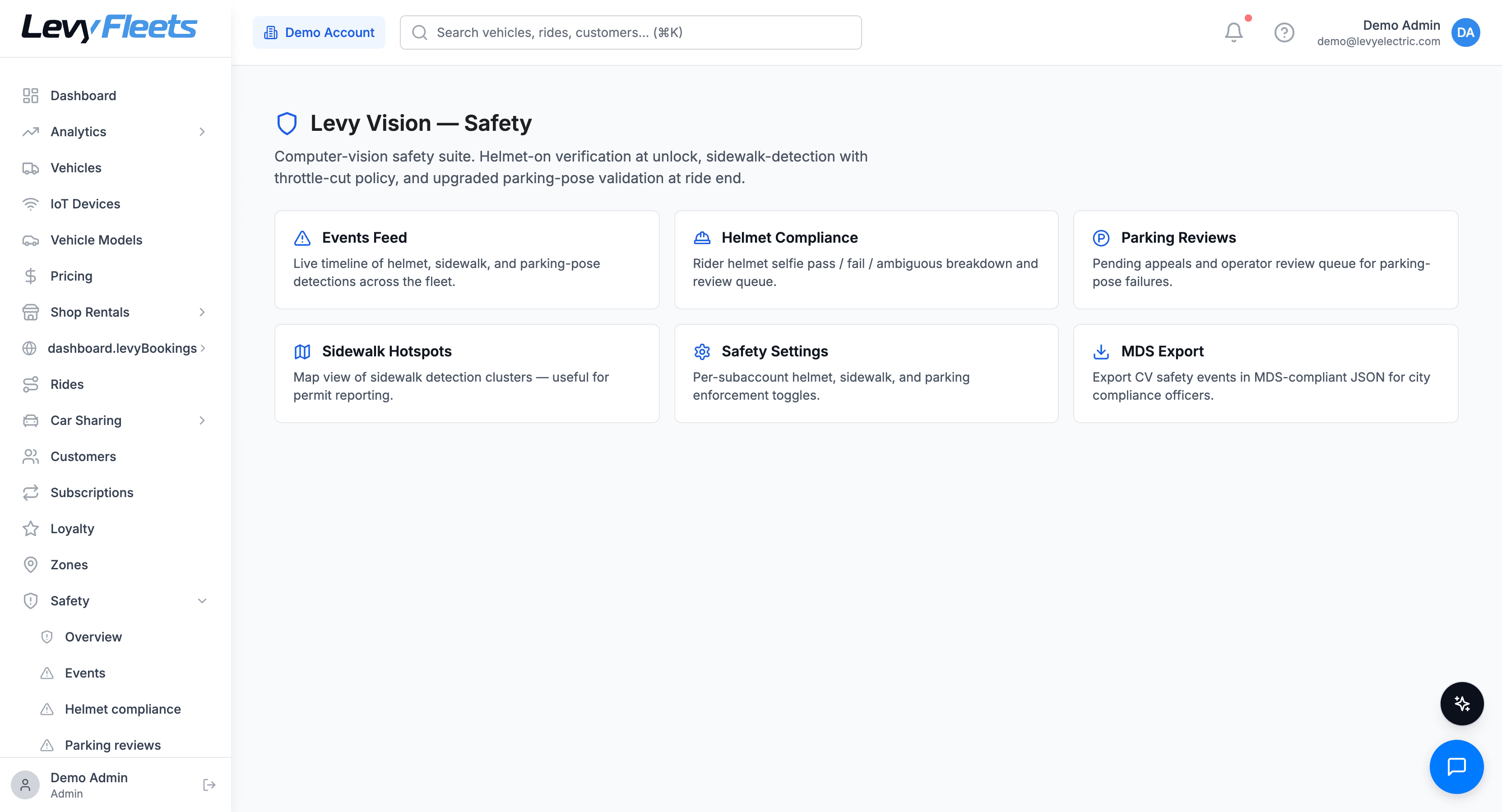
- Sidewalk detection with throttle-cut enforcement. Levy Vision detects sidewalk riding and can cut the throttle, a control aimed at the rider-versus-pedestrian conflicts that are among an operator's most serious third-party exposures.
- Helmet verification and parking-pose validation. Levy Vision verifies helmet use at unlock and confirms a vehicle is parked upright, in zone, and clear of the sidewalk at ride end, which gives you documented controls against the trip-and-fall and obstruction claims that come from badly parked vehicles. (It is a parking, helmet, and sidewalk compliance product, not a damage or vehicle-condition tool.)
- Rider Score. Behavior-based scoring lets you reward safe riders and intervene with risky ones before an incident.
- Verified rider identity. Identity verification is included on every plan (SoCure and Experian, plus Stripe Identity), so every ride and waiver acceptance ties to a named, verified person, which is what your indemnification clauses and evidence trail rely on.
The waiver side works alongside this: a rider agreement with assumption of risk, a release, and indemnification shapes what claims a rider can bring and who pays, which is the first line your insurance sits behind. The Levy rider agreement is structured this way and names local fleet operators among the protected parties (see the full Levy rider Rental Agreement).
Where Levy fits
Levy Fleets is a connected fleet operations platform, and it touches your insurance program without ever replacing your own commercial policy. As the IoT section shows, every vehicle is connected, so the evidence a claim turns on is captured automatically, and Levy Vision and Rider Score give you documented safety controls to bring to your broker.
The money mechanics around your retained risk are run for you on the Managed plan. Levy runs payments, disputes and chargebacks, and collections and dunning, so you have the tools to recover the damage, abandonment, and cleaning fees inside your deductible instead of writing them off. See how those flows work in the billing and payments help center. The Managed plan is revenue-share (20 percent of GMV under 100 active vehicles, 15 percent at 100 to 249 on an annual or approved term) with $0 upfront and a $250 per month platform minimum credited against fees, so you are not paying for enforcement infrastructure before riders are paying you. There is a fixed floor, but it is small relative to what a single retained loss can cost you.
Levy does not provide operator or rider insurance
Levy does not insure you or your riders. Two things do that work: the rider agreement every rider accepts before the vehicle unlocks, and your own commercial program (CGL, product liability, property and inland marine, umbrella, hired and non-owned auto, and workers compensation as applicable), bought through your own broker. Some Levy operators have used Christensen Group. What Levy adds is the evidence and the documented safety controls that strengthen the risk story you bring to that broker.
How this changes by vehicle type
The core stack (CGL, product liability, property, umbrella) is constant. What shifts by vehicle is the severity of a typical incident, the limits a city demands, and whether motor-vehicle rules pull in additional coverage.
Standing e-scooters carry the highest volume of small, frequent claims: falls, curb strikes, and rider-versus-pedestrian conflicts. CGL and product liability do the heavy lifting, city permits drive the required limits, and sidewalk detection, speed-limit zones, and helmet verification are the risk controls most worth pointing your broker to.
Frequently asked questions
Build the program before you launch
Insurance is your second line, and it is a money decision you make deliberately: tighten the waiver first because it is free, buy CGL and product liability sized to the risk the contract cannot waive, add cheap umbrella limits against the catastrophic claim, and set a deductible your cash flow can absorb. Line up the additional-insured endorsements your permits and property owners require before launch day. Do it with a licensed broker and, where liability language is involved, an attorney.
See the connected-fleet tooling behind your risk story
Book a Levy Fleets demo to see the GPS, geofencing, safety-vision, and verified-identity tooling that captures your evidence trail and gives your broker a real risk story, all on a $0-upfront revenue-share model.