.svg)
Hardware is the one launch decision you cannot cheaply undo. Software you can reconfigure in an afternoon, pricing you can change with a toggle, but a container of the wrong scooters is capital you live with for years. Levy Fleets runs on a $0-upfront, revenue-share model, so the platform is not what drains your cash. The vehicles are. That makes vehicle and IoT selection the highest-leverage choice you make before your first ride, and it is the one most new operators rush. This lesson walks the exact specs that separate a fleet-grade vehicle from a consumer scooter with a fleet sticker on it, explains the difference between native-connected and retrofit IoT, and shows where Levy fits.
Levy does not manufacture vehicles or IoT hardware. Levy sources, integrates, retrofits, and stocks third-party hardware across 30+ IoT vendors, and helps you spec the right connected vehicles rather than locking you to one manufacturer. Your job is to pick hardware that earns, and this guide is the checklist to do it.
Why hardware is a fleet-economics decision, not a shopping decision
A vehicle only makes money when it is on the street and rentable. Every hour it spends dead on a charger, waiting on a part, or bricked because its connectivity dropped is an hour of amortization you paid for and did not earn back. So evaluate hardware on uptime, on cost to keep running, and on how many rides it can survive, not on sticker price.
The trap is buying on upfront cost. Consumer-grade scooters look cheaper by hundreds of dollars per unit, then cost you more in maintenance, downtime, and replacements inside the first season, and many cannot accept a fleet IoT module at all. Fleet-grade hardware costs more up front and wins on total cost of ownership. The best scooters for a rental fleet are the ones with the lowest lifetime cost per ride, not the lowest price on the invoice.
Do not buy consumer scooters for a rental fleet
Amazon-grade scooters break faster, often lack IoT compatibility, and cost more in maintenance than the upfront savings. Spec commercial hardware built for shared use, then judge it on total cost of ownership per ride, not the purchase price.
Native-connected vs retrofit IoT
Every vehicle on Levy is connected. The question is not whether it has IoT, but how the IoT gets there. There are two paths, and most fleets use a mix of both.
Native-connected hardware
A native-connected vehicle ships from the factory with an embedded IoT controller already wired into the throttle, lock, battery, and lighting. Purpose-built shared scooters and e-bikes from vendors like OKAI, Segway, and Niu are native-connected: the module is designed into the vehicle, the lock is electronic and integrated, and the whole unit was engineered to be operated remotely by a platform.
What you get:
- Deep control out of the box. The module talks to the vehicle's own controller, so remote lock/unlock, battery reporting, and speed limiting are tightly integrated rather than bolted on.
- Fewer install variables. No wiring harness to splice, no aftermarket lock to mount, less that a technician can get wrong.
- Cleaner theft hardware. Integrated electronic locks and motor cutoff are built into the frame, not clamped on.
The tradeoff is that you buy the whole vehicle from a vendor that makes a native-connected model, so your model choice is narrower and typically more expensive per unit.
Retrofit IoT
A retrofit puts an aftermarket IoT box onto a vehicle that was not born connected. This is how you bring golf carts, mopeds, older e-bikes, low-speed vehicles, and non-connected scooters online. Levy works with embedded IoT controllers and retrofit hardware to bring these vehicles online, and can help you spec and source fully assembled IoT-enabled vehicles like golf carts, then handle end-to-end integration. Retrofit trackers and controllers from vendors like Queclink, Teltonika, Concox, CalAmp, Digital Matter, Ruptela, and Comodule are built for exactly this.
What you get:
- Vehicle freedom. You are not limited to models that happen to ship connected. If a vehicle fits your market, you can usually make it smart.
- Lower hardware cost on the base vehicle, offset by the cost and labor of the module and install.
- Standardization across a mixed fleet. One retrofit vendor across scooters, bikes, and carts can give you one telemetry format instead of five.
The tradeoff is install labor and a slightly looser integration: a retrofit box reads and controls what it is wired to, so the depth of control depends on the install quality and the vehicle's own electronics.
The practical rule
Use native-connected hardware for high-volume shared scooters and e-bikes where integrated locks and deep control matter most. Use retrofit IoT for everything else: carts, mopeds, LSVs, and any vehicle you already own. Levy supports both, so you are never forced into one path to stay on the platform.
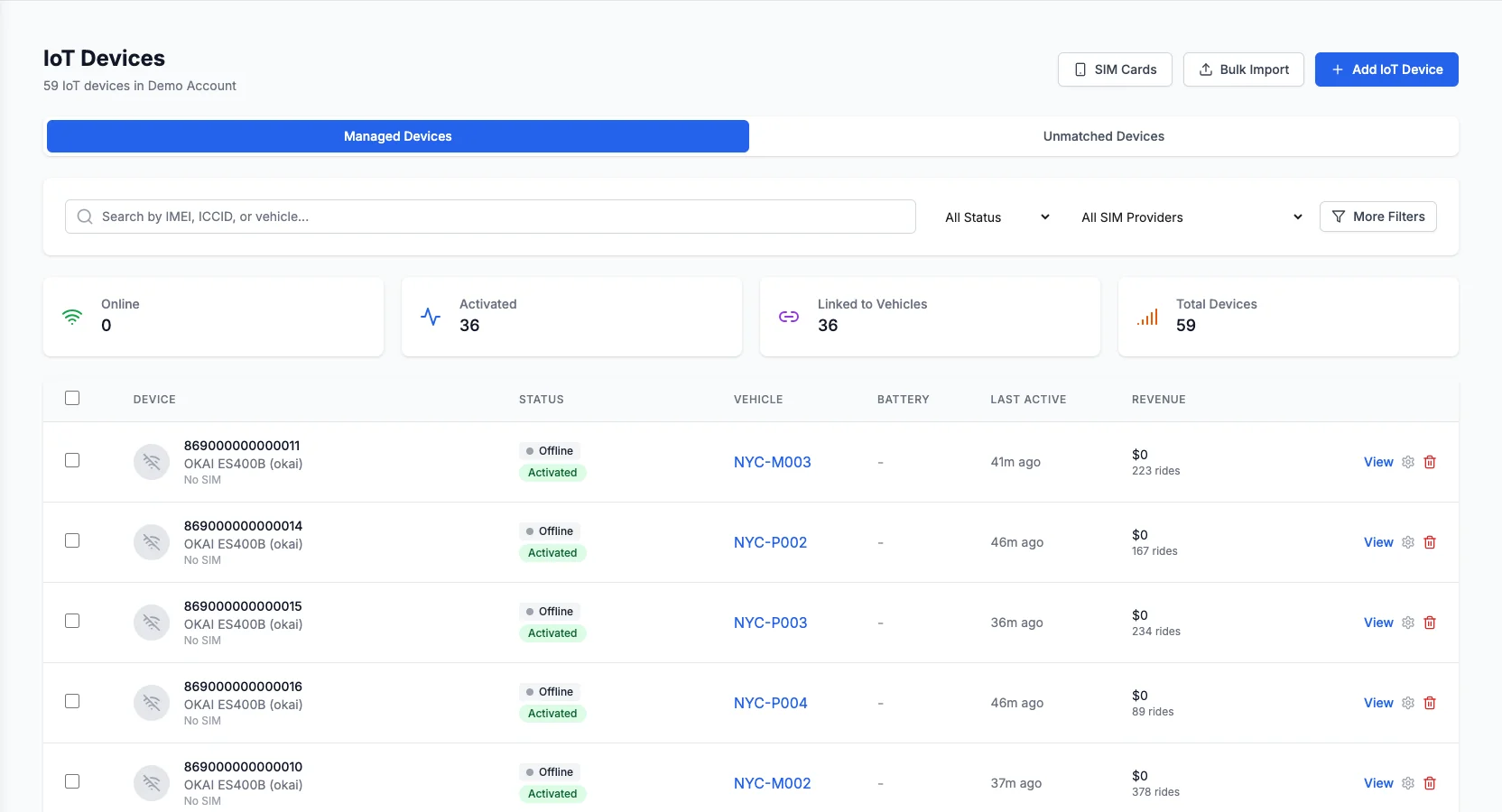
Whichever path a given vehicle takes, the platform gives you the same standard toolkit: GPS, remote lock/unlock, battery monitoring, speed tracking, geofencing, and real-time status are standard across the fleet. That is the payoff of Levy being hardware-agnostic across 30+ IoT vendors and protocols. Bring your existing hardware or choose from the supported vendors, and it lands in one operator dashboard.
The five specs that decide fleet-grade
Once you know the connectivity path, judge the physical vehicle on five specs. Lead with these on every quote you request.
1. Swappable batteries
This is the single highest-impact spec for uptime, so put it first. Charging is the recurring tax on availability: a scooter on a charger is off the road, and a scooter pulled off the road by a person is paying for that person's time too. A swappable battery lets you swap range in the field in seconds and reserve full charging for batteries, not whole vehicles. A fixed-battery vehicle takes roughly 4 to 8 hours to recharge (it varies by pack size, charger, and starting state of charge, so treat this as a planning range and confirm the spec on your exact model) and is dead the entire time. A swappable-battery vehicle is back earning the moment a fresh pack clicks in.
Swappable batteries also unlock Levy's Battery Swap tooling: pack state-of-health tracking, swap-station inventory, an in-house swap workflow, and a gig Juicer and Charger marketplace with bounties and payouts. None of that helps a vehicle whose battery is bolted in. If you expect meaningful volume, treat swappable batteries as a requirement, not a nice-to-have.
2. IP rating and weather sealing
The IP (Ingress Protection) rating tells you how well the vehicle and its electronics resist dust and water. It is two digits: the first is solids, the second is liquids. Higher is more sealed.
| Rating | Water resistance | Fleet reality |
|---|---|---|
| IP54 | Splash from any direction | Bare minimum, risky in wet climates |
| IP65 | Low-pressure water jets | A sensible floor for shared outdoor scooters |
| IP67 | Temporary immersion | Strong for rain-heavy or coastal markets |
Rain does not wait for your fleet to be ready. A vehicle that dies after one wet week is a warranty case and a downtime hole at the same time. Ask for the IP rating of the vehicle body and, separately, the battery and the IoT module, because a well-sealed frame with an exposed connector still fails. In wet or coastal cities, bias toward IP65 or better.
3. Durability and serviceability
Shared vehicles take abuse no personal vehicle ever sees: curb drops, tip-overs, riders who never read a manual. Durability is what keeps a unit out of the repair queue, and serviceability is how fast it gets back when it does land there. Look for:
- Wheel size and tires. Larger wheels (10 inches or more on scooters) and tubeless, self-sealing, or solid tires survive potholes and cut flat-repair labor.
- Dual braking. A mechanical brake plus an electronic or regenerative brake, so a single failure does not leave a rider with no stopping power.
- Reinforced stem and deck. The stem and folding joint are the first things to fatigue on a shared scooter. Reinforced, minimal-folding designs last longer.
- Modular, common parts. Vehicles built from replaceable modules get fixed in minutes, not scrapped. This is where parts availability matters as much as the vehicle itself.
Serviceability is a Levy advantage, not just a spec
Levy keeps US stock of common OKAI, Segway, and similar parts (tires and tubes, brake cables and pads, display panels, batteries, fenders, throttle assemblies). You order through Levy, not direct from the manufacturer, so parts ship in days instead of the weeks it takes to order from overseas. Choosing a vehicle whose parts Levy stocks turns a two-week downtime hole into a two-day one.
4. Theft and security hardware
A stolen or stripped vehicle is a total loss on an asset you were still amortizing. Theft resistance is part hardware, part platform.
On the hardware side, spec:
- An integrated electronic lock or motor cutoff, so the vehicle is useless to a casual thief once it ends a ride.
- A physical wheel lock or cable lock for markets where you park on public racks.
- A tamper-resistant IoT enclosure, ideally internal, so the tracker is not the first thing a thief removes.
On the platform side, Levy gives you real-time GPS, remote lock/unlock, geofencing, real-time status, and alerts. A vehicle that leaves its service area or moves while locked is visible immediately, which turns recovery from guesswork into a location on a map. The hardware makes theft harder; the platform makes recovery possible.
5. The IoT module and connectivity itself
The module is the vehicle's nervous system. If it drops offline, the vehicle is unrentable no matter how good the frame is. When you evaluate a native-connected model or pick a retrofit box, confirm:
- Protocol support on Levy. Levy is hardware-agnostic across 30+ IoT vendors including OKAI, Segway, Queclink, Omni, Acton, Niu, Concox, Teltonika, CalAmp, Digital Matter, and Comodule, plus car OEM telematics through Smartcar and High Mobility. Segway alone spans NB-O, NB-Y, NB-S3, Queclink, and Omni module types. Confirm your specific module is on the supported list before you buy in volume.
- A reliable cellular SIM and coverage in your operating city, since connectivity is the IoT SIM cost line in your daily economics.
- Battery and lock reporting, not just GPS. A tracker that only pings location cannot enforce speed zones or end a ride cleanly.
Match the hardware to the vehicle type
Fleet-grade means different things by form factor. Levy supports scooters, e-bikes, mopeds, golf carts, cars, low-speed vehicles, and even three-wheelers, so spec against the job the vehicle does.
How Levy fits into your hardware decision
Being hardware-agnostic is only useful if it removes work. Here is what Levy actually does around the vehicle you choose.
Source from a 150+ vehicle catalog
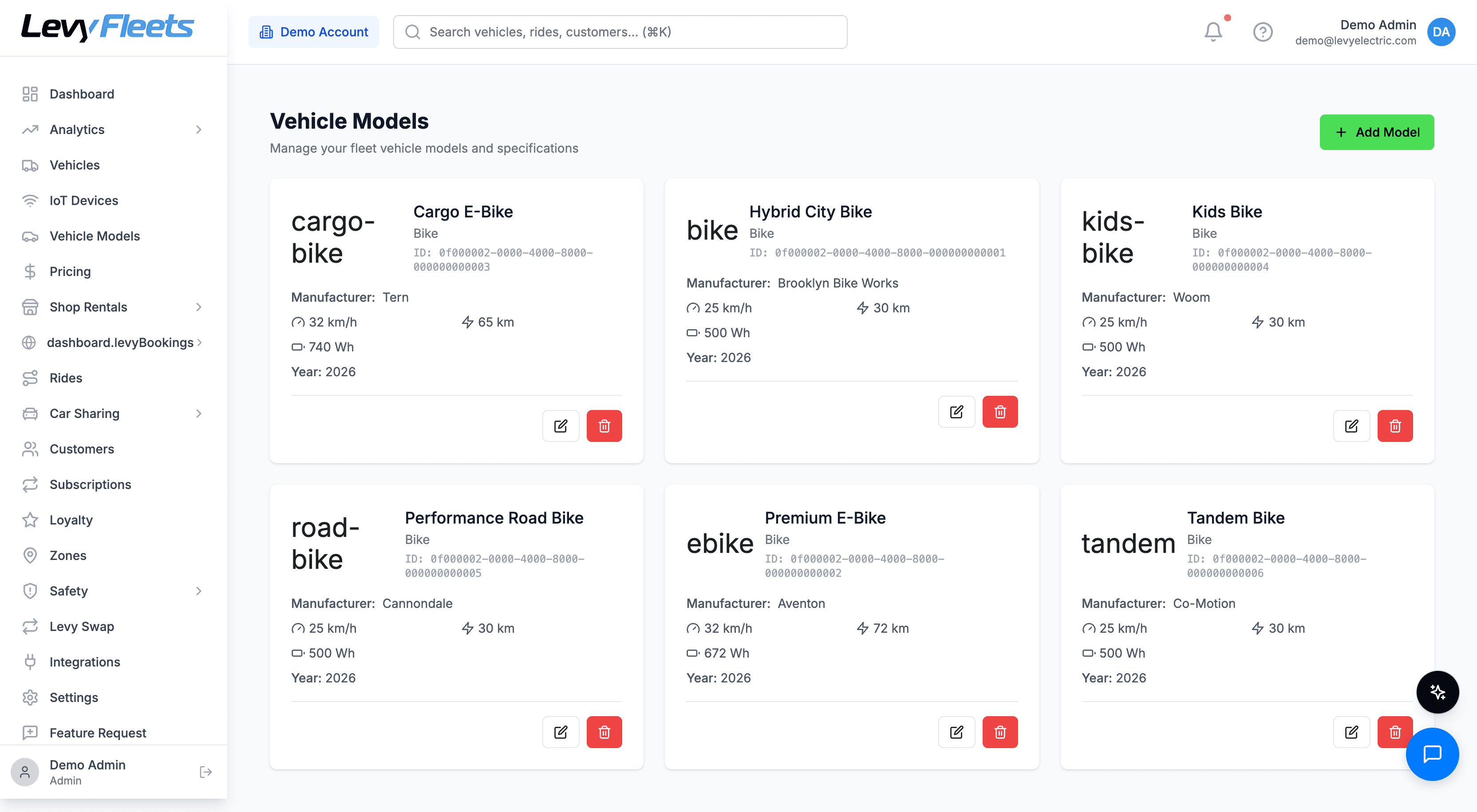
Browse 150+ fleet-ready electric vehicles with detailed specs, or bring hardware you already own. Levy helps you pick the right connected vehicles for your market instead of pushing one brand.
Integrate and retrofit
Whether your vehicle is native-connected or needs a retrofit module, Levy handles the IoT integration so every unit reports into one operator dashboard with GPS, lock/unlock, battery, and speed as standard.
Stock and ship parts from the US
Levy keeps US stock of common parts and ships in days, not weeks, so a spec you chose does not strand you on overseas lead times when something breaks.
Handle warranty on your behalf
OKAI hardware carries a 90-day warranty from delivery covering manufacturing defects. Levy files the claim with the manufacturer for you rather than leaving you to chase it.
Because Levy charges revenue share with $0 upfront, you pay when riders pay (20% of GMV under 100 active vehicles, and 15% of GMV at 100 to 249 active vehicles on an annual or approved term, with a $250 per month platform minimum credited against fees), the platform cost scales with your rides, not with how many vehicles you buy. That is what lets you spend your capital on the right hardware instead of on software licenses.
Your fleet-grade buyer's checklist
Before you sign a hardware purchase order, confirm every line:
- Swappable battery and a charging or swap plan that keeps range in the field.
- IP65 or better on the body, battery, and IoT module (IP67 for wet or coastal markets).
- Dual braking and durable wheels and tires sized for real streets.
- Reinforced, serviceable build using parts Levy stocks in the US.
- Theft hardware: integrated lock or motor cutoff, plus a tamper-resistant module.
- A Levy-supported IoT protocol confirmed for your exact module, native or retrofit.
- Total cost of ownership per ride, not sticker price, as your final decision metric.
Fleet scooter buyer's guide
A deeper spec-by-spec breakdown of the scooters that survive shared use, with swappable batteries as the top spec.
Frequently asked questions
Put it into practice
Choosing fleet-grade hardware comes down to one discipline: judge every vehicle on uptime and total cost per ride, not on the invoice. Pick the connectivity path that fits each form factor, insist on the five specs, and lean on Levy to source, integrate, stock parts for, and warranty whatever you choose. Ready to spec your fleet? Book a demo and we will help you match vehicles and IoT to your market, or model the economics of your hardware plan in the Fleet Estimator first.