.svg)
One rider crash, one sidewalk injury, one disputed $40 charge that escalates into a demand letter, and the paperwork you never read closely becomes the most important asset in your business. The rider agreement is the single cheapest piece of risk control you own. It costs nothing per ride, it applies to every rider on day one, and a well drafted version can end a claim before a lawyer ever bills an hour. A weak or unaccepted one leaves you exposed. This lesson breaks down the four clauses that actually limit your liability, the operational terms that make them hold up, and how the acceptance flow decides whether any of it is worth the pixels it is written on.
Operator education, not professional advice
This is operator education, not professional legal, tax, insurance, or fire-safety advice. Rental agreements are governed by state and local law, and enforceability varies widely by jurisdiction and by how the document is written and accepted. Before you launch, have a qualified attorney draft or review your agreement, and confirm requirements with a qualified professional or your local authority.
Why the rider agreement is your cheapest risk control
Think of your protection in two layers. The rider agreement is the first line: a contract every rider accepts before the vehicle unlocks, which shapes what claims a rider can bring and who pays when something goes wrong. Insurance is the second line: it pays out when a claim gets past the contract. You want both, and they do different jobs. The agreement is free and scales to infinity. Insurance costs real money every month and has limits and exclusions. Operators who lean only on insurance overpay and stay exposed on the gaps. Operators who lean only on the agreement discover that a waiver does not write a check when someone is genuinely hurt.
Get the sequencing right: tighten the agreement first because it is free, then buy coverage sized to the risk the agreement cannot waive. For the coverage side of the equation, work through our fleet insurance guide alongside this lesson. The rest of this article is the contract side.
The four clauses that carry the weight
Almost every enforceable rider agreement in shared micromobility is built on the same four load-bearing clauses. Understand what each one does and, just as important, what it cannot do.
Assumption of risk
An assumption-of-risk clause is the rider stating, in writing, that they understand riding carries inherent dangers and they choose to accept them. To be effective it has to be specific to the activity. Generic language ("riding may be dangerous") is weak. Strong language enumerates the real hazards: loss of control, falls, collisions with cars, pedestrians, or other riders, road and surface defects, potholes, weather, mechanical failure, battery and brake issues, and the rider's own inexperience or impairment.
How it limits liability: it reframes the core dispute. Instead of "the operator failed to keep me safe," the record shows "the rider knew these risks and rode anyway." In many jurisdictions a clear assumption of risk can defeat or reduce an ordinary negligence claim, because the rider voluntarily encountered a known danger. It does not cover risks you hid or created through your own fault, which is why it pairs with, but never replaces, the release below.
Waiver and release of liability
This is the heart of the document. A waiver and release is the rider agreeing to give up the right to sue and covenanting not to sue for claims arising out of the rental, the vehicle, the equipment, the services, parking, charging, or the agreement itself, to the fullest extent permitted by law. The two phrases that matter most are "to the fullest extent permitted by law" and the carve-out for non-waivable liability, because they keep the clause enforceable instead of getting the whole thing thrown out for overreaching.
A well drafted release also defines the "Released Parties" broadly so the shield extends past the platform to everyone in the chain, including you. This is where a platform agreement earns its keep for an operator: it can name local fleet operators among the protected parties so that the rider's release runs in your favor, not just the platform's. The Levy rider agreement is structured this way. You can read exactly how the release, the assumption of risk, and the covenant not to sue fit together in the full Levy rider Rental Agreement and use it as a reference model when you scope your own protection.
What a release cannot do:
- It generally cannot waive gross negligence, recklessness, or willful misconduct. Courts protect those on public-policy grounds.
- It cannot waive rights that a statute makes non-waivable, and some consumer-protection and personal-injury statutes qualify.
- Releases signed by or on behalf of minors get special treatment. Some states will not enforce a pre-injury release against a child even when a parent signs, so age gating (below) is not optional.
- It only works if the rider actually accepted it in a way a court will honor. See the acceptance section.
Indemnification
Where the release protects you from the rider's claims against you, indemnification protects you from third parties. An indemnification clause has the rider agree to defend, indemnify, and hold you harmless for claims, damages, and costs (including reasonable attorney fees) that arise from their use or misuse of the vehicle, their violation of law, or damage they cause to people or property.
How it limits liability: if a rider hits a pedestrian and the pedestrian sues you, indemnification is the mechanism that pushes that cost back onto the rider who caused it. Be realistic about collectibility. Indemnification against an individual rider is only as strong as that rider's ability to pay, so its practical value shows up most in three places: recovering vehicle damage and abandonment fees, deterring reckless use, and giving you a contractual basis to charge for the mess a rider leaves behind. Treat it as a cost-shifting and deterrence tool, not a guaranteed payout.
Arbitration and class-action waiver
An arbitration clause moves disputes out of court and into binding individual arbitration, and a class-action waiver stops riders from bundling many small claims into one large lawsuit. Together they change the economics of a dispute in your favor: no jury, contained legal spend, and no class exposure from a single defect or fee complaint.
The nuances matter, so build the clause carefully with counsel:
- Add a small-claims carve-out (most consumer arbitration clauses let either side use small-claims court) and a short opt-out window (commonly 30 days) because both help the clause survive an enforceability challenge.
- Include a delegation provision so questions about the arbitration itself go to the arbitrator.
- Know the mass-arbitration risk. Opponents can now file thousands of individual arbitrations at once, and consumer rules often make you pay the filing and arbitrator fees, which can flip the cost math. This is a real strategic trade-off, not a rubber stamp.
The supporting cast
Two more clauses round out the liability picture. A limitation-of-liability clause caps your maximum exposure and excludes consequential and indirect damages. A disclaimer of warranties provides the vehicle and services on an "as is" basis to the extent the law allows. Together they set a ceiling on what any single claim can cost you.
The operational terms that make the release stick
A release is only as good as the conduct rules it sits on top of. If your agreement never told the rider the rules, it is hard to argue they broke them. Bake these into the terms so a violation is a clean breach you can point to:
| Term | Why it protects you |
|---|---|
| Minimum age (commonly 18, higher for mopeds and cars) | Keeps the contract enforceable and screens out riders who cannot legally waive |
| Valid license where required (mopeds, cars) | Removes the "you let an unlicensed rider on the road" argument |
| Sober operation, no impairment | Establishes the rider breached before any incident |
| One rider, no passengers unless the vehicle allows it | Defeats claims tied to unsafe doubling |
| Helmet use where required or recommended | Documents the safety expectation you set |
| Obey all traffic, parking, and local law | Shifts citations and violations to the rider |
| No riding in prohibited zones or off-limits areas | Supports geofence and end-of-ride enforcement |
| Damage, abandonment, and cleaning fees | Gives indemnification something concrete to collect against |
| Data and location consent | Keeps your telematics and evidence trail lawful |
How the pieces fit together
None of these clauses is a wall on its own. They are layers. Assumption of risk narrows what counts as your fault. The release removes the rider's direct claim. Indemnification and arbitration control who pays and where the fight happens. The limitation-of-liability cap sets the worst case. The operational terms give you clean breaches to point to. A claim has to defeat every layer to reach you.
Make the agreement enforceable
A perfect agreement that a rider never truly accepted is worthless. Courts enforce online agreements when the user got reasonable notice of the terms and took an affirmative action to accept them. That standard is your build spec.
Use clickwrap, not browsewrap
Require an affirmative action to accept, a checked box or a tapped "I Agree" button, with the full terms one clear tap away. Do not rely on a buried "by using this app you agree" line. Affirmative assent is what makes the waiver hold up.
Verify who is accepting
Tie each acceptance to a real, verified person. If you cannot prove which human agreed, the waiver is hard to enforce. Identity verification at signup is what turns a checkbox into a binding record against a named rider.
Version and re-consent
Stamp every version of the agreement. When you make a material change, require riders to accept the new version before their next ride. An outdated acceptance can leave you enforcing terms the rider never saw.
Keep timestamped records
Store the version accepted, the timestamp, and the rider identity, and keep them. If you ever need the waiver, the record of acceptance is the evidence that makes it real.
Where Levy fits
Levy Fleets is a connected fleet operations platform, and the rider agreement lives inside the flow it runs for you. The rider app (iOS and Android) presents the rider Rental Agreement at signup, so every rider affirmatively accepts before the first unlock. The Levy agreement is structured with the clauses in this lesson, and it extends its release to name local fleet operators among the protected parties, which is the detail that makes the platform contract work in your favor. Read the full Levy rider Rental Agreement to see the exact structure.
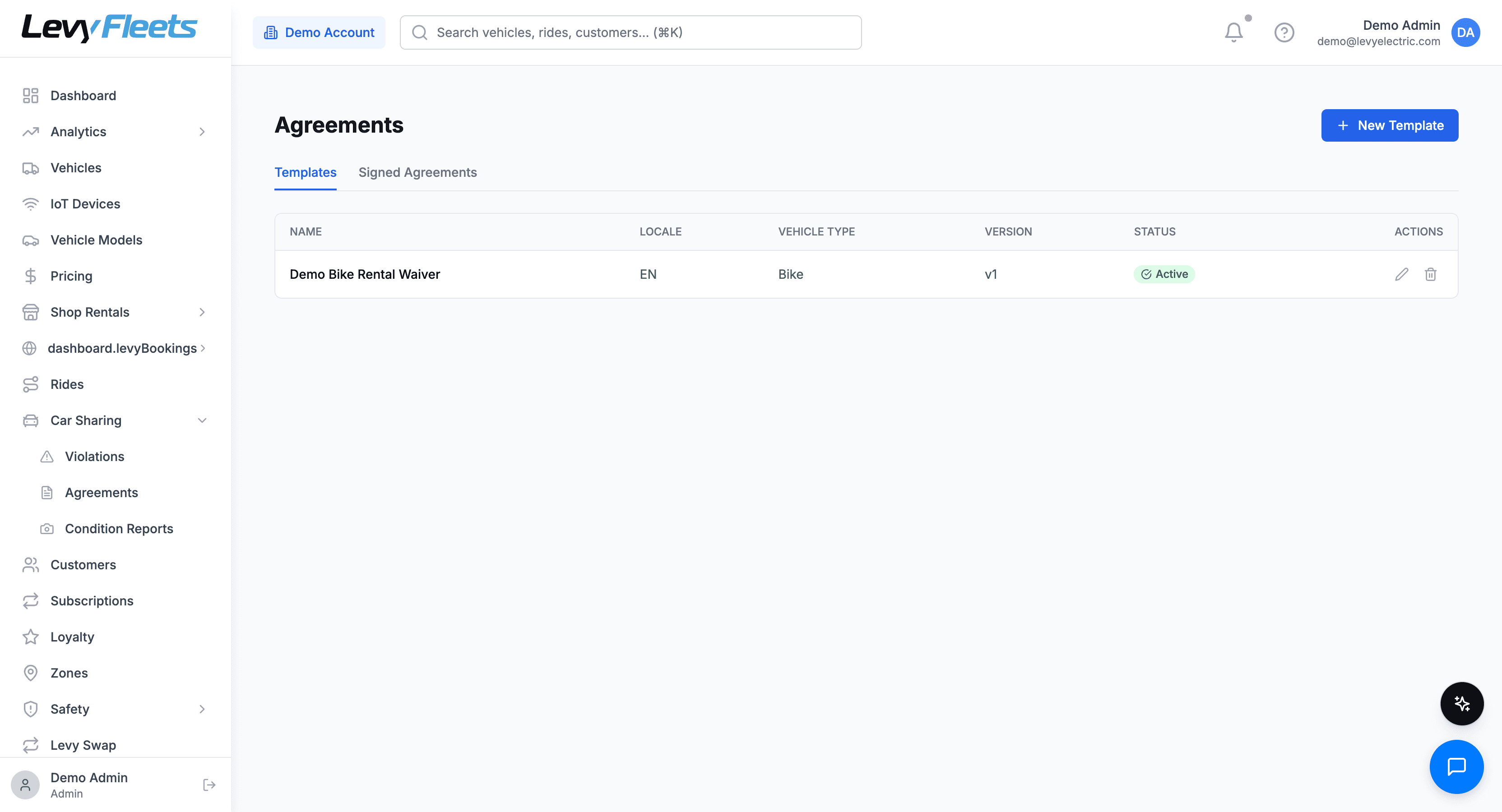
Identity is what makes any of it enforceable, and identity verification is included on every plan (SoCure and Experian, plus Stripe Identity), so each acceptance ties to a verified person rather than an anonymous checkbox. On the Managed plan, Levy runs payments, disputes and chargebacks, and collections and dunning, so the fee and damage terms you rely on are enforced end to end rather than sitting unread in a contract. That model is revenue-share: $0 upfront and you pay when riders pay, with a $250 per month platform minimum credited against your fees. Enforcement rides along with what you already owe on revenue instead of a separate bill you fund before riders pay you. For brick-and-mortar counters, Shop Rentals captures waivers at point of sale alongside walk-in bookings and damage logging, so in-person rentals carry the same paper trail as app rides.
The agreement is not your insurance
A waiver limits liability. It does not pay a claim. Levy does not provide rider or operator insurance, so you still need your own commercial policy sized to the risk the waiver cannot waive. Work through the scooter rental insurance guide to size it.
How this changes by vehicle type
The four clauses are constant. The operational terms and the risk framing shift with the vehicle.
Standing e-scooters carry the highest inherent-risk framing, so the assumption-of-risk clause should enumerate falls, road defects, and mixing with traffic and pedestrians explicitly. Reinforce helmet expectations and no-sidewalk-riding terms so end-of-ride parking and sidewalk enforcement have a contractual basis.
Frequently asked questions
Get the paperwork right before you launch
The rider agreement is the one risk control that costs you nothing per ride and protects every ride you run, but only if it is drafted for your jurisdiction, accepted affirmatively by a verified rider, versioned, and backed by enforcement. Build the four clauses, layer the operational terms, and wire up a clean acceptance flow before your first unlock, then size your insurance to the gaps that remain.
See the rider agreement in the flow
Book a Levy Fleets demo to see how the rider Rental Agreement is presented, accepted, and tied to verified identity before a rider's first unlock.