.svg)
Every dollar you put into a shared scooter fleet lands in one of two buckets. Capex is the money you spend once to get vehicles on the street. Opex is the money that leaves your account every month for as long as those vehicles keep earning. Mix the two up and your spreadsheet lies to you: a fleet that looks cheap because the vehicles are paid off can quietly bleed out on charging labor and repairs. This lesson walks the entire cost stack, gives realistic ranges for each line, and ties it together with per-ride math so you can see exactly where your margin goes.
The single biggest structural decision you make is how much of that stack you want to own as capex versus rent as opex. Levy Fleets is built to push the software half of the stack almost entirely into opex: $0 upfront on software, and a revenue-share model where you pay when riders pay. That does not make the hardware half disappear, so let us start there.
Planning figures, not financial advice
This lesson is operator-to-operator planning guidance, not financial, tax, insurance, or legal advice. The ranges and the worked example are illustrative industry planning figures that vary by market, season, vehicle mix, and how hard you run the fleet. The only fixed Levy inputs are the published pricing: the revenue-share percentage, the per-vehicle rate, the $250 platform minimum, the white-label add-on, and the Stripe processing rate. Model your own numbers in the Fleet Estimator, and confirm insurance, tax, and permit costs with a qualified professional before you commit capital.
Capex vs opex: why the split matters
Capex is a one-time outlay that you depreciate over the useful life of the asset. A connected scooter, a rack of spare batteries, a one-time white-label app build: you pay once, then spread that cost across every ride the asset produces. Capex is a cash-flow problem (you need the money up front) and a depreciation problem (the asset wears out and has to be replaced).
Opex is recurring and scales with how much you operate. Charging, repairs, cellular connectivity, field labor, payment processing, and platform fees all hit every month, and most of them grow as ride volume grows. Opex is a margin problem: it is the difference between gross revenue and what actually reaches your bank account.
The two buckets fail differently. Underestimate capex and you run out of runway before the fleet matures. Underestimate opex and every ride you add loses a little more money, so scaling makes the hole deeper instead of shallower. You have to model both, and you have to know which line each cost belongs to.
The one-line test
If the cost survives even when a vehicle sits idle all month, it is closer to capex or fixed opex (depreciation, connectivity, the platform minimum). If the cost only shows up when the vehicle earns, it is variable opex (payment fees, energy, most labor). Idle vehicles are punished by the first group and spared by the second, which is why utilization drives everything.
Capex: what you buy up front
Vehicle hardware
Hardware is the largest single line in almost every fleet budget. The exact number depends entirely on vehicle type and whether you buy new, connected units or retrofit vehicles you already own. Levy is hardware-agnostic across 30+ IoT vendors and helps you source the right connected vehicles rather than locking you to one manufacturer, and Levy does not manufacture the vehicles itself. So treat the ranges below as market budgeting figures for the class of vehicle, not a Levy price list.
| Vehicle type | Budget per connected unit | Notes |
|---|---|---|
| Kick scooter | $400 to $1,200 | The workhorse of most shared fleets. Wide range by build quality and battery size. |
| E-bike (including cargo and step-through) | $800 to $2,500 | Higher acquisition cost, but typically longer service life per unit. |
| Moped or e-moped (seated) | $1,500 to $3,500 | Bigger battery and drivetrain, higher revenue per ride to match. |
| Golf cart, NEV, or LSV | $6,000 and up | Low-speed vehicles carry the heaviest capex per unit. |
| IoT retrofit module (bring your own vehicle) | $50 to $150 per unit | For vehicles you already own. Levy works with embedded controllers and retrofit hardware to bring them online. |
If you are bringing existing vehicles, the retrofit line is your hardware capex instead of a full unit price. Either way, plan for hardware to dominate your launch budget. Treat the bands above as planning ranges, not quotes: real acquisition cost varies by build quality, battery size, order volume, and vendor, so model your own vehicle mix in the Fleet Estimator before you set a budget.
Charging and battery infrastructure
Every fleet needs a way to put energy back into the vehicles. That can be as simple as a wall of chargers in a warehouse, or as involved as a swap-battery operation with a stock of spare packs so a technician swaps a dead battery for a full one in the field instead of hauling the whole vehicle home. Spare battery packs are real capex: each one is an asset you buy once and cycle for its lifespan. Levy's Battery Swap tooling tracks pack state-of-health, swap-station inventory, and the in-house swap workflow, so if you go the swap route, budget for the spare packs and any swap-station hardware as up-front cost.
Spare parts starter inventory
You cannot wait weeks for a brake cable when a vehicle is down and not earning. A starter inventory of common wear parts is capex you should plan from day one. Levy keeps US stock of common parts (tires and tubes, brake cables and pads, display panels, batteries, fenders, throttle assemblies) and you order through Levy rather than direct from the manufacturer, so parts ship in days rather than weeks. That shortens how much inventory you tie up up front, but you still want a baseline on the shelf.
Software and app capex (near zero with Levy)
This is where the Levy model changes the shape of your budget. There is $0 upfront software cost: the operator dashboard, rider apps, IoT connectivity, payments, and analytics come with no build fee. The only optional software capex is the white-label add-on at $2,750 one-time to publish an operator-branded app on iOS and Android. If you launch on the Levy app under "Levy Label" instead of your own brand, there is no setup fee at all. Compare that to building a rider app and backend from scratch, which is a six-figure capex project before you have taken a single ride, and the reason to rent this half of the stack is obvious.
Opex: what you pay every month
Now the recurring side. These are the lines that decide whether each ride contributes margin.
Payment processing
Every rider payment carries a processing fee. Levy has volume pricing with Stripe of 2.6% + $0.20 per transaction, versus the standard 2.9% + $0.30. On a typical low-value micromobility ride that flat $0.20 matters more than the percentage, because the per-transaction floor is a bigger share of a $4 ride than of a $40 one.
Platform and software fees
This is the recurring cost of the platform itself, and Levy structures it as revenue-share so it moves with your revenue instead of hitting up front:
- Managed: 20% of GMV under 100 active vehicles (no vehicle minimum), dropping to 15% of GMV at 100 to 249 active vehicles on an annual or approved term. On the Managed plan, Levy runs support, payments, disputes, and collections, so several opex lines you would otherwise staff yourself are folded into that percentage.
- Software-Only: $14 per vehicle per month at 100 to 249 active vehicles, for operators running their own in-house operations on an annual commitment.
- Platform minimum: $250 per month per operator, credited against your fees. If a month's fees come in under $250, Levy invoices the difference. At low ride volume this minimum is effectively your software cost per ride, and it falls fast as volume climbs.
GMV vs net: two different money flows
The Managed fee is quoted as a percent of GMV, which is gross rider payments before taxes, government fees, refunds, and tips. Your partner payout is calculated on net revenue after Stripe processing fees, with operator and Levy sharing those processing costs proportionally. These are two separate flows, so do not collapse the plan fee and the payout base into one number when you model.
Connectivity
Every connected vehicle carries a cellular SIM with a small recurring cost per device per month. It is modest per unit, but it is pure fixed opex: you pay it whether the vehicle takes 90 rides that month or zero. Across the whole fleet it becomes a real number, and it is one more reason idle vehicles hurt.
Energy and charging labor
Two costs live here. The electricity itself is cheap per ride. The labor to collect, charge, and redeploy vehicles is not. If you run charging in-house it is field-staff time. If you use a gig model, Levy's Juicer and Charger marketplace pays gig workers bounties to charge or swap vehicles, with predictive bounty pricing, payouts, and fraud detection built in. Either way, plan for the labor of moving energy around to be one of your larger recurring lines.
Maintenance, parts, and repairs
Vehicles in shared service take abuse. Budget for ongoing repairs and the wear parts that go with them. Levy's Work Orders tooling covers task management, technician dispatch, parts tracking, and vendor invoicing, and the US parts stock keeps a down vehicle from becoming a multi-week revenue hole. The cost here is the technician labor plus the parts consumed, spread across the rides the fleet produces.
Field labor and rebalancing
Vehicles drift away from demand. Moving them back is labor. Levy's AI Ops add-on helps you spend that labor well: it produces demand forecasts and ROI-ranked rebalancing recommendations (move N vehicles from one hex to another by a target time, with a projected revenue lift) and joint battery-swap plus rebalance technician routing in the operator app. It recommends and forecasts. It does not auto-dispatch or auto-execute the moves, and it is not a surge-pricing engine, so treat it as a tool that makes your labor budget go further, not a way to remove the labor line.
Insurance
Levy does not provide rider or operator insurance. You carry your own commercial program (general liability, product liability, and property coverage on the fleet) through your own broker, and it is a recurring line to budget.
Put it together: cost per ride
Ranges are useful, but the number that actually governs your business is cost per ride. Here is a worked example for a small scooter fleet on the Managed plan, using a $5.00 gross fare (GMV) per ride to keep the math clean. Every line except the two Levy inputs (the Managed fee and the Stripe processing rate) is an illustrative planning assumption, so read the total as a conservative estimate rather than an exact net. Your real figures will differ by market, but the structure holds.
| Cost line | Bucket | Per ride at $5.00 GMV |
|---|---|---|
| Payment processing (2.6% + $0.20) | Variable opex | $0.33 |
| Levy Managed fee (20% of GMV) | Variable opex | $1.00 |
| Energy (electricity only) | Variable opex | $0.15 |
| Charging and rebalancing labor (amortized) | Variable opex | $0.30 |
| Maintenance and parts (amortized) | Variable opex | $0.45 |
| Connectivity (SIM, spread over rides) | Fixed opex | $0.04 |
| Hardware depreciation | Capex, amortized | $0.33 |
| Total cost per ride | $2.60 | |
| Contribution per ride | $2.40 |
Three things to read out of this table. First, the two largest lines, the platform fee and payment processing, are both revenue-linked, so they never sink you on a slow day: they shrink when revenue shrinks. Second, hardware depreciation is doing quiet work. It comes from spreading the up-front vehicle cost across every ride the unit produces, so the more rides per vehicle per day you drive, the smaller that line gets. A $600 scooter that produces roughly 1,800 lifetime rides carries about $0.33 of depreciation per ride (both the price and the lifetime-ride count are planning assumptions, not Levy figures). Halve the utilization and you double that line. Third, on Managed the 20% absorbs support, disputes, and collections labor, so the real comparison against Software-Only is not 20% versus $14 per vehicle, it is 20% versus $14 plus the cost of staffing those functions yourself.
One caution on that last row: contribution per ride is a vehicle-level figure, not profit. It is what a single vehicle throws off after its own direct costs, before the whole-business overhead that sits on top: liability insurance, city permits and fees, storage or depot rent, marketing, accounting and taxes, a theft-and-loss reserve, and your own time. Those are real costs and they come out of the contribution pool, so do not read $2.40 as take-home.
Downside cases: stress-test the contribution
A single base case hides the risk. The two assumptions most likely to move against you are the fare riders actually pay and the utilization that spreads your per-vehicle fixed lines. Here is the same fleet under softer assumptions (illustrative only, so model your own):
| Scenario | What changes | Cost per ride | Contribution per ride |
|---|---|---|---|
| Base case | $5.00 fare, roughly 1,800 lifetime rides per vehicle | $2.60 | $2.40 |
| Lower fare | $3.50 fare, same utilization | $2.26 | $1.24 |
| Half utilization | $5.00 fare, roughly 900 lifetime rides (depreciation and connectivity per ride double) | $2.97 | $2.03 |
| Both together | $3.50 fare and roughly 900 lifetime rides | $2.63 | $0.87 |
Contribution stays positive in every case, but it thins fast, and the whole-business overhead above still sits on top of these numbers. That is why utilization and fare are the two levers to defend hardest, and why you should run your own downside cases in the Fleet Estimator before you commit capex.
Watch the platform minimum at low volume
The $250 monthly minimum behaves like a fixed cost until your fees clear it. At 500 rides a month a $250 floor is $0.50 per ride on its own. At 5,000 rides it is $0.05. This is why early-stage fleets should model software cost against the minimum, not just the percentage, and why volume is the fastest way to cut your per-ride software cost.
How the split should shift as you scale
The right capex-to-opex balance is not fixed. It moves with fleet size.
Launch: minimize capex, rent everything you can
Keep the up-front outlay to hardware plus a starter parts shelf. Use the Managed revenue-share so software is opex that only bills when riders pay, and launch under Levy Label to avoid even the one-time white-label cost. Your goal is to reach real utilization before you spend on anything you can defer.
Growth: let volume crush your fixed lines
As rides climb, your fixed opex (the platform minimum and connectivity) shrinks per ride automatically, and your hardware depreciation per ride falls as utilization rises. This is the stage where the unit economics compound. Reinvest in the vehicles and zones that show the best rides per vehicle per day.
Scale: reprice the platform half of the stack
At 100 to 249 active vehicles the Managed rate drops to 15% of GMV, and the Software-Only plan at $14 per vehicle per month becomes an option if you have built in-house operations. Model both against your actual support and payments labor before switching, because Managed folds those functions into its rate.
Frequently asked questions
Model it before you spend
The cost stack above is the map. Your own numbers are the territory, and they depend on your city, your vehicle mix, and the utilization you can realistically hit. Before you commit capex to hardware, put your assumptions into a model and watch how the per-ride math responds.
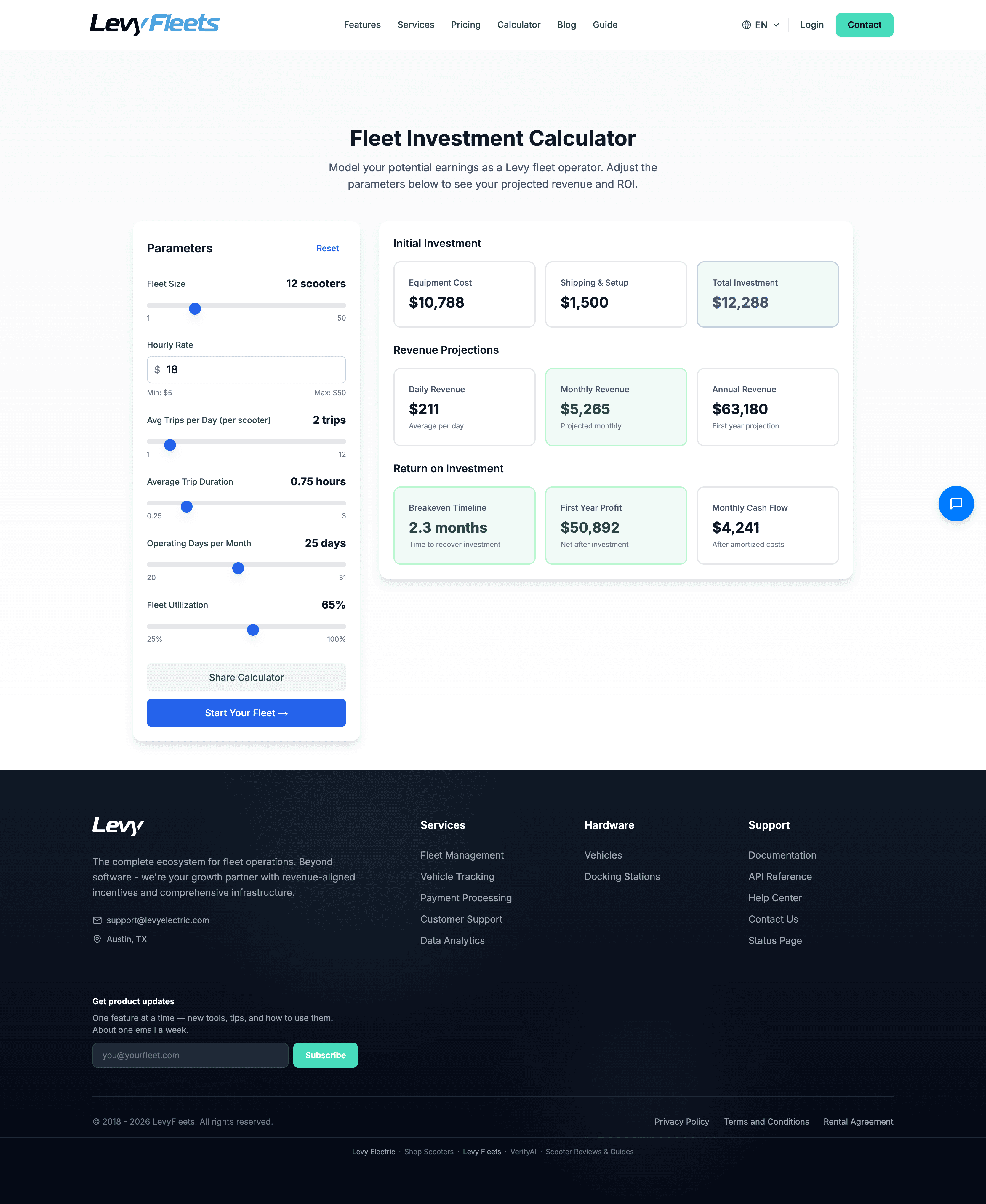
Run your fleet through the Fleet Estimator
Plug in your city, fleet size, and pricing to project revenue, cost per ride, and breakeven before you buy a single vehicle.
For the assumptions behind those projections and a fuller walkthrough of the economics, read the scooter rental business profitability breakdown. When your model shows numbers you like, book a Levy demo and we will walk your specific capex and opex plan line by line.