.svg)
Charging is the recurring tax on availability. Every minute a vehicle spends off the road to charge is a minute it cannot earn, and every vehicle a person collects, transports, or plugs in is paying for that person's time. Charging labor is one of the largest controllable costs in a shared fleet, and the model you pick (field swap, cluster and warehouse charging, or docking) decides your uptime, your cost per ride, and your margin. This lesson covers the three models compared, how to manage swap-station inventory, how to route your juicers and chargers, and the cost-per-charge math that tells you which model wins. For the marketing-side overview, see the companion piece on charging and battery-swap operations for scooter and e-bike fleets.
Planning guidance, not professional advice
The cost math, labor rates, insurance points, and gig-worker notes in this lesson are operator planning guidance, not financial, legal, tax, or insurance advice. Charging economics vary by market, and gig-labor rules, insurance endorsements, and safe-charging requirements differ by state and city. Confirm your own numbers and obligations with a qualified accountant, attorney, or insurance broker before you commit to a model.
Why charging strategy decides your margin
Charging cost has two parts, and they are not close in size. Electricity is tiny: a shared scooter or e-bike pack holds a fraction of a kilowatt-hour, so at a commercial power rate the energy to refill one pack costs cents. Labor is the number that matters. The person who drives to the vehicle, swaps or collects it, and gets it back on the street costs far more per charge than the electrons do, so any strategy that saves labor beats one that saves electricity.
That drives the whole discipline. The best operators charge by need instead of by schedule, and they charge batteries instead of whole vehicles wherever the hardware allows. Charging by need requires live per-vehicle battery data: Levy Fleets streams real-time GPS, battery, and speed telemetry into the operator dashboard as standard, so swap and collection decisions run on current state, not a nightly guess. Charging the battery instead of the vehicle is the uptime lever: a vehicle pulled off the street is dead inventory for hours, while a vehicle whose depleted pack is swapped in the field is back in service quickly, without the hours of downtime. That is why a swappable battery is the highest-leverage spec when you source hardware, and why this lesson treats the pack as the asset you are really managing.
The three charging models
There are three ways to get energy back into a fleet, plus the hybrid many operators land on. Read each model against your utilization, your parking and permit reality, and your labor market.
| Model | How it works | Uptime impact | Best for |
|---|---|---|---|
| Field battery swap | A tech or gig worker swaps a depleted pack for a charged one on location; depleted packs charge centrally | Highest: the vehicle never leaves the street | Dense, high-utilization scooter and e-bike fleets |
| Cluster and warehouse charging | Vehicles are collected to a warehouse, garage, or storefront, charged, then redeployed | Lowest: off the road during collection, charging, and redeployment | Small fleets, pilots, and private-property programs with predictable overnight downtime |
| Docking with built-in charging | Vehicles charge at docks where riders return them | Neutral to positive: riders perform the return-to-charge step | Parking-sensitive zones and permit regimes that reward orderly return |
Field battery swap
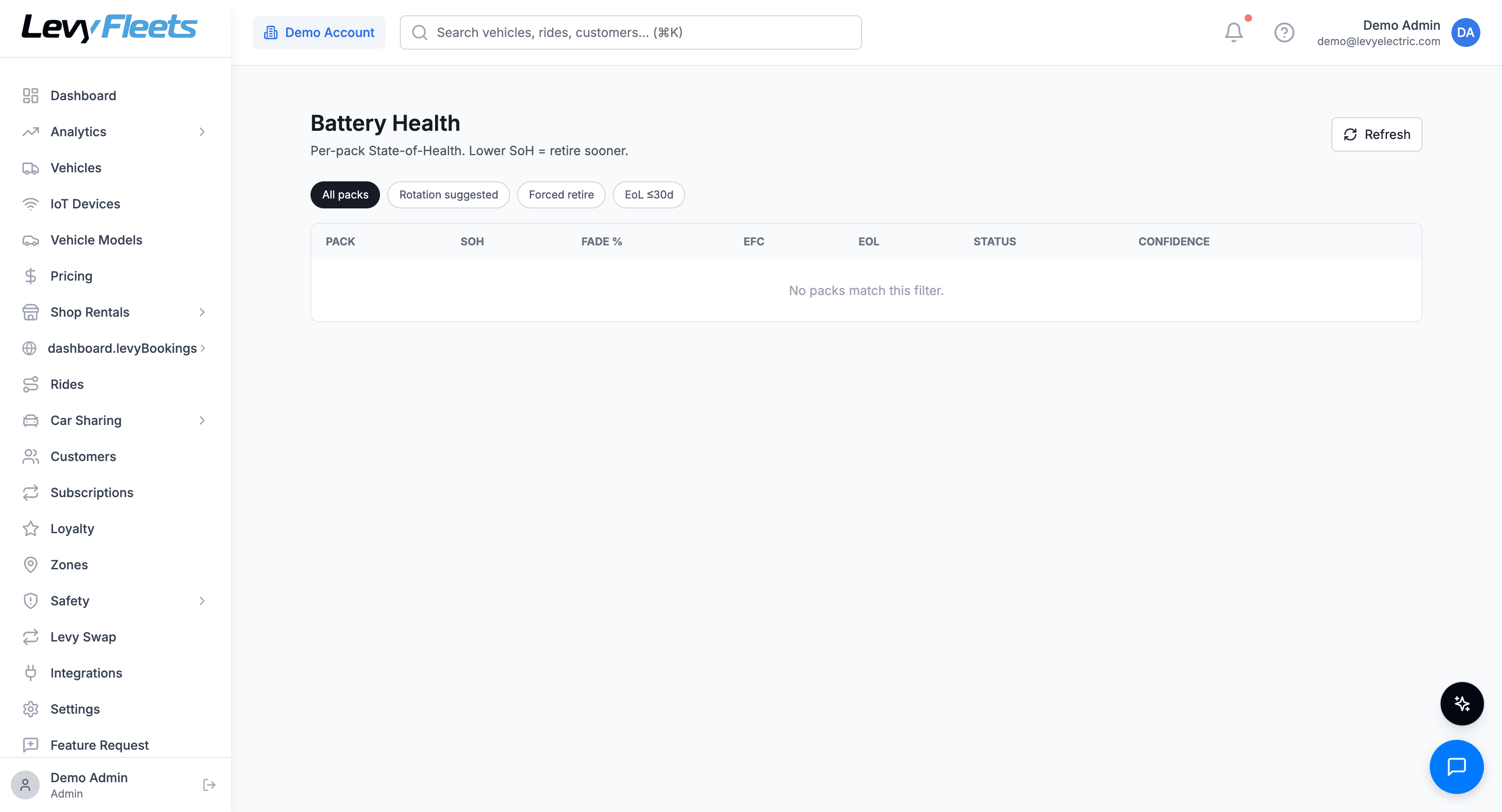
In a field swap the vehicle stays deployed and only the pack moves, so this is the highest-uptime model and the right default for dense scooter and e-bike fleets. Levy Swap is built around it. Full-time techs work a swap queue in the operator app: each vehicle that needs a pack shows why (low state of charge or a state-of-health rotation), so the team knows what to prioritize. The swap workflow scans the old and new packs and records each swap with a full audit trail. The tradeoff is battery inventory: you need enough charged spare packs to cover peak demand without over-capitalizing, and somewhere to charge the ones you pull.
Cluster and warehouse charging
Cluster charging is the simplest model to start and the most labor-heavy to scale. You collect vehicles to a central location, charge them, and redeploy. It needs no spare-pack inventory and works with non-swappable hardware, which is why pilots and private-property programs (a hotel, a campus, a resort with predictable overnight downtime) usually begin here. The cost is uptime and labor: the vehicle is off the road for the whole collection-charge-redeploy cycle, and both the collection and redeployment legs grow with the fleet. Watch for charging creep, where manual charging labor scales roughly with vehicle count and a model that felt free at 20 vehicles becomes your largest controllable cost at 200. Even if you never run pure cluster charging, you run a cluster back end the moment you adopt field swap.
Docking with built-in charging
Docking shifts the charging step onto the rider: vehicles charge at docks where riders return them, so docked units need no field charging labor. The appeal is parking order and permit compliance, since docks force orderly return in the exact zones cities care about. The cost is dock capital and siting, plus the flexibility hit versus free-floating. Levy does not manufacture docking hardware, but because the platform is hardware-agnostic across 30+ IoT vendors you source the dockable hardware that fits your market and run it on the same dashboard, rider apps, and payments as everything else. Geofencing and the end-of-ride parking-pose check in Levy Vision reinforce return-to-dock behavior by validating that a vehicle is upright and inside the allowed zone before a rider can end the ride. (Levy Vision is a parking, helmet, and sidewalk compliance layer, not a damage inspection.)
Operators at scale often run a hybrid: field swap for the high-utilization core, docks in parking-sensitive zones, and cluster charging as overflow and as the charging back end for the swap fleet. Vehicle type nudges the choice: small, cheap scooter packs are inexpensive to stock as spares for field swap, while larger e-bike and moped packs make charging by need matter more.
Cost per charge: the math that decides which model wins
Track charging as a real line item and compute a cost per charge, because the three models move that number in very different directions. The numbers below are illustrative planning inputs, not Levy figures or guarantees. Replace every one with your own rates.
The formula
Cost per charge has four components:
- Energy. Pack capacity in kilowatt-hours times your electricity rate, divided by charge efficiency. Almost always the smallest term.
- Labor. Fully loaded hourly cost of the worker, divided by charges completed per hour. Route density is the biggest driver.
- Battery inventory. For field swap only: the amortized cost of the spare charged packs you carry, spread over pack cycle life.
- Logistics. Vehicle, fuel, and per-stop overhead for the route.
Then convert cost per charge to cost per ride by dividing by the rides a charge supports before the next intervention. That per-ride figure is what you compare against revenue per ride.
A worked example (illustrative)
Take a 0.5 kWh scooter pack, an electricity rate of $0.15 per kWh, and 90% charge efficiency:
- Energy per charge: 0.5 × 0.15 ÷ 0.90 = about $0.08. Trivial, as promised.
- Labor per swap: a fully loaded field rate of $25 per hour at 6 swaps per hour (dense route) = about $4.17 per swap. Drop to 3 swaps per hour and the same labor becomes $8.33. Route density just doubled your cost without touching the wage.
- Battery inventory: a spare pack costing a few hundred dollars, amortized over its cycle life, adds a small fraction of a dollar per swap.
If one charged pack supports roughly 8 rides before the next swap, cost lands near $0.52 to $1.05 per ride depending on route density, plus energy and amortization. What moved the answer was not the price of power but how many charges your person completed per hour. Field swap keeps that number lowest at good route density, cluster charging runs highest as the fleet grows, and docking shifts the cost from recurring labor to dock capital and siting.
These figures are illustrative, not Levy guarantees
The dollar values above show how the math behaves, not Levy performance. Your energy rate, labor cost, route density, pack capacity, and rides-per-charge are yours. Project your own charging cost per ride alongside the rest of your unit economics in the Fleet Estimator before you commit to a model.
Running swap-station inventory at scale
A swap station is a physical location (a warehouse, garage, or charging closet) where you store and charge packs. In Levy Swap each station has a fixed slot count, and every slot sits in one of four states so you know what is ready to install:
| Slot state | What it means |
|---|---|
| empty | No pack in the slot |
| charging | Pack in the slot, plugged in, not yet full |
| charged | Pack fully charged and ready to install |
| maintenance | Pack pulled from rotation: defect, warranty, or awaiting inspection |
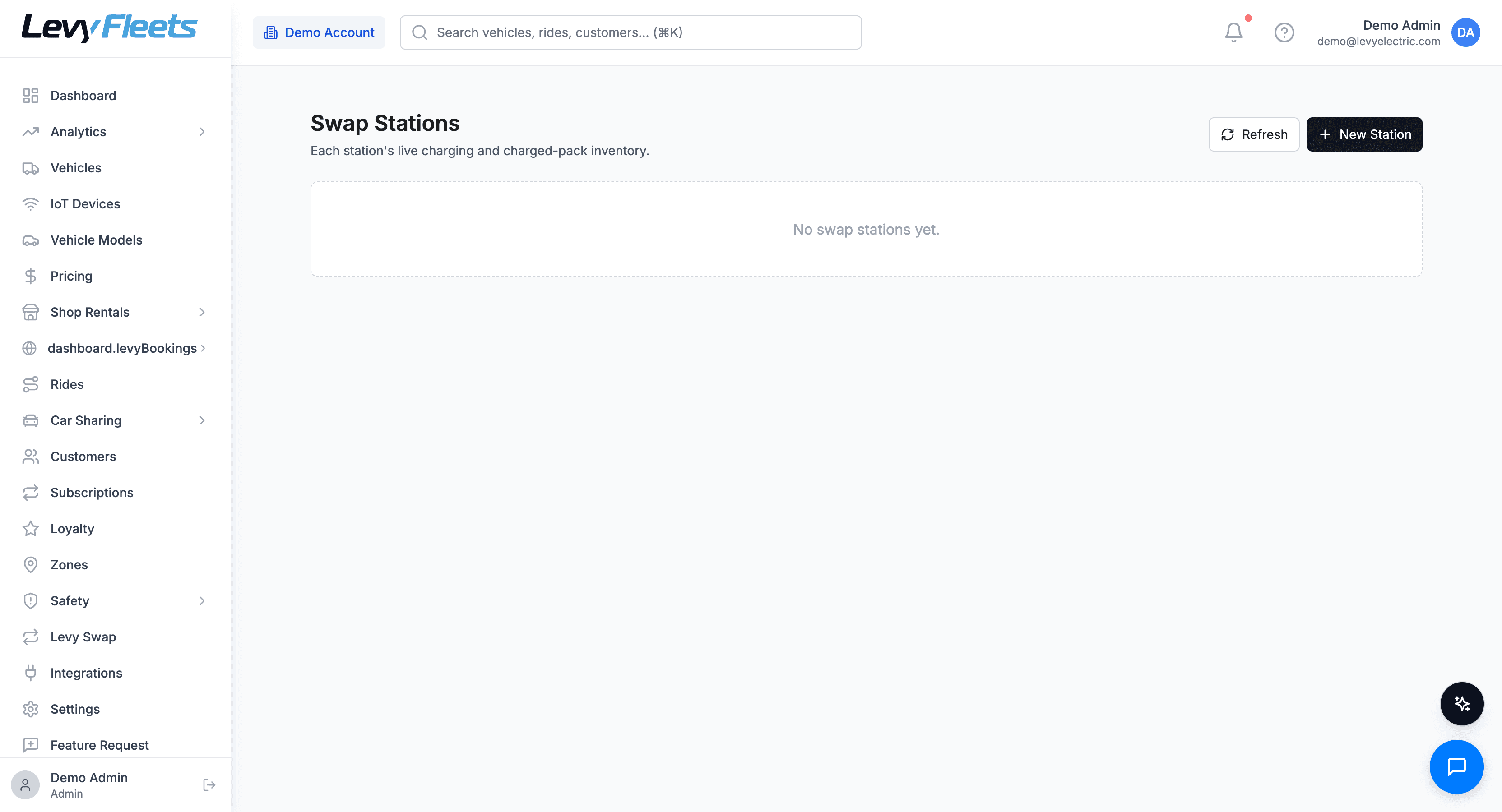
The Stations page rolls these up per location (for example "12 charged, 4 charging, 2 maintenance, 2 empty") so you can see which warehouse has fresh packs. This inventory view gives you the tools to see where charged packs actually are before you send a tech out. Two disciplines keep it healthy at scale:
Hold a target charged-pack ratio
Decide how many charged packs you need on the wall per deployed vehicle to cover peak-window swaps, then manage toward that ratio. Too few and swaps stall; too many and you have over-capitalized on spares that could have funded more vehicles.
Rotate by state of health, not just charge
State of health (SoH) tracks how much usable life a pack has left, for example cycle count and capacity fade. Use it to push aging packs into low-demand vehicles and retire them on schedule, rather than rotating a tired pack back into the high-mileage vehicle that wore it out.
When a pack shows a defect (a swollen cell, a damaged connector, a pack that will not hold a full charge), move the slot to maintenance so it leaves the install pool. Levy stocks common OKAI and similar parts in the US, including batteries, so replacements ship in days rather than weeks, and Levy files the OKAI 90-day warranty claim for manufacturing defects on your behalf. Track the work in Work Orders and Maintenance so every pack's cost is a real number.
Routing your juicers and chargers
Routing is where charging operations live or die, because route density is the lever that most moves cost per charge. There are two ways to staff the field, and Levy supports both.
In-house tech routing
Your full-time techs work the swap queue described above. To plan the day rather than react to it, Levy's AI Ops layer recommends joint battery-swap and rebalancing routes in the operator app, so a tech tops up low vehicles and repositions them toward demand on the same trip instead of making two passes. AI Ops produces demand forecasts and ROI-ranked recommendations only: it does not auto-dispatch or auto-execute moves, and its smallest time bucket is one hour, so treat it as a planning copilot that ranks the work while a human decides and drives the route.
The gig juicer and charger marketplace
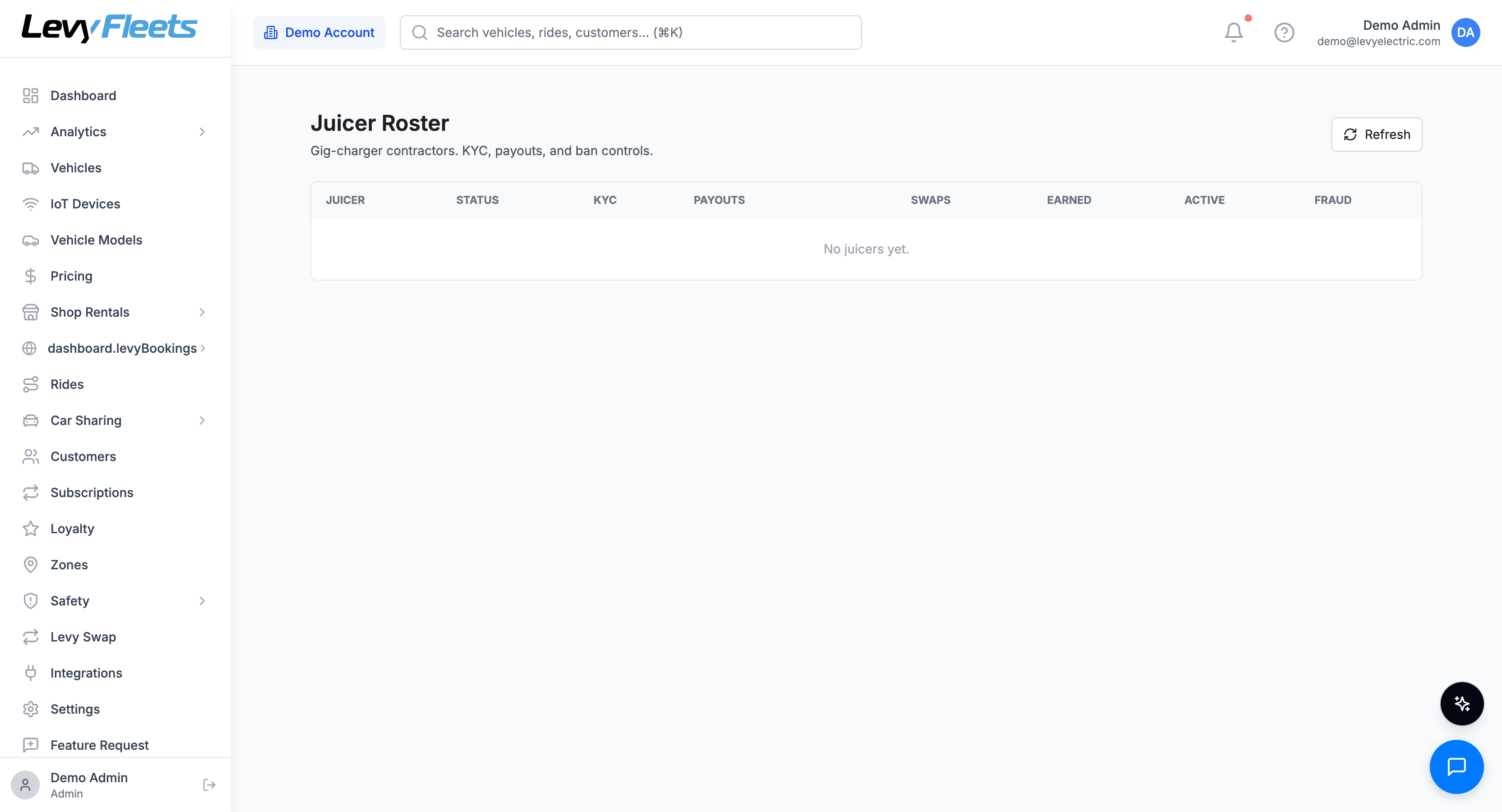
To convert fixed charging labor into a variable per-task cost, Levy Swap includes a gig marketplace: independent contractors (juicers or chargers, depending on the city) pick up low-battery vehicles, charge them, and drop them back inside your zones for a per-vehicle bounty you set. You pay per completed charge instead of carrying full-time-tech overhead. You set the bounty, and bounties can reprice based on demand to steer gig labor toward the vehicles that need charging first. Levy handles juicer payouts and runs fraud detection, and you keep roster control from the dashboard.
Do the groundwork before you enable the marketplace
Before you turn on the juicer marketplace, get the prerequisites in place: the legal, insurance, and safe-charging groundwork for gig charging labor in your market, plus a live swap station to charge from. Gig-worker rules vary by state and need legal review, so confirm the exact requirements in your operator agreement before you enable it. Read the battery swap and juicers help center end to end, and talk to your operator success contact first.
Designing charging ops that protect uptime
- Buy swappable-battery hardware if field swap is in your future. Retrofitting swap capability is rarely worth it. Levy is hardware-agnostic across 30+ IoT vendors, so you source the right swappable or dockable hardware and still run one platform.
- Right-size your battery inventory. Carry enough charged packs to cover peak-window swaps and no more. Idle spares are capital that is not earning.
- Charge by need, not by schedule. Use live battery telemetry to touch only the vehicles that are actually low. This cuts stops before it touches wages.
- Route by density. Cluster swaps and collections geographically, and lean on AI Ops swap-and-rebalance recommendations so one trip does two jobs.
- Rotate packs by SoH. Push aging packs to low-demand vehicles and retire them on schedule.
- Track cost per charge as a line item. Watch it move with route density and fleet size, and revisit your model before charging creep becomes your biggest controllable cost.
Frequently asked questions
Put your own numbers in
The right charging model protects uptime at the lowest labor cost in your market, and that is a math question, not a matter of taste. Build your cost per charge from your own energy rate, labor cost, and route density, compare the three models, and let the number pick.
Model your charging ops before you scale
Project your charging cost per ride alongside the rest of your unit economics in the Fleet Estimator, or book a demo to walk through Levy Swap, swap-station inventory, and juicer routing with the Levy team.