.svg)
A commuter fleet earns a steady drip of short trips five days a week. A tourism and events fleet earns in bursts: a summer weekend where every vehicle turns 8 to 12 times a day, a three-day festival that produces a month of normal revenue, then a quiet Tuesday in March where half your fleet sits. That spiky curve is a feature, not a bug, because tourists and event-goers pay full fare, ride for fun rather than utility, and rarely price-shop the way a commuter does. The whole game is capturing the peaks without drowning in the troughs. This lesson is the operator playbook: how to read seasonal demand, place vehicles where visitors actually see them, build a tour product, run event pop-ups, and price for the days when demand outruns supply. Levy runs your payments, support, and platform on a revenue-share model, so your fixed platform cost stays at the $250 monthly minimum through the slow months instead of scaling with a mostly-parked fleet, and you otherwise pay only when riders pay.
Planning guidance, not professional advice
This lesson covers fleet economics, pricing, and insurance at a planning level, not as financial, tax, legal, or insurance advice. The ride counts, utilization, and revenue figures here are illustrative industry planning ranges that vary by market, season, and how hard you run the fleet, so treat them as starting points, model your own in the Fleet Estimator, and consult a qualified professional before you commit capital, set your insurance coverage, or file taxes.
Why tourism and events pay better per ride
Anchor on the economics before you buy a vehicle. On Levy's Managed plan, Levy's fee is 20% quoted on GMV (dropping to 15% of GMV at 100 to 249 active vehicles on an annual or approved term), with $0 upfront and a $250 per month platform minimum credited against your fees. GMV is gross rider payments before taxes, government fees, refunds, and tips. Read the payout mechanics carefully rather than assuming a flat 80% of gross: your partner payout base is net revenue after Stripe processing (Levy's volume rate is 2.6% + $0.20 per transaction, below standard), those processing costs are shared proportionally between you and Levy, and your partner share defaults to 80% of that net. So plan on roughly 80% of net revenue after processing, and confirm the exact split in your agreement. There is no per-vehicle software charge on top, which is exactly what a seasonal business wants: in a slow month your platform cost floors at the $250 minimum instead of scaling with a fleet that is mostly parked.
Tourists and event riders lift the two numbers that matter most. Average revenue per ride runs higher, because a leisure rider takes a longer trip and does not flinch at a full-fare unlock. And utilization spikes hard on the right days, so a vehicle that turns 10 times on a Saturday subsidizes the ones that sit on a rainy Wednesday. Concentrate supply into the peak windows, price to match, and keep fixed costs low enough that the slow days do not eat the profit the peaks generated.
Model the peaks and the troughs, not the average
Seasonal demand hides inside an annual average. A fleet that averages 3 rides per vehicle per day might be doing 9 in July and 0.5 in January. Those figures are illustrative planning ranges, not guarantees: your market, season, and how hard you run the fleet will move them. Size your permanent fleet to the shoulder season and reposition extra vehicles into the true peaks, and run both a peak-month and a trough-month scenario in the Fleet Estimator before you commit capital.
Read the season before you buy vehicles
Every tourism market has a shape. A beach town peaks in summer and empties in winter, a ski valley inverts that, a convention city spikes on a calendar you can look up a year ahead, and a college town runs on the academic year. Map your market's demand curve month by month, then size your permanent fleet to the low-to-middle of that curve rather than the top, so you are not financing idle vehicles through the off-season.
Once you have the curve, run every decision through the same three-phase grid. The postures below are qualitative starting points, not numbers to lift verbatim, so map them onto your own market and model the dollars in the Fleet Estimator.
| Season phase | Demand signal | Fleet posture | Pricing posture | Crew posture |
|---|---|---|---|---|
| Peak (in-season weekends, event days) | Highest utilization, full-fare leisure riders | Reposition extra vehicles in and load the visitor funnels | Deliberate peak rates, day passes, tour bundles | Full crew staged to execute the moves AI Ops points to |
| Shoulder (early and late season, weekdays) | Moderate, mixed leisure and local | Permanent fleet sized to here | Standard rates with some packages | Baseline crew, routine battery swaps |
| Trough (off-season, weather-outs) | Low, mostly residual local demand | Park or store surplus, finance nothing heavily that sits idle | Off-season promotions and local subscriptions | Minimal crew, maintenance and prep |
Levy's AI Ops add-on helps here, honestly. Its demand forecasting predicts rides per area over 1, 4, or 24 hour horizons, conditioned on weather and events, which is exactly the volatility a tourism fleet lives with. It also produces ROI-ranked rebalancing recommendations (move N vehicles from one area to another by a certain time for a projected lift). Read that carefully: AI Ops forecasts and recommends. It does not auto-dispatch, does not auto-execute moves, and is not a real-time or surge-pricing engine (its smallest time bucket is one hour). You or your crew make the call and move the vehicles. For a seasonal operator, that forecast is a staging tool: it tells you which Saturday and which waterfront block to load up before the crowd arrives.
AI Ops is a forecast, not an autopilot
Do not plan as if vehicles reposition themselves. AI Ops surfaces where demand is headed and ranks which moves pay off, but a human executes every rebalance and battery swap. Staff your peak weekends assuming you do the moving, and use the forecast to point your crew, not replace it.
Place for visibility, not just density
In a commuter fleet you place vehicles where trips start. In a tourism fleet you place them where visitors can see them, because a tourist does not open your app to hunt for a scooter, they see one and decide to ride. Visibility is your cheapest marketing channel, so treat placement as a storefront decision. Levy's geofencing zones are the tool: configure service areas, parking zones, no-go areas, and speed-limit zones, plus out-of-zone parking rules and parking rewards.
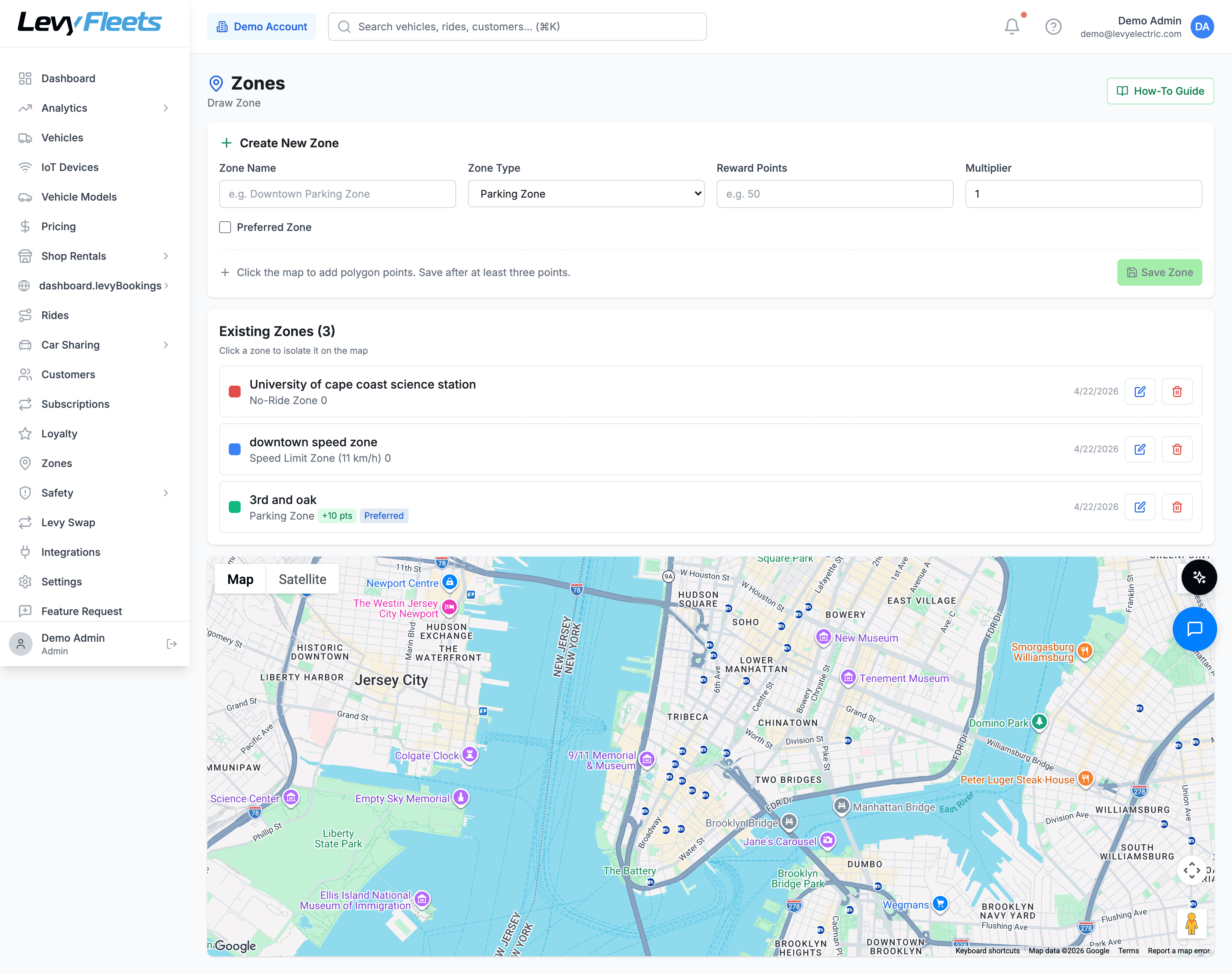
- Stage at the visitor funnels. Hotels, the waterfront promenade, the trailhead, the convention-center entrance, the boardwalk. Define tight parking zones at each so vehicles cluster visibly instead of scattering.
- Pull vehicles back with parking rewards. Riders strand vehicles at their destination. Parking rewards incentivize returns to your high-visibility corrals, so the storefront restocks itself overnight without a full rebalancing crew.
- Fence the crowd-sensitive spots. In a dense pedestrian district, a no-go area or a low speed-limit zone keeps you off the city's permit-revocation list. Tourist zones are exactly where one bad parking incident becomes a news story.
Levy Vision keeps those high-traffic zones clean and compliant, which is a permit issue in tourist districts, not a nicety. It runs three checks: helmet verification at unlock, parking-pose validation at ride end (is the vehicle upright, inside the parking zone, not blocking the sidewalk, and is the photo clear), and sidewalk detection with throttle-cut enforcement in pedestrian-heavy areas. Note the scope precisely: Levy Vision is a parking, helmet, and sidewalk compliance system, not a damage inspection or condition-report tool.
Build the tour product: guided and self-guided
Rentals and tours are two different products, and the tour carries a higher price and a booked-in-advance revenue stream that smooths your peaks. Levy gives you the booking machinery for both. The Booking Widget and point-of-sale toolkit is the core: an embeddable booking widget for your website, an iPad point-of-sale for a counter or kiosk, tour schedules, and B2B accounts. Advanced Bookings (Book Ahead) layers reserved inventory on top: model-level inventory reservations, named pickup locations, per-slot caps, vehicle assignments, and deposit payments, so a 10 AM waterfront tour can hold exactly 12 e-bikes with a deposit collected up front and no overbooking. For a walk-in counter, Shop Rentals covers the brick-and-mortar side: counter walk-ins, public bookings through the embed widget, waivers, gift cards, and damage logging. Waivers matter for first-timers on unfamiliar vehicles, and gift cards are a real revenue line in a tourist economy.
See the tourism scooter use case end to end
The tourism scooter solution page lays out how a visitor-focused rental and tour operation is positioned and how it plugs into the Levy booking, payments, and compliance stack.
Guided tours: sell the schedule, cap the group
Publish fixed departures (sunset waterfront, historic downtown, coastal loop) as tour schedules. Take reservations through the booking widget with a deposit via Advanced Bookings, cap each slot to a group a guide can manage, and assign specific vehicles. A guide, a set route, and a story command a premium a bare rental never will.
Self-guided tours: sell the route, let the app run it
Package a suggested loop at a flat time-boxed price, then let geofencing do the guiding: a service area keeps riders on the scenic route, speed-limit zones slow them through crowded spots, and no-go areas keep them out of trouble. The rider gets freedom, you get a higher-value booking than a raw per-minute rental.
B2B blocks: sell the whole group at once
Use B2B accounts to sell allotments to hotels, cruise excursion desks, event planners, and corporate retreats. One account books 30 riders for a Thursday, you hold the inventory with Advanced Bookings caps and deposits, and you fill a weekday trough with a single sale.
Run event pop-ups
An event is a fleet operator's best day: a concentrated crowd, a fixed window, and a captive audience. A festival, marathon, conference, or game day can produce a month of normal revenue in a weekend if you stage for it. Treat a pop-up as a temporary, tightly-scoped operation, not a permanent expansion.
Forecast and staff the window
Pull the event onto your calendar early. AI Ops demand forecasting is conditioned on events, so use it to project the volume and the exact hours the surge lands, then staff your crew and stage your vehicles to that forecast. The crew does the moving; the forecast just aims it.
Draw the temporary geofence and corrals
Stand up a service-area zone scoped to the venue, with speed-limit zones through the densest pedestrian stretches and no-go areas around stages, entrances, and emergency lanes. Use Advanced Bookings pickup locations and parking zones to build clear pickup and drop corrals at the gates and lots.
Pre-sell through the organizer
Set up the event organizer or venue as a B2B account and sell a ride allotment or sponsored-ride block before the gates open. A pre-sold block turns an uncertain pop-up into guaranteed revenue before you roll a single vehicle in.
Tear down and reconcile
When the event ends, collapse the temporary zones, pull the extra vehicles back to your permanent footprint, and read the numbers. Rides, revenue per vehicle, and disputes tell you whether to book the same event bigger next year or pass.
Zones are your event operating agreement
The fastest way to lose an event contract is a scooter in a fire lane or a rider tearing through a crowd. Speed-limit zones, no-go areas, and Levy Vision sidewalk detection with throttle-cut enforcement are how you show a venue or city you can run a safe pop-up. Bring your zone map to the organizer meeting as proof.
Price for peak demand
Tourism and event demand is the one context where you can price to the crowd without alienating a regular. A visitor riding for fun on a peak Saturday is not comparing your unlock fee to yesterday's. Levy supports dynamic pricing, subscriptions, packages, and promotions, and every piece has a tourism use.
- Dynamic pricing for the peak window. Configure higher rates for your true peak hours and days, when demand outruns supply. This is operator-configured pricing you set deliberately, not an automatic surge engine. AI Ops forecasts demand and recommends rebalances, but it does not set or auto-adjust your prices. You own the price sheet.
- Day passes and time-boxed packages. A leisure visitor wants to ride all afternoon, not watch a per-minute meter. A flat day pass or a 3-hour explorer package raises your average ticket and removes the anxiety that shortens leisure trips.
- Tour bundles and gift cards. Bundle a guided tour, sell a vacation-length pass, and lean on gift cards for a market where visitors buy experiences for others. All of it is booked revenue that lands before the ride.
- Deposits on reserved inventory. Advanced Bookings collects deposit payments on reserved tours and event blocks, which secures the booking and cuts no-shows on your highest-value slots.
- Off-season promotions. In the trough, flip the toolkit: run promotions and local subscriptions to pull residual demand from locals so the fleet is not fully idle between seasons.
Peak pricing is yours to set, deliberately
Levy's dynamic pricing is a control you configure, not a black box that surges on its own. AI Ops tells you a peak is coming and where to stage vehicles, but the price is your decision. Set peak rates ahead of the season, publish them, and keep them defensible: leisure riders tolerate a premium, but a chaotic, unexplained price still burns your reviews.
Protect the economics against a visitor rider base
A tourist rider base carries risks a local one does not: out-of-market and foreign cards, first-time riders on unfamiliar vehicles, and a higher baseline of chargebacks from people who will never ride with you again. The Managed plan is built to absorb exactly this. Levy runs managed payments, the rider wallet, disputes and chargebacks, and collections and dunning, so a disputed vacation charge is Levy's fight to win, not your weekend. Identity verification and fraud prevention (through SoCure, Experian, and Stripe Identity) screen the risky first-time signups a tourism funnel produces in volume. The managed stack lets you chase a high-churn visitor audience without personally eating every dispute it generates.
By vehicle type
The playbook flexes by what you put under the rider. Levy is hardware-agnostic across 30+ IoT vendors, so you source the right vehicle for the market rather than being locked to one.
The workhorse of dense tourist districts and boardwalks. Cheap to acquire, easy to place visibly at hotels and waterfronts, and ideal for short, spontaneous leisure trips. Lean on speed-limit zones and sidewalk detection to stay welcome in crowded pedestrian areas, and price with day passes for all-afternoon explorers.
Frequently asked questions
Put it together
A tourism and events fleet is a peak-capture business. You size to the shoulder season, place vehicles where visitors can see them, build a higher-value tour product on top of raw rentals, stage hard for the events on your calendar, and price the peaks deliberately while the managed stack absorbs the payment and fraud risk a visitor base brings. Levy gives you the booking, zoning, forecasting, payments, and compliance machinery to run all of it on a revenue-share model, so the slow months cost little beyond the $250 platform minimum and the peaks are pure upside. For the broader startup context, read our guide to starting an e-bike rental business, and see the tourism scooter solution for how a visitor-focused operation maps onto the platform.
Size your season before you commit
Want to see what a peak month and a trough month actually earn for your specific market and fleet plan? Run your numbers in the Fleet Estimator to project utilization, revenue per vehicle per day, and payout, or book a demo to walk through the tour and event booking tools with our team.