.svg)
Every rider you add has a price, and every rider you keep has a value. Growth is what happens when the value beats the price, ride after ride, at scale. On Levy Fleets that math is friendlier than it looks, because you run on a $0-upfront, revenue-share model where you pay when riders pay. There is no large fixed software license eating into your acquisition budget (a $250 per month platform minimum applies, credited against your revenue-share fees), so most of the money you would have spent on software can go straight into filling seats and handlebars. This lesson shows you how to acquire riders on purpose: how to think in cost-per-acquisition (CPA) instead of gut feel, how to design first-ride incentives that convert without bleeding margin, how to build a referral loop that compounds, and how to decide whether the next dollar belongs in paid ads or in an organic loop you already own.
Planning guidance, not financial advice
The fares, CPA figures, contribution math, and payback ranges in this lesson are illustrative planning tools, not projections of your results. Every number depends on your market, pricing, season, and local costs. Model your own inputs in the Fleet Estimator and consult a qualified financial or accounting professional before you commit an acquisition budget.
Know your CPA before you spend a dollar
Cost-per-acquisition is the total money you spend to turn a stranger into an activated rider, divided by the number of activated riders you get. Two words in that sentence do the heavy lifting.
"Activated" is the first. An app install is not a customer. A rider who completes a first paid ride is. Count activations, not downloads, or you will celebrate a cheap campaign that filled your app with people who never unlocked a vehicle. Levy's rider apps and operator dashboard let you see the funnel end to end, from install to first ride to repeat, so anchor your CPA on the step that actually earns money.
"Total" is the second. Your acquisition spend is not just ad budget. It is the ad spend plus the incentive you gave away plus the processing cost of that first ride. Stripe is included on every Levy plan at volume pricing of 2.6% plus $0.20 per transaction, and on a heavily discounted first ride that fixed $0.20 can be most of the fare. Fold it in.
The formula is simple. The discipline is counting honestly.
CPA = (ad spend + incentives paid + processing on incentive rides) / activated riders
Tie CPA to value with payback period
A CPA number means nothing on its own. It only makes sense next to what a rider is worth to you. The cleanest way to connect the two is payback period: how many months of a rider's contribution it takes to earn back what you paid to acquire them.
Start with your contribution per ride. Take the net fare after processing, then apply your partner share. On the Managed plan, Levy's fee is 20% of GMV under 100 active vehicles (15% at 100 to 249 active vehicles on annual or approved terms), and your partner share defaults to 80%, so you keep roughly four-fifths of net revenue on each ride before your own local costs. Here is an illustrative walk, using round numbers you should replace with your own:
| Line | Illustrative value |
|---|---|
| Average gross fare | $4.10 |
| Stripe processing (2.6% + $0.20) | about $0.31 |
| Net fare after processing | about $3.79 |
| Your 80% partner share | about $3.03 |
| Rides per new rider per month | 4 |
| Monthly contribution per rider (before local ops) | about $12.12 |
Treat that last row as a deliberately conservative estimate, not your profit. It subtracts the full Stripe fee from your side (in practice processing is shared proportionally between you and Levy, so your real processing cost is a little lower), and it stops at contribution, before your local costs like insurance, permits, storage, rebalancing, taxes, and marketing. The gross fare and the four-rides-a-month assumption are planning placeholders that vary widely by market and season, so replace them with your own and model the result in the Fleet Estimator.
Now compare that to two acquisition paths. If a paid campaign costs you $30 per activated rider, payback is roughly 2.5 months of riding before you clear even. If a referral costs you $6 in credit per activated rider, you are paid back inside the first month. Same rider, very different economics, and that gap is the whole reason the back half of this lesson exists.
Set a CPA ceiling, then hold campaigns to it
Pick a payback period you can live with (many small fleets aim for 3 months or less), work backward to a maximum CPA, and kill any channel that runs above it for two weeks straight. A channel that cannot clear your ceiling is not "still warming up." It is a leak.
Ground your CPA in real unit economics
The profitability guide breaks down the per-ride and per-vehicle numbers behind fleet breakeven, so the contribution figure you plug into payback is yours, not a guess.
First-ride incentives that convert without bleeding margin
The first ride is the hardest ride. A new rider has to download an app, verify identity, add a card, find a vehicle, and trust that the thing will unlock. An incentive exists to pay down that friction, not to buy a rider a habit. Keep it targeted at the first ride and let the product earn the second.
You have real levers here, all built into Levy's pricing and promotions tooling:
- Free unlock or a discounted first ride. Drop the unlock fee to $0 or knock a fixed amount off the first trip. This removes the exact cost a first-time rider notices before they have ridden a block. Because Levy's fee is a percentage of GMV, a discounted first ride generates less GMV and therefore a proportionally smaller platform fee, so Levy effectively shares the cost of the promo with you rather than charging full freight on a ride you gave away.
- Ride credit toward a wallet balance. A small credit that lands in the rider wallet nudges a second ride, because people spend a balance they already hold. Managed payments and the rider wallet are standard on the platform.
- First-ride passes and packages. For commuter-heavy markets, a discounted intro pass can convert a curious rider straight into a repeat one. Passes, subscriptions, and packages are all supported.
The trap with any incentive is abuse: throwaway accounts farming free rides. Levy includes identity verification and fraud prevention on every plan (SoCure and Experian, plus Stripe Identity), which raises the cost of creating fake accounts and protects your promo budget. Still, cap the exposure yourself.
Cap the downside on every promo
Scope first-ride offers to genuinely new riders, put an expiry on the credit, and cap the discount so a promo cannot cover an expensive long trip end to end. An uncapped "free first ride" on a moped can cost you many times what it costs on a two-minute scooter hop. Set the ceiling before you launch, not after you read the invoice.
Build a referral loop that compounds
Paid ads stop the moment you stop paying. A referral loop keeps running, because every rider you acquire can bring the next one. That is why referral is usually the cheapest durable channel a fleet has, and it is built into Levy's Loyalty product, which covers points, tiers, rewards, and referral programs.
The mechanic that works is two-sided: reward the referrer and the new rider, and only pay out when the new rider completes a real first ride. That single rule (pay on activation, not on invite) is what keeps a referral program from turning into a free-money faucet.
Pick a two-sided reward
Give both people something small and concrete, for example ride credit or a free unlock on each side. Keep it symmetric so the ask feels fair when a rider forwards their code.
Pay only on activation
Release the reward when the referred rider finishes a first paid ride, not when they install or enter a code. This ties your spend directly to activated riders, which is the number your CPA is built on.
Make the code impossible to miss
Surface the referral prompt right after a good ride, when satisfaction is highest, and again in lifecycle messages. The best time to ask for a referral is the moment a rider just had a smooth trip.
Guard against self-referral
Lean on the included identity and fraud tooling, cap referrals per account, and require a completed paid ride before any reward unlocks.
The number to watch is your referral coefficient: the average number of new activated riders each existing rider brings. Multiply how many riders share their code by how many of those invites convert to a first ride. If that product creeps toward and past 1, the loop becomes self-sustaining and every cohort seeds the next. Most fleets will not hit 1 from referral alone, and that is fine. Even a coefficient of 0.2 means every five riders hand you a sixth for a few dollars in credit, which is far below any paid CPA you will find.
Set up referrals, points, and tiers
The Loyalty help center walks through referral programs, points, reward tiers, and free unlocks so you can stand up a two-sided loop and reward repeat riders.
Referral is not your only organic loop. Two more are worth wiring in:
- Parking rewards. Levy's zones tooling supports parking rewards, so you can credit riders for ending trips in the spots you want filled. That doubles as an operations tool, because it pulls vehicles back to high-demand curbs and cuts your rebalancing cost while it rewards good behavior.
- Rider Score perks. The Rider Score system includes reward tiers and a helmet-selfie discount. Tying small perks to safe riding gives your best riders a reason to keep riding and to talk about the fleet.
In-app promos and lifecycle messaging
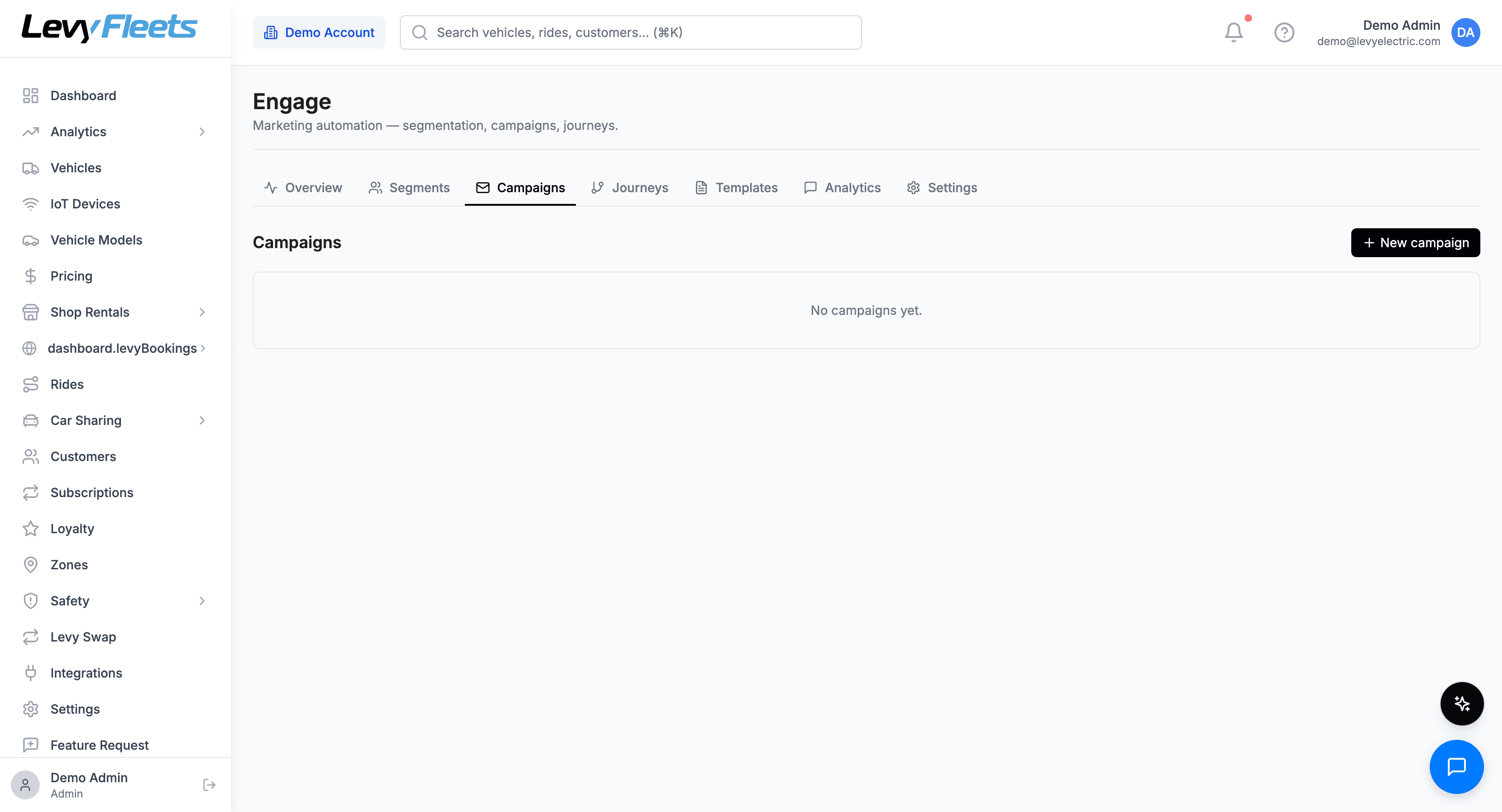
Acquisition does not end at the first ride. A rider who never comes back cost you the same CPA as one who rides daily, so the cheapest growth you will ever buy is turning riders you already paid for into repeat riders. That is what Marketing Automation is for: audience segments, drip campaigns, A/B testing, and lifecycle messaging, across email, SMS, and push. Email goes out through Postmark, SMS through Telnyx with Twilio failover, and push through Expo with APNs and FCM, all included so the incremental cost of an owned-channel message is close to zero.
Build a few lifecycle plays and let them run:
- Welcome and second-ride nudge. A short drip after the first ride, with a small time-boxed credit, to convert a one-time trial into a habit while the memory is fresh.
- Winback for lapsed riders. Segment riders who have not ridden in, say, 30 days, and send a targeted offer. These riders are already verified and carded, so reactivating them is far cheaper than acquiring someone new.
- Weather and event pushes. A well-timed push before a sunny weekend or a local event lifts rides from riders you already have. AI Ops can help you see where demand is heading, since it forecasts rides per zone over 1, 4, or 24 hour horizons and ranks rebalancing recommendations, so you can point your messaging and your vehicles at the same rising demand. AI Ops recommends and forecasts, it does not auto-execute moves and it is not surge pricing, so you stay in control of every send and every price.
Test the offer, not just the subject line
Marketing Automation includes A/B testing. Use it on the thing that actually moves money, which is the offer and the segment, not only the headline. A $2 credit to lapsed 30-day riders and a $2 credit to active daily riders are two completely different campaigns wearing the same words.
Build segments, drips, and lifecycle campaigns
The Marketing Automation help center covers audience segments, drip and journey builders, A/B testing, and the email, SMS, and push channels included on every plan.
Paid versus organic: where the next dollar goes
Paid and organic are not rivals. They do different jobs, and a healthy fleet runs both. Paid buys you speed and reach when you need riders now, for example at launch or when you deploy into a new zone. Organic buys you durable, low-CPA growth that keeps compounding after the spend stops. Google Ads and Facebook are included on every plan for the paid side, and your referral, loyalty, parking-reward, and lifecycle loops carry the organic side.
Use this to decide where the next dollar goes:
| Consideration | Paid (Google Ads, Facebook) | Organic (referral, loyalty, lifecycle) |
|---|---|---|
| Speed to riders | Fast, riders in days | Slow to start, compounds over months |
| Typical CPA | Higher, and it resets each campaign | Lower, and it falls as the loop matures |
| Best used for | Launches, new zones, seasonal pushes | Steady baseline growth and retention |
| What happens when you stop | Riders stop arriving | Loop keeps running on its own |
| Control | Precise targeting and budget caps | Depends on rider satisfaction and reward design |
The practical sequence for a new market: spend paid to seed the first cohort quickly, then shift budget into referral and lifecycle as that cohort starts referring, so your blended CPA falls month over month. Watch the blended number, not any single channel in isolation. A paid campaign that looks expensive on its own can be worth it if it feeds a referral loop that pays you back in free riders later.
By vehicle type
The acquisition motion shifts with what you operate, because trip length, fare, and rider intent are different.
Short, frequent, impulse trips. A $0 unlock first ride removes the exact friction that stops a curious first-timer, and high ride frequency means referral and lifecycle loops fire often. Keep incentives small and cap them tight, because the fares are small too.
Frequently asked questions
The one habit that keeps growth profitable
Acquisition is not a launch task you finish. It is a loop you tune. Count activated riders, not installs. Fold incentives and processing into CPA, not just ad spend. Tie every CPA to a payback period, and hold each channel to a ceiling you set on purpose. Start paid to move fast, then let referral, loyalty, and lifecycle carry the baseline so your blended CPA falls as the fleet matures. Do that, and growth stops being a bet and starts being a system.
Model your growth on real numbers
Use the estimator to see how rides, fares, and your revenue share translate into monthly payout, so you can set a CPA ceiling you can actually fund.