.svg)
You already paid to acquire every rider in your app. The question that decides your margin is whether they come back. A rider who takes one trip and disappears cost you the full acquisition price for a single fare. A rider who takes several trips a month for a year pays that acquisition cost back many times over and starts referring the next cohort for free. Retention is where a fleet stops leaking and starts compounding, and on Levy Fleets it costs you almost nothing extra to run, because the entire loyalty, rewards, and safe-rider stack is included on every plan under the same $0-upfront, revenue-share model where you pay when riders pay. This lesson covers the five levers that encourage riders to come back: loyalty tiers that reward frequency, ride passes that lock in habit, achievements and challenges that pull riders back on purpose, referrals, and a behavior-based rider score that turns safety into a retention lever.
Illustrative numbers, not financial advice
The fares, ride counts, revenue-share, and contribution figures in this lesson are planning examples to show the mechanics, not financial, tax, or accounting advice. Your real numbers depend on your market, pricing, fleet costs, and terms, and Managed pricing carries a $250 per month platform minimum credited against your fees. Model your own figures in the Fleet Estimator and confirm anything material with a qualified professional.
Retention is the cheapest growth you will ever buy
Every dollar you spend acquiring a rider is spent once. Every dollar of retention keeps paying, because a retained rider takes more trips without you paying a second acquisition cost.
Start with what a rider is worth. On the Managed plan, Levy's fee is 20% of GMV under 100 active vehicles (15% of GMV at 100 to 249 active vehicles on an annual or approved term), and your partner share defaults to 80%, so you keep roughly four-fifths of net revenue on each ride after Stripe's 2.6% plus $0.20 per transaction comes out. There is no per-vehicle software license eating into that (Managed is pure revenue share, subject to a $250 per month platform minimum that is credited against your fees), so the difference between a one-ride rider and a habit rider drops almost entirely to your bottom line.
Here is an illustrative walk with placeholder numbers. Real fares, ride counts, and processing costs vary by market, season, and how hard you run the fleet, so replace the round numbers with your own.
| Line | One-time rider | Retained rider |
|---|---|---|
| Rides in the first year | 1 | 60 |
| Average gross fare | $4.10 | $4.10 |
| Stripe processing (2.6% + $0.20) | about $0.31 | about $0.31 |
| Net fare after processing | about $3.79 | about $3.79 |
| Your 80% partner share per ride | about $3.03 | about $3.03 |
| First-year contribution (before local ops) | about $3.03 | about $182 |
Same acquisition cost, same fare, and a 60x difference in contribution. Note that this is a vehicle-level contribution before your local operating costs (insurance, permits, storage, marketing, taxes, theft reserve, and overhead), not profit. That gap is the reason retention deserves a real strategy and not just a "be nice to riders" hope. If you want to pressure-test the per-ride and per-vehicle numbers you plug in here, our breakdown of scooter rental profitability walks the full contribution math, and the Fleet Estimator lets you model your own fares, ride counts, and revenue share so the figures are yours, not a guess.
Watch three retention numbers, not vanity totals
Total riders only goes up, so it tells you nothing. These three move with the health of your fleet:
- Repeat rate. The share of first-ride riders who take a second paid ride. This is your most important early signal, because a rider who never takes a second ride is unlikely to come back later.
- Rides per active rider per month. Frequency is where retained value actually accrues. A loyalty program's job is to nudge this number up one ride at a time.
- Monthly rider churn. The share of active riders who go quiet in a month. A retention program that works shows up here first, as a falling churn rate, before it shows up in revenue.
Instrument the second ride before anything else
The biggest retention cliff is between ride one and ride two. Track your repeat rate weekly in the operator dashboard, and treat every tactic in this lesson as a machine for lifting that one number. If your second-ride rate is climbing, everything downstream compounds.
Loyalty tiers: reward frequency, not just history
Levy's Loyalty product covers points, tiers, rewards, and referral programs, and it is included on every plan. Tiers are the backbone. They give your most frequent riders a visible status and a concrete per-ride reason to keep choosing you over a competitor parked on the same corner.
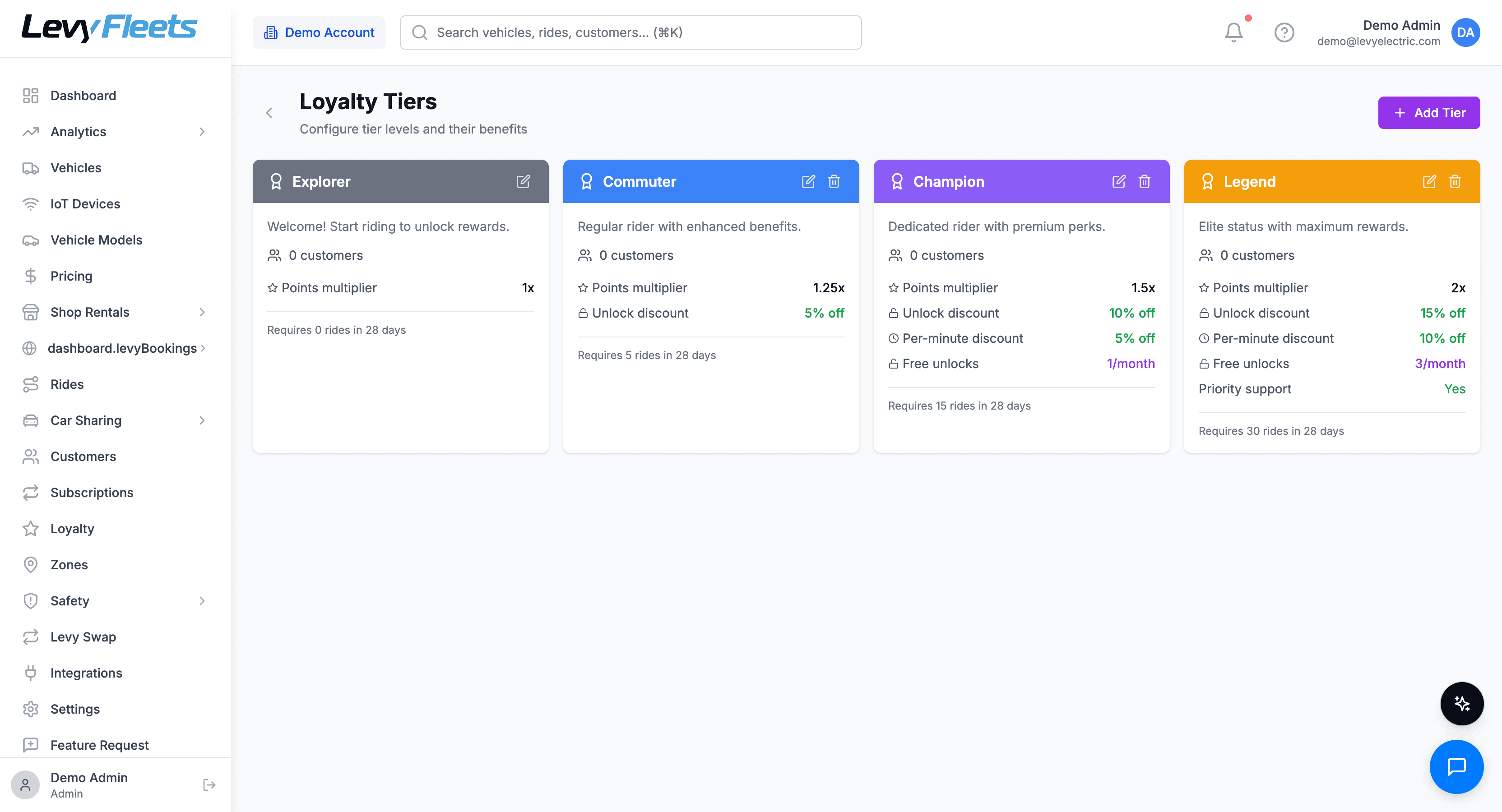
The important design detail: you can build tiers around recent frequency rather than a lifetime-points total. Set them so riders qualify by completing a minimum number of rides inside a rolling window you choose (the window length is configurable), with status that reflects recent riding and slides back down if a rider's recent activity drops. That rewards riders who are active now, the behavior you want to protect, instead of handing permanent status to someone who rode heavily a year ago and has since gone quiet.
There are no tiers out of the box. You define your own. A clean starting structure for a scooter fleet looks like this:
| Tier | Min rides in the window | Example benefit |
|---|---|---|
| Bronze (base) | 0 | Standard pricing, everyone starts here |
| Silver | 5 | 1 free unlock |
| Gold | 15 | 2 free unlocks, small per-ride discount |
| Platinum | 30 | 4 free unlocks, larger per-ride discount, priority access |
Free unlocks are the highest-leverage tier benefit, because the unlock fee is the exact cost a rider feels at the start of every trip. Each tier can grant a configurable number of free unlocks on a cadence you set, and the platform applies them automatically at ride start, so the rider just sees a $0 unlock fee. That is a reward the rider notices every time they ride, which is precisely when you want them thinking well of you.
Turn on points first, then layer tiers
Enable the points program so riders start earning on every ride, redeemable as wallet credit. Points alone give you a working loyalty loop while you design the rest.
Define three or four tiers, not ten
Keep the ladder short and legible. A rider should be able to hold it in their head: how many rides to the next tier, and what they get when they arrive.
Put free unlocks on the middle and top tiers
Free unlocks are felt at the moment of purchase, so they pull frequency hard. Scale the count up with the tier so climbing feels worth it.
Match the qualification window to your ride rhythm
A shorter window suits a commuter-heavy fleet. If your riders are seasonal or recreational, widen the window so a good rider does not lose status over a slow week.
Configure points, tiers, and free unlocks
The Loyalty help center walks through the points program, the rides-in-a-window tier model, per-tier free unlocks, and referral setup so you can stand up the full program from the dashboard.
Ride passes and subscriptions: buy the habit up front
Loyalty tiers reward frequency after it happens. Ride passes manufacture it. Levy's pricing tooling supports subscriptions, packages, and promotions, and a prepaid pass is one of the most reliable retention instruments you have: a rider who has already paid for rides has a standing reason to keep riding until the balance is used.
Two mechanics do most of the work:
- Ride passes and packages. A bundle of rides or unlocks sold at a modest discount to face value. The rider pre-commits, and every trip against that balance is a trip they are not taking on a competitor. Packages work well for predictable, repeat trips.
- Subscriptions. A recurring pass (for example a monthly commuter plan that waives unlock fees) turns an occasional rider into a fixed line in your monthly revenue. Subscriptions are built to encourage repeat use, because canceling is a deliberate act while riding is the default.
Because Levy's fee is a percentage of GMV, a discounted pass produces proportionally less platform fee, so Levy shares the cost of the discount rather than charging full freight on a bundle you sold at a markdown. Price the discount to protect margin, cap what a single pass can cover, and let the prepaid balance do the retention work.
Short, frequent, impulse trips. Sell an unlock pass (a bundle of waived unlock fees) rather than a distance pass, because the unlock fee is the friction riders feel on every short hop. Keep the bundle small so a lapsed pass does not feel like a big loss the rider resents.
Achievements and challenges: pull riders back on purpose
Tiers and passes reward riding. Achievements and challenges make riding a game, and a game is a reason to open the app when a rider otherwise would not. Both are part of the Loyalty product and award points on top of any other benefit.
They do different jobs:
| Achievements | Challenges | |
|---|---|---|
| Duration | Permanent milestone badges | Time-limited, scheduled start and end |
| Participation | Automatic when the condition is met | Opt-in, the rider joins |
| Progress | Cumulative lifetime (first ride, 100 rides, 100 km) | Resets per challenge |
| Best for | Long-term collection and identity | Urgency, filling specific gaps |
Achievements are your long game. A "100 rides" badge with a points bonus gives a rider a reason to keep a running count and to feel recognized when they hit it. They cost you only the points you attach and run themselves once configured.
Challenges are your steering wheel. Because they are time-limited and opt-in, you can point them at exactly the behavior your fleet needs this week: weekend rides to fill a slow Saturday, off-peak rides to smooth a demand trough, or trips that end in a preferred parking zone to pull vehicles back where you want them. That last one doubles as an operations tool: you can aim a challenge at pulling vehicles back toward the zones you want them in.
Aim challenges at your demand troughs, not your peaks
You do not need to bribe riders when demand is already high. Use challenges to lift the valleys. AI Ops forecasts rides per zone over 1, 4, or 24 hour horizons, so you can see where demand is soft and schedule a challenge into that gap. AI Ops recommends and forecasts, it does not auto-execute moves and it is not surge pricing, so the timing call and the reward stay yours.
Referrals: turn a retained rider into your next acquisition
Retention and acquisition meet at the referral. A happy, retained rider is your cheapest acquisition channel, and referrals are built into the same Loyalty product. The mechanic that works is two-sided and paid on activation: every rider has an auto-generated referral code, a new rider enters it and completes a first paid ride, and only then does wallet credit land for both sides. Paying on a completed ride rather than on an install is what keeps a referral program from becoming a free-money faucet.
Keep the reward symmetric, surface the prompt right after a smooth ride when satisfaction peaks, and use Levy's included identity verification and fraud prevention (SoCure and Experian, plus Stripe Identity) as a guard against self-referral. Referral is covered in depth in the customer acquisition lesson, so treat it here as the bridge: your retention work fills the top of this loop, and the loop hands you new riders for a few dollars in credit apiece.
Safe-rider rewards: turn safety into a retention lever
An under-used retention tool in micromobility is safety, and Levy ships it as a behavior-based rider score. Once you enable it, it scores every completed trip from 0 to 100 using signals you already collect (speed compliance, parking compliance, clean ride ends, helmet verification, and violations), then rolls those trip scores into a profile that weights recent rides more heavily.
That score drives rewards and interventions at the same time, which is what makes it a retention lever and not just a compliance tool:
- On the reward side, you can sort riders into score-based tiers and grant tier-appropriate perks, for example wallet credits, per-ride discounts, and priority access for your highest-scoring riders. A rider who knows that riding well earns a cheaper, better experience has a concrete reason to keep choosing you.
- On the intervention side, it walks a graduated ladder when a score drops, starting with a soft in-app nudge and escalating only if behavior does not improve. That gives you a configurable, automatic way to respond to riders whose behavior slips, without watching every trip by hand.
- The helmet-selfie discount ties it together at unlock. A rider verifies their helmet with a live selfie, gets a discount off the unlock fee, and that same verification feeds the safety score. You put a reward on the exact behavior you want to encourage, and the rider feels it as a saving.
The score also gives you a rider-behavior record you can use for city permit reporting and safe-ride metrics worth discussing with your insurance broker, so one feature touches retention, safety, and compliance at once.
Turn on the behavior-based rider score
The Rider Score help center covers the scoring formula, reward tiers, the intervention ladder, the helmet-selfie discount, and the reaction-time safe-ride check, all configurable from the dashboard.
Put the retention stack together
None of these tools works best alone. Run them as one cadence:
- Points on from day one, so every ride earns something redeemable.
- A short tier ladder with free unlocks on the middle and top tiers to reward frequency.
- A pass or subscription offered after a rider's second or third ride, to convert habit into a prepaid commitment.
- A standing achievement set plus a rotating challenge aimed at your current soft spot in demand.
- Referrals surfaced after good rides, paid only on a referred first ride.
- The rider score rewarding your highest-scoring riders and giving you a graduated way to respond when a rider's score drops.
Each piece lifts a different part of the funnel, and together they help turn a first-time rider into a repeat rider, and a repeat rider into an advocate, with no new fixed cost.
Frequently asked questions
The retention habit that keeps a fleet compounding
Acquisition fills the top of the funnel. Retention keeps it from draining out the bottom. Run the cadence above, and you give the rider you paid to acquire once more reasons to keep coming back, while your best riders can become the channel that brings you the next cohort. Retention stops being luck and becomes a system, and because Levy runs the whole stack at $0 upfront, the tools to build that system are already in your hands.
See how repeat rides change your payout
Use the estimator to model how rides per rider and your revenue share translate into monthly payout, so you can size the retention lift that actually moves your bottom line.