.svg)
Your first market taught you the business. Your second market tells you whether you built a business or a job. The good news for the money math: adding a market on Levy Fleets costs $0 in upfront software, because the model is revenue-share and you pay when riders pay. The $250 per month platform minimum is charged per operator, not per market, so a second city adds variable cost against real revenue, not another fixed overhead line. That means expansion is rarely blocked by capital. It is blocked by repeatability. If launching market two takes the same 200 hours of your personal attention that market one did, you cannot get to ten. This lesson is about converting the things you did by hand the first time into playbooks, SOPs, and metrics that let a market run without you, and about reading the numbers that tell you when to double down on a market and when to pull out.
Model your own numbers, and get professional advice
The unit economics, contribution-margin math, expansion thresholds, and pricing in this lesson are planning frameworks, not guarantees. Real rides per vehicle, costs, and payouts vary by market, season, and how hard you run the fleet, so treat every figure as an estimate to test against your own city in the Fleet Estimator. Confirm the tax, insurance, and legal implications of a multi-market structure with a qualified professional before you commit capital.
What actually changes when you add a market
One market is an operation. Three or more is a system. The jump breaks three things first, and every decision below is aimed at one of them.
- Repeatability. The first launch lived in your head: which vehicles to source, how to draw the zones, which permit office to call, how to seed demand. None of that is written down, so market two costs almost as much effort as market one. Scaling means externalizing that knowledge into a launch playbook anyone can run.
- Proximity. You were physically present for market one. You charged vehicles, chased down a stranded scooter, and answered the 9pm rider call yourself. You cannot be in three cities at once, so you have to decide, deliberately, what must be done by hands on the ground and what can be centralized or handled remotely.
- Span of control. One person can hold a single market's daily rhythm in their head. Nobody holds five. You need a fixed set of numbers, reviewed on a schedule, that surface a failing market before it quietly drains cash.
The economics get better as you grow, which is the reason to push through the awkward middle. Levy's Managed revenue share is 20% of GMV (gross rider payments before taxes, government fees, refunds, and tips) under 100 active vehicles and drops to 15% of GMV at 100 to 249 active vehicles on an annual or approved term. Your active vehicle count is summed across every market, so a portfolio of three cities can cross into the lower tier that no single city would reach alone. Multi-market operations with custom SLAs is one of the explicit triggers for Levy's Enterprise plan, so once you are running several cities you are in the conversation for blended, custom structures.
Before you commit to a second market, be honest about whether the first one clears its bar. The whole business turns on utilization: rides per vehicle per day is what decides whether a fleet makes money, and the unit economics of a scooter fleet do not improve just because you add a second flag on the map. Expanding on top of a weak market multiplies a loss. Expanding on top of a proven one compounds a win.
Build the playbook before the second market
A playbook is not documentation for its own sake. It is the asset that lets you hand a launch to someone else and get a predictable result. Build two: one for standing a market up, one for running it day to day.
The launch playbook
Write down every decision and task that turned market one from an idea into live rides, in order, with the owner and the artifact for each step. Your launch playbook should cover market selection and sizing, permits and city compliance, vehicle sourcing and staging, zone configuration, pricing setup, demand seeding, and the go-live checklist. The point is that by market three, launching is a checklist a market lead executes, not a project you personally run.
Levy carries the heavy, repeatable parts of this so your playbook is mostly local logistics. Vehicle sourcing is hardware-agnostic across 30+ IoT vendors and a catalog of 150+ fleet-ready electric vehicles, so you spec the right mix for each city (scooters for dense downtowns, e-bikes for longer commuter grids, mopeds or low-speed vehicles for spread-out sites) without renegotiating a hardware relationship every time. US spare-parts stock for common parts (tires and tubes, brake cables and pads, display panels, batteries, fenders, throttle assemblies) ships in days, not the weeks a direct manufacturer order takes, which matters far more when you are not physically standing next to the fleet.
The daily operations SOP
The second document is the one your field team follows every day: battery swap thresholds, rebalancing rules, the response window for a stranded or offline vehicle, the parking-appeal review cadence, and the maintenance intake process. Levy's operator app and operator dashboard are where this SOP lives in practice, and Work Orders and Maintenance gives you task management, technician dispatch, parts tracking, and vendor invoicing so a repair follows the same path in every city.
Write the SOP from your own last 30 days
The fastest way to write a real operations SOP is to log what you actually did for two to four weeks in your current market, then turn each recurring action into a rule with a trigger and an owner. You are not inventing a process, you are documenting the one that already works, so it survives being handed to someone else.
Decide what runs remote and what must be local
The core scaling question is which work needs hands in the city and which can be centralized. Get this split right and one small central team can support many markets. Get it wrong and you hire a full local crew per city and the margins collapse.
Start from a hard rule: anything that physically touches a vehicle is local, and almost everything else can be remote. Levy's Managed plan is what makes the remote half real, because Levy runs support, payments, disputes, and collections, with 24/7 managed support behind the rider experience. That is the difference between needing a person awake in every timezone and running a lean central function.
| Function | Remote or central | Local (in market) |
|---|---|---|
| Rider support, 24/7 | Central (Levy Managed) | No |
| Payments, disputes, collections | Central (Levy Managed) | No |
| Marketing, promotions, lifecycle | Central | Local activation only |
| Analytics and daily metric review | Central | No |
| Demand forecasting and rebalance planning | Central (AI Ops recommendations) | No |
| Zone and pricing configuration | Central | Reviewed with local input |
| City permits and compliance filings | Central, per city | Local relationships |
| Battery swaps and charging | No | Local (or gig Juicers) |
| Rebalancing (moving vehicles) | Planned centrally | Executed locally |
| Repairs and maintenance | Dispatched centrally | Local technicians |
| Deployment and vehicle recovery | No | Local |
Two Levy capabilities let you shrink the local footprint further. AI Ops produces demand forecasting (predicted rides per zone over 1, 4, or 24 hour horizons, conditioned on weather and events) and ROI-ranked rebalance recommendations of the form "move N vehicles from zone A to zone B by time T, projected lift $X." Plan the moves centrally from those recommendations, then hand the route to a local hand. Note the boundary clearly: AI Ops recommends and forecasts, it does not auto-dispatch or execute moves for you, and it is not dynamic or surge pricing. A person still decides and a person still drives.
The other lever is charging. The Battery Swap product includes a gig Juicer and Charger marketplace with bounties and payouts, so in a new market you can crowdsource overnight charging instead of hiring a full charging crew on day one, and enter the city light.
What must stay local differs by vehicle type, which changes how many people and how much space each market needs.
Highest touch per vehicle. Frequent battery swaps and rebalancing dominate the local workload, so the swap-and-rebalance rhythm is your main SOP. This is the strongest fit for gig Juicers to cover charging, keeping your fixed local headcount low while ride volume ramps.
Standardize the launch into a repeatable sequence
Once the playbook exists, a launch becomes a sequence anyone can run. This is the shape of a standardized market launch on Levy.
Validate the market and size the deployment
Confirm there is real repeat demand, not a hunch. Pick a dense pilot zone rather than the whole city, and right-size the initial fleet to the trips you can prove. Under-deploying and adding vehicles beats over-buying and stranding them.
Clear compliance before vehicles arrive
Handle permits and city requirements up front. Levy's City Compliance tooling supports MDS 2.0 provider feeds, GBFS 3.0 feeds, city policy ingestion, and real-time geofence enforcement, plus a city-portal magic link for the agency, so you meet data and geofence obligations from day one instead of scrambling after launch.
Source and stage the vehicles
Spec the right vehicle mix from the 150+ catalog across 30+ IoT vendors, stage them, and confirm every unit is connected. The platform is IoT-first, so GPS, remote lock and unlock, battery monitoring, speed tracking, geofencing, and real-time status are standard on every vehicle.
Configure zones and pricing to the template
Draw the service area, no-go areas, speed-limit zones, and parking rewards in the zones tool, and apply your standard pricing, passes, and promotions. Reuse the configuration from a proven market as the template so you are adjusting a known-good setup, not building from scratch.
Seed demand locally
Use Marketing Automation (audience segments, drip campaigns, A/B testing, and lifecycle messaging) plus Loyalty and referral programs to convert the first cohort into repeat riders. Decide branding here: run the launch on the Levy app at no setup fee under Levy Label, or publish an operator-branded app on iOS and Android for the $2,750 one-time white-label fee if the market warrants it.
Go live and watch the first two weeks
Turn on rides, then review the daily metrics closely for the first 14 days and adjust deployment against real utilization before you scale the count.
Structure hiring for a portfolio, not a single city
The scaling org has two layers. A small central team owns everything remote across all markets: analytics and metric review, demand and rebalance planning, marketing and lifecycle, pricing and zone standards, compliance filings, and coordination with Levy's managed support. A thin local layer owns the physical work in each city.
The most important local hire is a market lead who owns the daily SOP, dispatches or performs swaps and rebalancing, and handles deployment and recovery. Below that, staff variably: gig Juicers for charging, one or more technicians for repairs (weighted heavier for e-bikes and mopeds), and part-time field help scaled to ride volume. Because Levy runs 24/7 rider support, payments, disputes, and collections centrally, you do not staff a support desk or a billing function per market, which is the single biggest reason a lean local footprint works.
Sequence the hiring to utilization: enter with gig charging and a single market lead, and convert to fixed field staff only once the numbers prove durable demand. Adding people ahead of rides is how a promising market turns unprofitable.
The metrics that flag a market as ready, working, or failing
You cannot manage five markets by feel. Pick a fixed scorecard, pull it from the operator dashboard and Analytics, and review it on the same cadence for every city so a struggling market cannot hide.
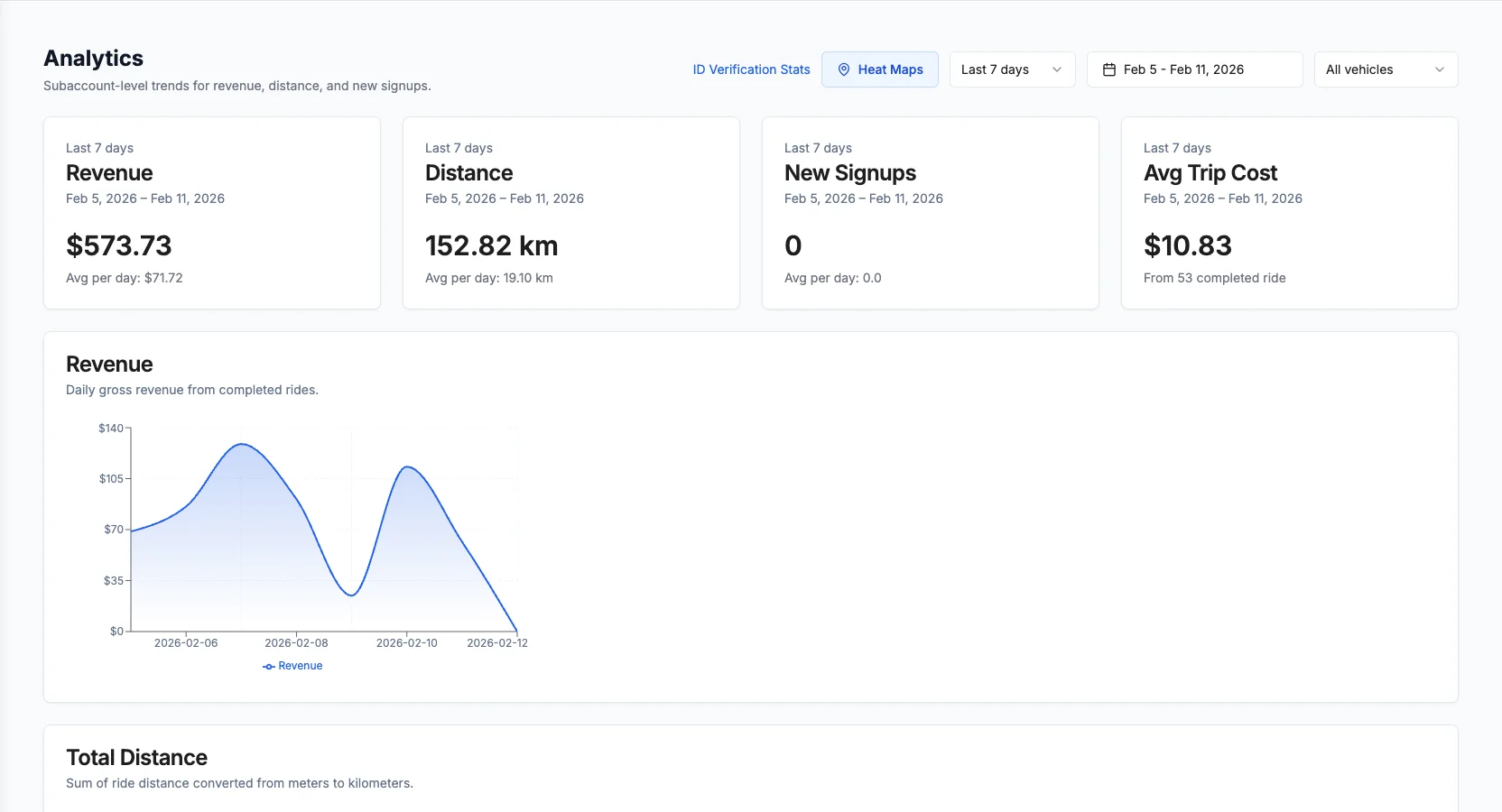
The core health metrics to track per market:
| Metric | Why it matters | What to watch |
|---|---|---|
| Rides per vehicle per day | The master utilization number that decides margin | A sustained downward trend, or sitting below your target band |
| Revenue per vehicle per day | Turns utilization into dollars | Whether it covers local field cost per vehicle |
| Contribution margin per vehicle | Revenue minus local labor, charging, rebalancing, and damage | Negative or thinning after the ramp period |
| Monthly payout versus the $250 platform minimum | Tells you if the market clears the floor | Fees still under the minimum months after launch |
| Fleet uptime and vehicles online | Idle or offline vehicles earn nothing | Rising offline count, recurring hardware faults |
| Repeat rider rate and retention | Proves demand is real, not one-time novelty | First-ride riders who never return |
| Compliance status | A pulled permit ends a market overnight | Any MDS or city obligation slipping |
One caution on that scorecard: contribution margin per vehicle stops at the field costs that scale with each vehicle (local labor, charging, rebalancing, and damage). It is not the market's full profit. Levy's revenue-share fee, payment processing (Stripe at 2.6% + $0.20 per transaction, shared proportionally), insurance, permits, storage, marketing, taxes, and your own overhead all sit below it, so a positive contribution margin is a necessary signal, not proof the market clears on a fully loaded basis.
Turn the scorecard into decisions with clear thresholds you set in advance.
Signals a market is ready to expand or replicate
Utilization is stable or climbing after the first 60 to 90 days, contribution margin per vehicle is positive and holding, monthly fees clear the $250 platform minimum comfortably, and the repeat-rider rate shows real demand rather than launch novelty. When a market hits these, it can absorb more vehicles, and its configuration becomes the template for the next launch.
Signals a market is failing
Rides per vehicle per day trend down for several weeks with no seasonal explanation, contribution margin per vehicle goes or stays negative after the ramp, months pass without clearing the platform minimum, or offline vehicles and hardware faults keep climbing. Set a decision date at launch (for example, 90 days) so a weak market gets a deliberate fix-or-exit call instead of quietly bleeding cash.
Because the model is revenue-share with no upfront software cost and a per-operator minimum, exiting a bad market is cheap: you recover and redeploy the vehicles rather than eating a stranded license. That asymmetry is what makes disciplined, metric-driven expansion safe. You can try a market, read the numbers honestly, and move the fleet to a better city without a sunk-cost penalty.
Frequently asked questions
Turn one proven market into a repeatable system
Scaling is not about heroics in five cities at once. It is about turning the first market you ran by hand into a system anyone can run: a launch playbook and a daily SOP so every city stands up the same way, a clean split between remote work and local hands, a hiring sequence that follows utilization instead of leading it, and a fixed scorecard that tells you when to expand a market and when to exit it. The revenue-share, $0-upfront model with a per-operator minimum makes both entry and exit cheap, so disciplined expansion is a low-risk way to compound a proven fleet. Prove one market, template it, and repeat.
See the multi-market operator dashboard
Book a demo to see how the operator dashboard, AI Ops recommendations, City Compliance, and managed support come together to run several markets from one lean central team.