.svg)
A residential amenity is the closest thing to a captive fleet you will ever run. One property is one geofence, the riders already live inside it, and the person who signs (a property manager, an HOA board, or a developer) has budget and a reason to spend it. That changes the unit economics. Your acquisition cost per activated rider drops toward zero, because you close one account and inherit a whole building, and your rebalancing cost drops, because the vehicles never leave the site. And because Levy Fleets runs on a $0-upfront, revenue-share model where you pay when riders pay, with only a $250 per month platform minimum, you can stand up one site and let it prove itself before your fixed costs climb. This lesson covers who to sell, how to frame the resident benefit, three ways to bill the program, and how to run the fleet as a closed network.
This is operator education, not professional advice
The billing structures, contract clauses, insurance points, and revenue framing below are a starting framework, not legal, tax, financial, or insurance advice. Property deals vary by state, property type, and owner, so have a licensed attorney, an accountant, and a commercial insurance broker review your amenity agreement, your revenue-share terms, and your coverage before you sign anything.
Why a residential property is the easiest fleet to run
Public shared micromobility is a demand-generation business: every ride starts with a stranger you paid to acquire, and demand swings with weather and season. A residential amenity is a demand-capture business. The riders already move around the property every day, from the parking structure to the door to the transit stop, so you are not creating demand, you are equipping demand that is already there.
That gives you four structural advantages a street fleet never has:
- A single geofence you control. The property is one zone. Draw it once with Levy's zones tooling: set the service area, mark no-go areas beyond the boundary, apply speed limits, and place parking rewards where vehicles should cluster.
- Concentrated, repeat demand. Residents take the same short trips over and over, so utilization is easy to forecast and you right-size the deployment instead of over-buying.
- A buyer with budget. On a property, the manager or HOA can fund the mobility as an amenity, adding a second, contracted revenue source alongside rider fares.
- Near-zero rebalancing. When vehicles stay on one site, the daily cost of moving them collapses, and that is usually the biggest operating expense on a street fleet.
Sell the property manager, not the resident
The most important shift here is who you are selling. Instead of marketing to riders one at a time, you sell one decision-maker who controls the property: a multifamily property manager, an HOA or condo board, a master-planned community developer, or a student-housing operator. Win that one signature and you win the building.
So pitch their outcomes, not your features. Property owners and managers buy four things:
- A differentiated amenity. An on-site scooter and e-bike program is a visible, photographable perk that shows up in a leasing tour and a listing.
- Retention and lease-up velocity. A resident who likes an on-site amenity is more likely to renew, and managers are measured on occupancy and turnover.
- Less parking pressure. Every resident who scooters to the train instead of keeping a second car is parking demand you just removed.
- A sustainability story. Electric micromobility is a clean, on-brand story a property tells its residents, owners, and investors.
Then show them the machine behind it. Levy is a turnkey stack: software plus vehicle sourcing, IoT, payments, and 24/7 managed support, running on 99.8% platform uptime with 2.4M+ rides completed across 127+ active fleet partners. The managed model gives them the amenity without running a mobility company.
See the apartment scooter and bike amenity use case
The apartments solution page lays out how an on-site scooter and e-bike amenity serves residents, reduces parking demand, and plugs into the Levy platform with no operational burden on the property team.
Three ways to bill a residential program
There is no single right structure. Pick the one that matches who is willing to pay. All three run on the same platform and flow through Levy's managed payments and Stripe (included on every plan at volume pricing of 2.6% plus $0.20 per transaction).
Property-funded (the amenity model). The property pays for the mobility as a resident benefit, and residents ride free or on a monthly allowance. You bill the property through a B2B account (supported in Levy's booking widget and point-of-sale tooling), or fund resident wallets and scope the benefit so the property's money covers the fares. A monthly ride credit or a "first 30 minutes free" perk is a real, enforceable rule you build with subscriptions, packages, and promotions, not a spreadsheet promise.
Resident-funded with a share to the property. Residents pay per ride, and the property earns a share for hosting the fleet and providing parking and charging. You keep the majority of each fare and pay the property an agreed percentage. That percentage is a commercial deal you negotiate with the property, and it is separate from how Levy pays you. (For reference on the Levy side: your operator payout share on the Managed plan defaults to 80%, the complement of Levy's 20% fee, and it is calculated on net revenue after Stripe processing fees. That 80% is what Levy pays you as the operator, not the share you hand the property.) Structured this way, hosting for a share hands the property a hands-off revenue line while you run everything.
Hybrid. The property subsidizes a slice (the first few minutes, or commuter hours) and residents pay for the rest. This fits a property that wants a real benefit without a blank check. Levy's zones, pricing, promotions, and packages tooling express all three shapes without custom work.
| Consideration | Property-funded | Resident-funded | Hybrid |
|---|---|---|---|
| Who pays for rides | The property | Residents, per ride | Split |
| Property's role | Buyer of an amenity | Host earning a share | Both |
| Revenue predictability | High, contracted | Usage-driven | Mixed |
| Resident price sensitivity | Removed | Still in play | Reduced |
| Best fit | Class A multifamily | Value or large communities | Broad range of properties |
Do not confuse the billing model with your Levy plan
The property-funded versus resident-funded choice is how you price the property. It is separate from how Levy prices you. On Levy's Managed plan, Levy's fee is 20% of GMV under 100 active vehicles (15% of GMV at 100 to 249 active vehicles on annual or approved terms), with a $250 per month platform minimum credited against fees. If you run operations in-house at scale, Software-Only is $14 per vehicle per month at 100 to 249 vehicles. Whatever you charge the property, that revenue flows through the same $0-upfront, pay-when-riders-pay structure.
Because there is no upfront software cost and only a $250 per month platform minimum, even a single garden-style property can clear the minimum and stand on its own economics.
Run it as a closed network
A residential amenity is a closed-network fleet: a defined set of vehicles serving a defined population inside a defined boundary. Operating it well is mostly about keeping the fleet on-site, ready, and scoped to residents.
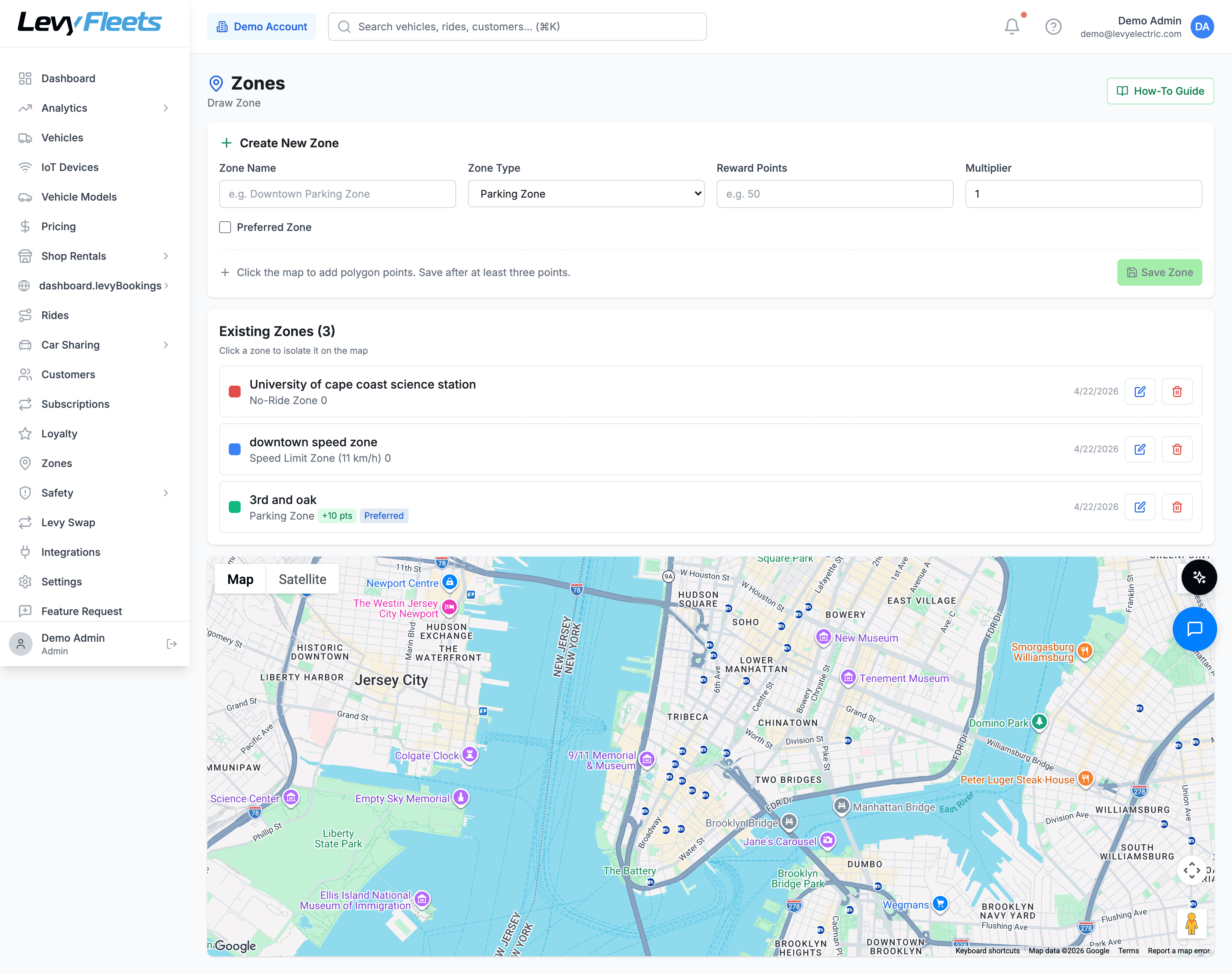
- Draw the property as a zone. Set the service area to the boundary, mark everything beyond it as a no-go area, and add speed-limit zones for interior paths and garages. Geofencing is included for everyone, not gated behind a tier.
- Keep vehicles where residents pick them up. Place parking rewards at the lobby, bike room, and transit-facing corner so vehicles cluster where the next rider looks. That is your low-cost substitute for city-scale rebalancing.
- Scope the money to residents. Fund resident wallets, or scope promotions, packages, and subscriptions to the property. Riders still pass standard identity verification and fraud checks on onboarding (via SoCure, Experian, and Stripe Identity), so a closed network is not a loose one.
- Reserve limited inventory. On a smaller deployment, Book Ahead lets residents reserve a specific model with pickup locations, caps, and a deposit, so a commuter can count on a vehicle at 8 AM.
- Solve charging on-site. Keep vehicles ready with pack state-of-health tracking, swap stations, and the Juicer and Charger marketplace, or an in-house swap workflow. A dead scooter is a churned resident.
- Right-size with forecasts. AI Ops forecasts demand per zone over 1, 4, or 24 hour horizons and gives ROI-ranked rebalancing recommendations. It recommends and forecasts, it does not auto-execute moves and it is not surge pricing, so you stay in control.
Do not promise integrations you cannot ship
It is tempting to tell a property manager the amenity will plug into their property-management system for lease-based billing. Do not commit to that in a contract. Keep the agreement to what the platform does today: managed payments, B2B accounts, zones, analytics, rider apps, and a REST API with webhooks for integrations you build deliberately.
Launch a residential pilot
Run the first property as a tight, bounded pilot, not an open-ended rollout. A pilot lets the manager say yes cheaply and gives you clean data to expand on.
Qualify the property and name the trip
Target dense sites with real repeat trips: garden-style and mid-rise multifamily, high-rise towers near transit, student housing, and master-planned or HOA communities. Name the trip the amenity serves (unit-to-garage, property-to-transit, or building-to-building). A vague amenity sits idle and churns.
Match the vehicle to the property
Scooters and e-bikes fit last-mile and transit trips at apartments and towers. Golf carts and low-speed vehicles fit large HOA and master-planned communities. Levy is hardware-agnostic across 30+ IoT vendors with a catalog of 150+ fleet-ready electric vehicles, so you spec to the property rather than forcing one vehicle type onto every site.
Scope the pilot on one page
Fix the geofenced service area, the vehicle count and mix, the term (a 60 to 90 day window is common), who funds the rides, and two or three success metrics (rides per vehicle per day, first-ride adoption, and a satisfaction score). If you cannot fill in all five, you are not ready to deploy.
Deploy and configure the closed network
Draw the zone, place parking rewards, set speed limits, scope the resident pricing, and stand up charging. Decide branding: the Levy app under Levy Label (no setup fee), or a property-branded app on iOS and Android for a $2,750 one-time white-label fee.
Prove it with data
Report utilization, ride counts, and resident satisfaction from the analytics that ship with the platform. Numbers the manager can forward to their owner or board convert a pilot into an annual contract.
Convert and expand across the portfolio
Turn the pilot into a term agreement, then use the proof from property one to open the next. Managers and HOA management companies run many properties, so one relationship can unlock a whole portfolio.
What to put in the amenity agreement
A residential deal lives or dies on the contract. Whatever the billing model, cover these clauses. Treat it as a reusable outline you fill in per property.
- Parties and term. The operator entity and the property owner or management company, the effective date, the initial term (annual is typical), and renewal and termination terms.
- Service area and deployment. The geofenced boundary, the vehicle count and mix, pickup locations, and any caps, referencing the zone, speed-limit, and no-go configuration.
- Commercial model. Whether it is property-funded, resident-funded with a share, or hybrid, the exact fee or share percentage, the base it is calculated on, and how and when the property is paid or invoiced.
- Payment and billing. Billing cadence, payment method, that payments run through Levy's managed payments and Stripe, and how refunds, disputes, and chargebacks are handled.
- Roles and responsibilities. Who deploys and rebalances, who handles maintenance and battery swaps, who fields resident support (Levy provides 24/7 managed support on the Managed plan), and who manages parking and charging space.
- Access to property space. Charging outlets, a maintenance or storage closet, garage and bike-room placement, and signage. A program with nowhere to charge fails quietly.
- Branding. Levy Label runs on the Levy app at no setup fee, or a property-branded app on iOS and Android is a $2,750 one-time white-label fee.
- Insurance and liability. Define insurance responsibilities and recommend independent coverage where the property wants it. Levy does not provide rider or operator insurance. The rider agreement every rider accepts before unlock names property owners and hosts among the released parties.
- Compliance and safety. Reference the parking rules, helmet policy, and any sidewalk or speed enforcement. Levy Vision covers helmet verification at unlock, parking-pose validation at ride end, and sidewalk detection with throttle-cut enforcement. It is parking, helmet, and sidewalk compliance only, not a damage inspection.
- Data and reporting. Agree on the ride, utilization, and satisfaction metrics the property receives and how often, and set data-privacy boundaries for resident information.
Match the program to the property type
The residential motion changes shape with the property and the vehicle, because the trip, the fare, and the buyer's expectation shift.
Best served by scooters and e-bikes for last-mile and transit trips. The property manager is your buyer, and a property-funded or hybrid model reads as a premium amenity in a leasing tour. Keep the deployment small and dense (often 10 to 20 vehicles at a mid-rise), scope resident pricing tightly, and use parking rewards to keep vehicles at the lobby and garage.
Frequently asked questions
Turn one property into a portfolio
A residential amenity is the rare growth lever that lowers your acquisition cost and raises your revenue predictability at the same time. You close one property and capture a population of riders inside a boundary you control, priced as a property-funded benefit, a resident-funded share, or a hybrid. Run it as a closed network: geofence the site, scope the money to residents, keep vehicles charged and clustered, and forecast with AI Ops. Put the commercial model, space access, branding, and service levels in writing, then use the proof from property one to open the rest of the portfolio. For a deeper template of a property-hosted program, study how a hospitality amenity is positioned, priced, and operated in the hotel and resort scooter amenity playbook.
Model a residential site's payout
Use the estimator to turn a property's resident count, expected trips, and your billing model into a monthly payout, so you can price a residential pilot with real numbers before you pitch the property manager.