.svg)
A campus is one of the best pieces of ground a shared fleet operator can own. It is dense, it is bounded, and it has tens of thousands of people making short trips between the same buildings every day. Get it right and you have a captive, high-frequency rider base inside a geofence you control, with a landlord who wants your program to succeed because it takes cars off their lots. Get it wrong and the same density that made it attractive turns into scooters strewn across a quad, a safety incident on the front page of the student paper, and an administration that bans you by the end of the semester. This lesson is the operator's version of the campus play: who actually signs the deal, the specific ways these programs die, a 10-step launch you can run start to finish, how to geofence a campus so vehicles stay where they belong, and how to convert a one-semester pilot into a multi-year contract. Because you run on Levy's $0-upfront, revenue-share model where you pay when riders pay, you can walk into a campus conversation without a license fee dragging on your margin, and put the money you would have spent on software into vehicles and marketing instead. There is still a $250 per month platform minimum credited against fees, so budget for that, not for a truly zero fixed cost.
Playbook guidance, not professional advice
The unit economics, insurance, and contract points in this lesson are planning inputs, not financial, tax, legal, or insurance advice. Campus deals turn on real contracts, liability terms, and revenue assumptions that vary by school, market, and season, so validate your numbers in the Fleet Estimator and run agreements, insurance, and RFP responses past your own accountant, attorney, and insurance broker before you commit.
Who actually buys a campus program
The single most common reason a campus deal stalls is that you sold to the wrong person. Campuses do not have one buyer. They have a champion who wants it, an economic owner who funds it, and a gatekeeper who can kill it. You have to find all three.
The economic buyer, the champion, and the gatekeeper
On a university, enthusiasm and budget rarely sit in the same office. Student government and the sustainability office will love your program, but neither one signs a contract. Map the building before you pitch.
| Role | Who holds it | What they want | Why they matter |
|---|---|---|---|
| Economic buyer | Transportation and parking services, or auxiliary/business services | Fewer cars competing for parking, or a revenue-generating amenity | Owns the budget line and the contract |
| Champion | Sustainability office, student government, student affairs | Carbon reduction, a visible student perk, campus modernization | Creates internal demand and cover |
| Gatekeeper | Risk management, general counsel, EH&S, procurement | No liability, no injuries, a clean RFP | Can veto the whole thing on safety or process |
The pattern that closes: let the champion generate demand, sell the economic buyer on parking relief and unit economics, and disarm the gatekeeper with your safety stack before they raise it. On campus, parking is almost always the strongest argument. Every rider on a scooter is a car not fighting for a permit space, and parking structures cost the school real money to build and maintain. Lead there.
Corporate campuses buy differently
A corporate or office campus compresses the same map into fewer people. The economic buyer is usually facilities or real estate, the champion is sustainability or HR pitching it as an employee benefit, and the gatekeeper is still risk and legal. The trip pattern is different too: transit-station-to-office and building-to-building hops rather than dorm-to-lecture-hall. The pitch shifts from student demand to commuter friction and parking cost per employee, but the three-role structure is identical.
See the campus scooter solution
Levy's campus scooter page lays out the amenity case for university and corporate campuses: less parking demand, quick inter-building movement, and an employee or student perk program.
Why campus programs fail
Campus programs do not usually die from lack of demand. They die from a handful of predictable operational and political failures. Know them cold so you can design them out before launch.
- No economic owner. The program lives on the enthusiasm of a champion with no budget. When that person graduates, transfers, or loses their internal fight, the program has no funding and quietly ends. Anchor the deal to the office that owns parking or auxiliary revenue.
- Vehicles wander off the geofence. Without a tight service-area boundary and out-of-zone parking rules, riders leave scooters at the edge of campus or blocks away in the city, availability collapses, and your rebalancing cost eats the margin.
- Parking chaos on the quad. Scooters dumped in front of the library and across accessible paths is the fastest way to turn facilities and disability services against you. This is a political failure, not just an operational one, and it kills programs fast.
- A safety incident. Sidewalk riding through pedestrian plazas and no helmet use hands risk management the exact story they need to shut you down. One viral clip can end a pilot.
- Ignoring the academic calendar. A campus empties over summer, winter break, and spring break. If you model revenue on a full-semester ridership curve applied to twelve months, your unit economics fall apart the first July.
- Poor availability from weak operations. Dead batteries and broken vehicles mean a rider opens the app, sees nothing charged nearby, and stops checking. Availability is the product on campus.
- A pilot with no exit ramp. The program runs, everyone enjoys it, and then the pilot ends with no agreed metrics and no data to justify renewal, so it does not renew.
Design for the safety conversation before it happens
Risk management will ask about helmets, sidewalks, and parking on the first call. Do not improvise. Levy Vision runs helmet verification at unlock, parking-pose validation at ride end, and sidewalk detection with throttle-cut enforcement, so you can show a real compliance stack instead of promises. Note the scope honestly: Levy Vision covers helmet, parking, and sidewalk compliance. It is not a damage inspection or vehicle-condition tool, so do not position it as one.
The 10-step campus launch
Run these in order. The first four are the deal, the middle four are the build, and the last two are how you launch and prove it.
Map the three buyers
Identify the economic buyer, the champion, and the gatekeeper by name before you pitch. Confirm who controls the parking or auxiliary budget line, because that is who signs.
Scope the pilot
Define a single service area, a starting vehicle count, and a term (one semester is the natural unit). Keep it small enough to run flawlessly and large enough to prove demand.
Pick the vehicle mix
Match vehicles to the terrain and trip length. Campuses on Levy can run scooters, e-bikes, mopeds, golf carts, and low-speed vehicles, and Levy is hardware-agnostic across 30+ IoT vendors with a catalog of 150+ fleet-ready electric vehicles, so you spec the right mix instead of being locked to one manufacturer.
Model the unit economics
Build the numbers on the revenue-share model: $0 upfront, and on the Managed plan Levy's fee is 20% of GMV under 100 active vehicles (15% of GMV at 100 to 249 active vehicles on annual or approved terms), against a $250 per month platform minimum credited against fees. GMV is gross rider payments before taxes, fees, refunds, and tips; your actual payout base is net revenue after Stripe processing (2.6% + $0.20 per transaction, shared proportionally), so treat any quick "gross minus everything" figure as a conservative estimate, not an exact payout. Your partner share defaults to 80%. Model the academic calendar honestly, with summer and breaks at a fraction of term ridership, and validate the whole picture in the Fleet Estimator, because ridership and revenue per vehicle vary by market and how hard the fleet is run.
Draw the geofence
Configure the campus service area, parking zones, no-go zones, and speed-limit zones in Levy's zones tooling before a single vehicle deploys. This is covered in detail in the next section.
Set the safety configuration
Turn on helmet verification, parking-pose validation, and sidewalk detection with throttle-cut. Stand up Rider Score for behavior-based scoring, rewards, and interventions so the risk conversation has real answers.
Source and stage the hardware
Bring your existing hardware or source from Levy's supported vendors, and pre-stage spare parts. Levy stocks common OKAI and similar parts in the US, so tires, brake pads, and display panels ship in days rather than weeks, and OKAI vehicles carry a 90-day manufacturer warranty that Levy files on your behalf.
Brand the app
Launch on the Levy app under Levy Label at no setup fee, or publish an operator-branded app on iOS and Android with the white-label add-on for a one-time $2,750. Campus decision-makers often want the school's identity on the product, so price that in if it helps close the deal.
Launch around a campus moment
Time go-live to orientation, move-in week, or the first week of a term, when foot traffic and app installs peak. Use Marketing Automation (audience segments, drip campaigns, A/B testing, and lifecycle messaging across email, SMS, and push) to drive first rides.
Instrument and report
Agree on the pilot's success metrics with the buyer up front, then track them in analytics from day one: rides, availability, parking compliance, and safety. You cannot renew a pilot you did not measure.
Geofencing to campus
Geofencing is where a campus program is won or lost operationally. A campus is a bounded space with pedestrian cores, restricted buildings, and a landlord who cares intensely about where vehicles sit. Levy's zones tooling exists for exactly this: configure geofencing zones for service areas, parking, no-go areas, and speed limits, with real-time GPS and remote status on every vehicle.
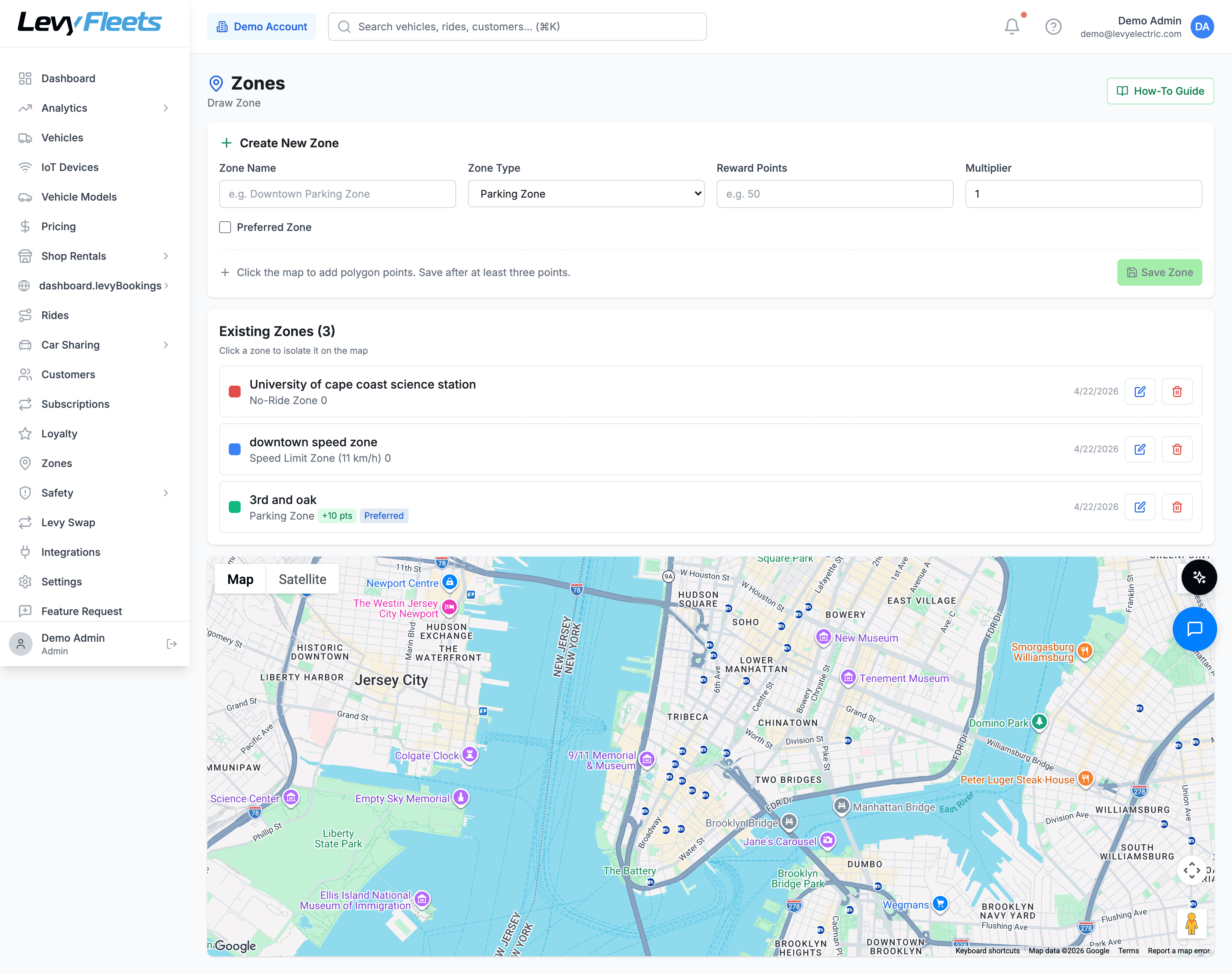
The four zone types every campus needs
- Service-area boundary. Draw the outer geofence tight to campus. Riders who try to end a trip outside it hit your out-of-zone parking rules, which keeps vehicles on the property where availability compounds and rebalancing cost stays low. This one boundary prevents the most common failure mode, vehicles wandering off campus.
- Parking zones with rewards. Define designated corrals at high-demand buildings, transit stops, and dorm clusters. Levy's zones tooling supports parking rewards, so you can credit riders for ending trips in the corrals you want filled. That is both a tidiness tool that keeps facilities happy and an operations tool that pulls vehicles back to the curbs where the next rider is waiting.
- No-go zones. Fence off pedestrian-only cores: the central quad, plaza in front of the library, dining hall entrances, and any accessible path. Setting these before launch is the single best defense against the parking-chaos political failure.
- Speed-limit zones. Slow vehicles automatically near lecture halls, crosswalks, and crowded plazas. Layered on top of sidewalk detection with throttle-cut, this is the concrete answer you give risk management when they ask how you keep speeds down around pedestrians.
Use parking rewards to do your rebalancing for you
On a dense campus, the corrals riders should use are also the corrals where the next rider will look. Set parking rewards to pull vehicles toward transit stops and high-traffic buildings, and a chunk of your rebalancing happens for free as riders chase the credit. It is the cheapest operations lever you have.
When campus overlaps a city
A university in a downtown often sits inside a city's own micromobility rules. Levy's city-compliance tooling handles MDS 2.0 and GBFS 3.0 feeds, city policy ingestion, real-time geofence enforcement, and stacked-geofence priority, so when your campus zones overlap a municipal speed or no-park rule, the priority resolves cleanly instead of leaving a gap. If the city requires data feeds, you can provide MDS and a city-portal magic link without building anything custom.
Pilot to permanent: expanding the program
Almost every campus starts as a pilot, and that is fine. A pilot is a sales tool. Your job is to run it so well, and measure it so clearly, that renewal is the obvious decision.
Define the pilot as a proof
Before launch, agree with the buyer on the exact numbers that will define success, and instrument them from day one:
- Ridership: total rides and rides per vehicle per day across the term.
- Availability: the share of the day riders can find a charged vehicle near them.
- Parking compliance: the share of trips ending in a designated corral, straight from your zones and parking-pose data.
- Safety: helmet verification rate, sidewalk-detection events, and Rider Score trends.
- Parking relief and sustainability: rides substituted for car trips, the argument the economic buyer cares about most.
Report against these at the midpoint, not just the end, so a struggling metric gets fixed inside the pilot rather than showing up in the renewal meeting.
Pull the expansion levers
Once the pilot proves out, expansion has clear levers:
- Grow the vehicle count. Crossing 100 active vehicles moves your Managed rate from 20% to 15% of GMV on annual or approved terms, so scaling the fleet improves your own margin as it improves coverage. Operators running their own in-house support at 100 to 249 vehicles can also look at the Software-Only plan at $14 per vehicle per month.
- Add vehicle types. Layer e-bikes for longer cross-campus trips or golf carts and low-speed vehicles for facilities and event shuttling onto the same platform and dashboard.
- Add zones. Extend the service area to satellite campuses, medical centers, adjacent student-housing neighborhoods, and the transit corridors that connect them.
- Go multi-campus. University systems and multi-site employers are natural multi-market expansions, which is exactly the Enterprise conversation (250+ vehicles, multi-market, custom terms).
- Deepen the loops. Turn on Loyalty (points, tiers, rewards, and referral programs) so your existing riders recruit the next cohort at a fraction of paid acquisition cost.
Let AI Ops point your operations, not run them
As the program grows, AI Ops can forecast demand by area over 1, 4, or 24 hour horizons and rank rebalancing recommendations by projected ROI, which is genuinely useful across a campus that empties and fills on a class schedule. Keep the scope honest: AI Ops recommends and forecasts, it does not auto-execute moves and it is not surge or dynamic pricing. You stay in control of every rebalance and every fare.
Match the vehicle to the campus
The right mix depends on the campus footprint and the trips people actually take. Campuses on Levy can run scooters, e-bikes, mopeds, golf carts, and low-speed vehicles.
The default campus vehicle. Short, frequent, dorm-to-class and building-to-building hops. High trip frequency makes referral and parking-reward loops fire constantly, and the small footprint fits tight corrals near entrances. Keep speed-limit zones firm around pedestrian cores.
Frequently asked questions
Run it like a system
A campus program is not a one-time launch, it is a machine you tune. Sell the office that owns parking, not just the students who cheer for you. Design out the failure modes before launch: a tight geofence, corrals with rewards, no-go zones on the quads, and a real safety stack for the risk conversation. Run the 10 steps in order, launch on a campus moment, and measure the metrics you agreed on so renewal is a formality. Then pull the expansion levers, more vehicles, more types, more zones, more campuses, and let your economics improve as the program grows. If you are launching your very first fleet and want the fundamentals underneath this playbook, start with the guide on how to start an electric scooter rental business, then bring it to campus.
Model your campus program on real numbers
Use the estimator to turn a vehicle count, ridership, and average fare into a monthly payout, so you can walk into the buyer's office with unit economics instead of a guess. Or book a demo to see the campus setup live.