.svg)
Most operators build their whole business on the public curb: strangers, walk-up rides, weather-dependent demand, and a marketing budget that has to earn every single trip. A B2B program flips that. Instead of chasing one rider at a time, you sell one deal that delivers a whole population of riders in a fixed geography with a counterparty who has budget: an office, a corporate campus, a hotel, a resort, or a residential community. The demand is denser, the cost per rider is lower, and the revenue is far more predictable than street rides. And because Levy Fleets runs on a $0-upfront, revenue-share model where you pay when riders pay, you can pilot a corporate site without buying software up front or committing to a fixed license first. This lesson shows you how to price a B2B program two ways, run the sales motion from first meeting to signed agreement, and structure the partnership contract so the deal holds up.
This is operator education, not professional advice
The contract, insurance, liability, and tax points in this lesson are general guidance to help you scope a corporate deal, not legal, insurance, or tax advice. Partnership agreements, indemnification, coverage requirements, and how B2B revenue is taxed all vary by jurisdiction and by counterparty. Have a qualified attorney and a licensed insurance broker review any corporate agreement before you sign it.
Why B2B is the highest-margin lane most operators skip
Public shared micromobility is a demand-generation business: every ride starts with a stranger you had to acquire, and demand swings with weather and season. A B2B program is a demand-capture business instead. The riders already work, live, or stay in one place, they have a reason to move within it, and someone (an employer or a property) will often pay to make that movement easy. A corporate fleet program gives you four things a street fleet does not:
- Concentrated geography. A campus or property is a single geofence, so your vehicles stay where the riders are and rebalancing cost drops sharply. Levy's zones tooling lets you draw the service area, set speed-limit zones, mark no-go areas, and place parking rewards, so the fleet self-organizes inside the site.
- Predictable demand. Commuters move at set hours, guests move on weekends, students move between buildings, so utilization is easier to forecast and you can right-size the deployment instead of over-buying.
- A paying counterparty. In a public fleet, the rider is your only source of money. In a B2B program, the employer or property can subsidize or fully fund the mobility as a benefit, pulling a second revenue source into the deal.
- Lower acquisition cost. You close one account and inherit its people, with no per-rider ad spend to seed the first cohort, so your cost per activated rider is usually a fraction of a public launch.
The offices use case shows this clearly: a workplace scooter or e-bike program moves employees between buildings and from transit to the door, and doubles as a recruiting and sustainability story the employer wants to tell.
See the office and campus scooter use case
The offices solution page lays out how a workplace scooter program serves last-mile commutes, inter-building trips, and corporate campus mobility, and how it plugs into the Levy platform.
Two ways to price a B2B program
There is no single right structure. Pick the one that matches who is willing to pay: the company or the rider. Both run on the same Levy platform and flow through Levy's managed payments and Stripe (included on every plan at volume pricing of 2.6% plus $0.20 per transaction).
Managed program (client-funded). The company or property pays for the mobility as a benefit, and riders ride free or at a subsidized rate. You bill the client directly through a B2B account (supported in Levy's booking widget and point-of-sale tooling), or fund rider wallets and scope promotions and packages to the site so the employer's money covers the fares. Because subscriptions, packages, and promotions are all part of Levy's pricing tooling, you can express "company covers the first 30 minutes" or "residents ride free inside the property" as a real, enforceable rule rather than a spreadsheet.
Revenue-share program (rider-funded, partner earns). Riders pay per ride, and the host (the property, hotel, or campus operator) earns a share for hosting the fleet and driving demand to it. This is the model when the counterparty will not fund the program outright but will take a cut for giving you exclusive placement, parking, and charging. You keep the majority of each fare and pay the partner an agreed percentage of what their site generates.
The two models compare like this:
| Consideration | Managed (client-funded) | Revenue-share (rider-funded) |
|---|---|---|
| Who pays for rides | Employer or property | Riders, per ride |
| Your revenue predictability | High, contracted | Variable, usage-driven |
| What the partner wants | A turnkey benefit or amenity | A cut of the revenue for hosting |
| Best fit | Offices, campuses, residential perks | Hotels, resorts, high-traffic venues |
| Rider price sensitivity | Removed or reduced | Still in play |
| Your upside if usage spikes | Capped at the contract | Grows with every ride |
A practical hybrid works too: the employer subsidizes the first slice of every trip (say, commuter hours) and riders pay for personal trips beyond that.
Do not confuse the B2B model with your Levy plan
The managed-versus-revenue-share choice above is how you price the corporate client. It is separate from how Levy prices you. On Levy's Managed plan, Levy's fee is 20% of GMV under 100 active vehicles (15% of GMV at 100 to 249 active vehicles on annual or approved terms), with a $250 per month platform minimum credited against fees. If you run in-house at scale, Software-Only is $14 per vehicle per month at 100 to 249 vehicles. Whatever you charge the corporate client, that revenue flows through the same $0-upfront, pay-when-riders-pay structure.
Because there is no upfront software cost and only a $250 per month platform minimum, even a modest single-site pilot can clear the minimum and stand on its own economics. That is why B2B is worth chasing early: you land a site, prove it, and expand without a big fixed bet.
The B2B sales motion, stage by stage
Selling a corporate program is a longer motion than acquiring a street rider, but far more repeatable. Run it as a pipeline, not a series of one-off favors.
Prospect the right sites
Target places with dense, repeat, short-trip demand and a decision-maker who owns the space: office parks, corporate campuses, business improvement districts, large employers, hotels and resorts, and residential communities. The best first targets are sites where people already walk a lot between points, because that walking is the demand you capture.
Qualify against a real use case
Before you pitch, name the trip: building-to-building on a campus, transit-to-door for commuters, or guest recreation at a resort. A program with a specific, high-frequency trip attached gets used, while a vague "amenity" sits idle and churns. Match the vehicle to the trip too: scooters and e-bikes for last-mile, golf carts and low-speed vehicles for campus shuttling.
Pitch the buyer's outcome, not your features
Employers buy a recruiting and sustainability story and less parking demand. Properties buy a differentiated amenity and a new revenue line. Lead with their outcome, then show that Levy is a turnkey stack: software plus vehicle sourcing, IoT, payments, and 24/7 managed support, running on 99.8% platform uptime with 2.4M+ rides completed across 127+ active fleet partners.
Scope a paid or contracted pilot
Do not sell a campus. Sell a pilot on one zone, with a fixed vehicle count, a fixed term, and success metrics agreed up front. A tight pilot lets the buyer say yes cheaply and gives you clean data to close the full deal.
Prove it with data
Report utilization, ride counts, and rider satisfaction from the analytics that ship with the platform. Numbers the buyer can forward to their own boss are what convert a pilot into a full agreement.
Close, then land and expand
Convert the pilot to a term agreement, then use the proof from site one to open site two. Multi-site employers and hospitality groups are the fastest path to scale, because one signature can unlock many locations.
Study a hospitality partnership in depth
The hotel and resort scooter amenity playbook shows how a property-hosted program is positioned, priced, and operated, a useful template for any revenue-share partnership.
Structure the pilot so it cannot fail quietly
Most B2B pilots die not because the product failed but because nobody agreed what success meant. Fix that before you deploy a vehicle.
Write the pilot on one page
Pin down five things in writing: the geofenced service area, the vehicle count and mix, the term (a 60 to 90 day window is common), who funds the rides, and the two or three metrics that define success (rides per vehicle per day, first-ride uptake, and a satisfaction score). If you cannot fill in all five, you are not ready to launch.
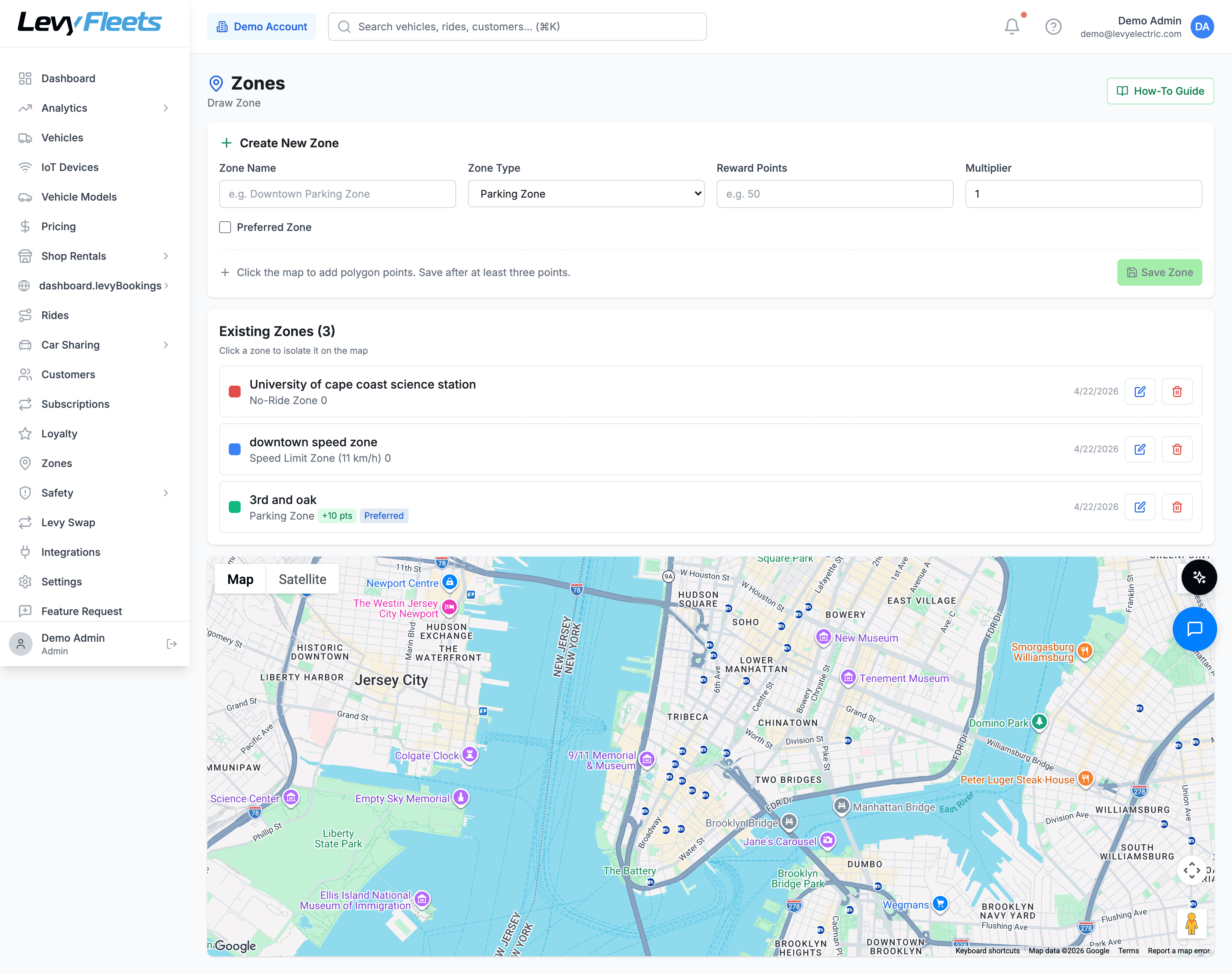
Use the platform to make the pilot tight. Draw the campus or property as a zone with the right speed limits and no-go areas, place parking rewards so vehicles cluster at the entrances and transit stops that matter, and lean on AI Ops to forecast demand per zone over 1, 4, or 24 hour horizons so you deploy the right number of vehicles. AI Ops recommends and forecasts, it does not auto-execute moves and it is not surge pricing, so you stay in control of every rebalance and price.
Right-size the vehicle mix to the site: a dense urban office might need 15 to 25 scooters, while a spread-out campus is often better served by e-bikes plus a handful of low-speed vehicles or golf carts. Treat those counts as starting ranges, not targets: real vehicle needs vary with site density, trip length, and season, so model your own site in the Fleet Estimator before you commit a number. Levy is hardware-agnostic across 30+ IoT vendors with a catalog of 150+ fleet-ready electric vehicles, so you spec the pilot to the trip rather than forcing one vehicle type onto every site.
What to put in the partnership agreement
A corporate deal lives or dies on the contract. Whether the model is managed or revenue-share, cover these clauses so both sides know their obligations. Treat it as a reusable outline you fill in per deal.
- Parties and term. Name the operator entity and the client, the effective date, the initial term (annual is typical), and renewal and termination terms including notice periods.
- Service area and deployment. Define the geofenced zone, the vehicle count and mix, pickup locations, and any caps, referencing the speed-limit and no-go zones so the physical program matches the paper.
- Commercial model. State plainly whether it is managed (client-funded) or revenue-share (rider-funded), the exact fee or share percentage, the base the share is calculated on, and how and when the partner is paid or the client invoiced. Ambiguity here turns a good partner into a bad one.
- Payment and billing. Specify billing cadence, payment method, processing responsibility (payments run through Levy's managed payments and Stripe), and how refunds, disputes, and chargebacks are handled. Managed payments, the rider wallet, and collections are standard on the platform, so name who owns each.
- Roles and responsibilities. Split the operational duties: who deploys and rebalances, who handles maintenance and battery swaps, who fields rider support (Levy provides 24/7 managed support on the Managed plan), and who manages parking and charging.
- Branding. Decide whose brand the riders see. Run on the Levy app at no setup fee under Levy Label, or publish an operator-branded app on iOS and Android for a $2,750 one-time white-label fee. A large employer or hospitality group often wants its own look, so price that into the deal.
- Insurance and liability. Define insurance responsibilities and recommend independent coverage where the client wants it. Levy does not provide rider or operator insurance, so spell out which party carries which policy.
- Compliance and rules. Reference the parking rules, helmet policy, and any sidewalk or speed enforcement on the site. Levy Vision covers helmet verification at unlock, parking-pose validation at ride end, and sidewalk detection with throttle-cut enforcement, so the safety terms you promise are enforced on the vehicle.
- Data and reporting. Commit to what you will report and how often. Analytics are included, so agree on the ride, utilization, and satisfaction metrics the client receives, and set data-privacy boundaries for employee and guest information.
- Service levels. Set the availability expectation. Levy runs on 99.8% platform uptime with active monitoring, a credible SLA anchor, plus a response commitment for vehicle issues.
Do not overpromise integrations you cannot ship
It is tempting to tell a hotel or property manager the program will plug into their property-management or booking system. Do not commit to that in a contract. Keep the agreement to what the platform does today: managed payments, zones, analytics, rider apps, and a REST API with webhooks for the integrations you build deliberately.
Match the program to the vehicle type
The same B2B motion changes shape with what you deploy: the trip, the fare, and the buyer's expectation all shift with the vehicle.
Best for dense offices, downtown campuses, and transit-to-door commutes where trips are short and frequent. Scooters keep the deployment cheap per vehicle and the fares small, so a managed subsidy of the first few minutes covers most commuter trips without a large employer bill. Cap and scope any subsidy tightly, since high frequency means small errors add up.
Frequently asked questions
Turn one signed site into a revenue engine
A B2B program is the rare growth lever that lowers your acquisition cost and raises your revenue predictability at once. You close one account and capture a population of riders in a geography you control, priced either as a managed benefit the client funds or a revenue-share the partner earns. Put the commercial model, roles, branding, and service levels in writing, and you have a durable revenue stream that does not depend on the public curb or the weather.
Model a corporate site's payout
Use the estimator to see how a concentrated set of riders, fares, and your revenue share translate into monthly payout, so you can price a B2B pilot with real numbers before you pitch it.