.svg)
Every completed ride generates three numbers you must keep straight: what the rider paid for the rental, what tax you collected on top, and what landed in your bank account after fees. Blur them together and you will overpay tax, underpay a partner, or hand an investor a spreadsheet that collapses under the first hard question. Per-ride amounts are small (a typical scooter ride runs a few dollars), but you run thousands of them, so tiny errors compound into real money fast.
This lesson covers the fundamentals: the revenue and tax to track, how sales and rental tax collection and remittance work, the expense categories to set up from day one, and the monthly close that keeps records clean enough to pay a partner and raise money against. Because Levy Fleets runs on revenue share and manages payments for you, much of the money mechanics live inside the platform. Your job is to reconcile them, categorize the rest, and stay current with the tax authorities.
This is operator education, not professional advice
This lesson is general education for fleet operators. It is not legal, tax, accounting, insurance, or fire-safety advice. Tax rules for vehicle rentals vary widely by country, state, county, and city, and they change. Before you register, collect, or remit anything, consult a qualified accountant or tax professional and confirm the rules with your local tax authority. When something here conflicts with your professional's guidance or your jurisdiction's rules, they win.
Why bookkeeping is a competitive edge
Most new operators treat books as a year-end scramble, and it costs them three ways. Tax authorities charge penalties and interest on late or wrong remittances, and rental tax audits are common because the money is collected from the public. Your Levy payout and revenue-share reconciliation depend on clean ride-level records: if your numbers do not match the platform's, you cannot tell whether you were paid correctly. And diligence for any raise asks the same question, show me the unit economics, which a clean profit and loss statement answers in ten minutes.
Good books are also how you run the business day to day. You cannot manage revenue per vehicle per day, or know your real cost to keep a scooter on the street, if your expenses are a shoebox of receipts. The full breakdown of scooter rental business profitability covers those unit economics; this lesson is the recordkeeping layer underneath them.
The four money flows to track
Separate the money into four distinct flows. New operators lump them into one "sales" number and lose the ability to reconcile. Keep them apart from ride one.
- Gross rider revenue (GMV). What riders pay you for rentals, before tax and fees. On Levy this is your Gross Merchandise Value.
- Tax collected. Sales or rental tax charged on top of the fare. Not your money; you hold it for the tax authority.
- Processing and platform fees. Stripe payment processing plus your Levy fee, taken out before you are paid.
- Net payout. What actually reaches your bank account, and what you reconcile against your books.
GMV versus your payout base
GMV is the base Levy uses to calculate its revenue-share fee, with a precise public definition: gross rider payments before taxes, government fees, refunds, and tips are taken out. Two things follow. First, tax is not part of GMV, so Levy never takes a percentage of the tax dollars you collect. Those dollars were never revenue. Second, GMV is measured gross, so refunds and tips are accounted for separately rather than netted into one number. Record a refund as its own line, not as a smaller original sale.
GMV is the meter, not your take-home
GMV is what the platform bills against, not what you keep. Your take-home is GMV minus processing fees minus your Levy fee. Track both: if you only watch bank deposits, you cannot verify your fee and payout.
Where the Levy fee and processing fees sit
On the Managed plan, Levy's fee is 20% of GMV, dropping to 15% once you run 100 to 249 active vehicles on an annual or approved term. Your partner share is the complement, defaulting to 80%. On the Software-Only plan you pay $14 per vehicle per month and run operations in house. Either way, a $250 per month platform minimum applies: if a month's fees are under $250, Levy invoices the difference, so budget for it in slow months.
Separately, Stripe processing applies to every charge. Levy passes through volume pricing of 2.6% plus $0.20 per transaction (versus the standard 2.9% plus $0.30), and operator and Levy share those costs proportionally. Your revenue share is calculated on net revenue after Stripe fees. Keep the Levy fee and the Stripe fee as separate expense lines so you can see each one move.
Here is how a single illustrative ride breaks down. The tax rate shown is an example only; yours will differ by jurisdiction.
| Line item | Amount | What it is |
|---|---|---|
| Rider fare, pre-tax | $12.00 | This is GMV |
| Rental/sales tax collected (example 8%) | $0.96 | Held for the tax authority, not revenue |
| Total charged to the rider | $12.96 | What Stripe processes |
| Stripe processing fee (2.6% + $0.20) | about $0.54 | Shared proportionally |
| Levy Managed fee (20% of GMV) | $2.40 | 15% of GMV at 100 to 249 vehicles |
The $0.96 is a tax liability you owe onward and must not spend. The rest splits between processing, the Levy fee, and your net payout, with the payout calculated on net revenue after processing fees. In your books, that one charge touches four accounts: revenue, tax payable, processing expense, and platform fee expense, which is why you separate the flows up front.
Sales and rental tax: collect, hold, remit
Tax is where operators get in real trouble: you are handling the public's money and the authorities notice. The mechanics come down to four moves.
Figure out what is taxable where you operate
Vehicle rentals are often taxed differently from ordinary retail sales. Depending on your jurisdiction you may face a general sales tax, a specific rental or lease tax, a local surcharge, a right-of-way or per-trip city fee, or a combination. A handful of US states have no statewide sales tax, while some cities layer their own micromobility fees on top. Do not guess or copy an operator in another city. Confirm which taxes and fees apply to short-term rentals at your addresses with a tax professional and your local authority.
Register before you collect
Most jurisdictions require a sales or rental tax permit before you legally collect. Registration also sets your filing frequency (monthly, quarterly, or annually), which drives your remittance calendar. Do this before launch, not after your first audit letter.
Collect at the point of the ride
Tax is charged on top of the fare when the rider pays, so it flows through the same managed payment. Because GMV is defined before taxes, the tax portion stays separable in your records rather than buried inside the fare. Make sure your configured rate matches your registered rate, and revisit it whenever a local rate changes.
Hold it separately, then remit on schedule
The tax you collect is a liability, not income. The most common cash mistake is spending collected tax on operating costs and coming up short at filing time. Move it out of your operating view (many operators sweep an estimate into a separate account weekly) and remit on your jurisdiction's schedule.
Never spend collected tax
Collected tax is money you hold for the government, full stop. Treat it like escrow. Let it sit in your operating account as apparent cash and you will spend it, then owe it anyway (plus penalties and interest) at filing time. Book it to a "tax payable" liability the moment it is collected, and reconcile that account to zero every time you remit.
Expense categories to set up from day one
Set up your chart of accounts before your first ride. A rental fleet has a recognizable cost structure, and consistent categories from the start mean your profit and loss statement writes itself. Adapt these names to your accounting software.
| Category | What goes here |
|---|---|
| Vehicle cost | Scooter, e-bike, moped, or cart purchases, plus spare batteries. Usually capitalized and depreciated, not expensed at once. |
| Parts and repairs | Tires and tubes, brake cables and pads, display panels, fenders, throttle assemblies, and other wear parts. Levy stocks these in the US, so you order through Levy. |
| Connectivity | IoT SIM and cellular data for the connected hardware on every vehicle. |
| Platform and processing | Your Levy Managed fee or the $14 per vehicle per month Software-Only fee, the $250 monthly minimum true-up, Stripe processing, and the one-time $2,750 white-label app fee. |
| Field operations | Rebalancing labor and mileage, charging and battery-swap payouts, chargers, and consumables. |
| Facilities | Warehouse or storage rent, utilities, and shop tooling. |
| Labor | Mechanics, field staff, and contractors, whether W-2 or 1099. |
| Insurance | Fleet, liability, and any coverage your city permit requires. |
| Permits and city fees | Per-vehicle city fees, right-of-way permits, and other government fees. Separate from sales tax. |
| Marketing | Ad spend on channels like Google Ads and Facebook, promotions, and referral costs. |
| Software and admin | Accounting software, bank fees, professional services, and office costs. |
Depreciation is where the vehicles hide
Your biggest asset, the vehicles, usually does not appear as one big expense. It is capitalized and depreciated over its useful life, so your profit and loss shows a slice each month, not the full purchase up front. Get this right and your real unit economics become visible instead of a month-one paper loss. Set it up with an accountant early.
Build records clean enough to reconcile
Clean books come from a few habits repeated weekly, not a year-end cleanup. Levy handles the payment rails, so much of your source data already lives in the platform; your job is to pull it, categorize it, and reconcile it against your bank.
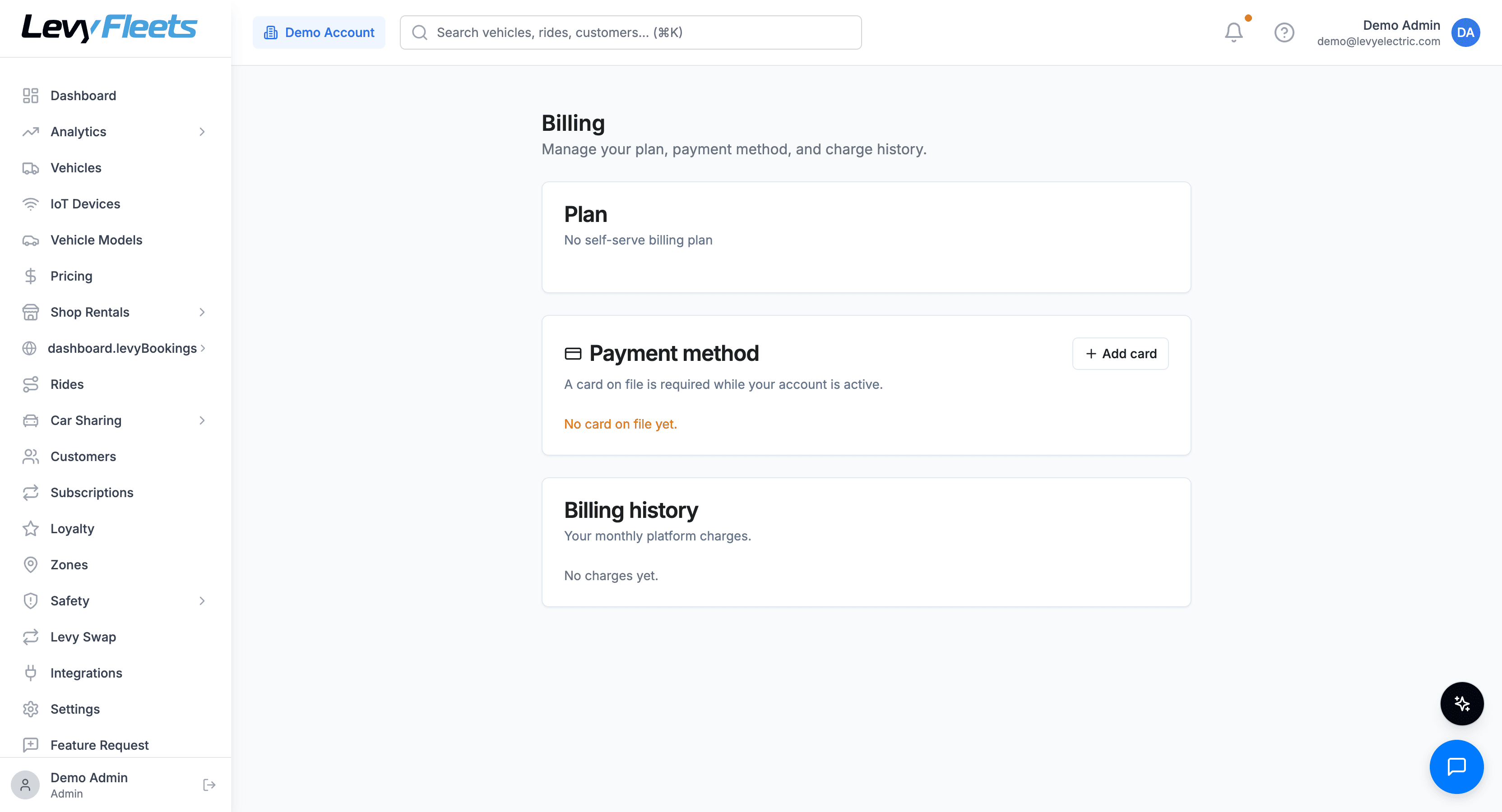
- Reconcile to the ride, not just the deposit. Levy's managed payments, wallet, disputes, and collections all produce records. Tie bank deposits back to the rides and payouts so you see the full picture: gross fare, tax, fees, and net. The billing section of the Levy help center documents how payments, payouts, and adjustments are recorded.
- Treat wallet top-ups as a liability, not revenue. A preloaded wallet is not yet earned; it becomes revenue only when the rider takes a ride and draws it down. Booking top-ups as revenue overstates your income and your tax.
- Handle refunds and chargebacks as their own entries. A refund reduces revenue and, if it included tax, your tax liability; a chargeback is a reversal plus, often, a fee. Levy's managed disputes and collections process these, but you record the accounting effect and refund against the ride.
- Keep receipts attached to transactions. Attach every parts, fuel, and facilities receipt to the matching expense in your accounting software. An audit or diligence review is trivial when the receipt is one click from the line item.
Run a monthly close
A monthly close turns raw transactions into statements you can trust. Block two to three hours at the start of each month for the prior month.
Pull the platform statement
Export the prior month's GMV, fees, taxes, refunds, and net payout from your Levy dashboard and analytics. This is your source of truth for revenue-side numbers.
Reconcile the bank
Match every Levy payout deposit and expense withdrawal to a categorized transaction. Chase down anything that does not tie out.
Categorize every expense
No transaction leaves the month uncategorized. Split anything mixed (a hardware order with both spare batteries and wear parts, say) into the right accounts.
Reconcile the tax liability
Confirm the tax you collected matches the tax you owe, and that any remittance zeroed the liability for the period it covered.
Verify the partner payout math
Confirm your net payout reflects your partner share (defaulting to 80%) against GMV, net of processing fees. If the platform's number and your expectation diverge, investigate while the month is fresh.
Produce the statements
Generate a profit and loss statement and a revenue-per-vehicle-per-day figure. These are what you run the business on and what any investor asks for first.
Records that make partners and investors say yes
A lender, a co-investor, and a city procurement officer are all evaluating the same thing: can this operator account for the money. A few artifacts do the heavy lifting.
- A clean monthly profit and loss statement, with revenue, tax collected and remitted, and expenses in consistent categories.
- Per-vehicle unit economics: revenue per vehicle per day, cost to keep a vehicle on the street, and contribution margin. These prove the model scales, not just survives.
- A reconciled tax position: proof you collected, held, and remitted correctly, with no surprise liabilities. Diligence often tests this first, because unpaid tax is a hidden claim on the business.
- A cash flow view separating operating cash from the tax you are holding, so no one mistakes escrowed tax for working capital.
The operators who raise money and win city contracts are rarely the ones with the flashiest app. They are the ones whose numbers are boring, consistent, and verifiable, and that starts with categorizing the first ride correctly.
Frequently asked questions
Put real numbers behind it
Bookkeeping gets easier when you know your margins going in. Model your GMV, your Levy fee at 20% (or 15% at 100 to 249 vehicles), processing, and net payout before you launch, so your chart of accounts reflects the real money flows from ride one.
Estimate your fleet's economics
Plug in your vehicles and expected rides to see GMV, fees, and net payout, then build your books around the real numbers.