.svg)
Pricing is the one lever you can change in an afternoon that moves every number in your business: rides per vehicle, revenue per ride, retention, and your monthly payout. Most new operators copy the nearest competitor's rate card and hope, then discover three months in that they are leaving money on the table or scaring riders off. This lesson gives you a pricing method instead of a guess. You will set your model before your price, price to your own unit economics first, then adjust for demand and competition, and layer on passes and promotions that lift lifetime value rather than just discounting.
The good news on cost structure: Levy Fleets runs on a $0-upfront, revenue-share model, so you pay when riders pay. On the Managed plan, Levy's fee is 20% of GMV under 100 active vehicles (15% at 100 to 249 active vehicles on annual or approved terms), against a $250 per month platform minimum credited against your fees. Because the software cost scales with your rides rather than a fixed license, the price you set is what funds both your margin and your growth. The one fixed floor to plan around is that $250 monthly platform minimum, so revenue-share does not mean zero fixed cost.
Operator education, not financial or tax advice
The numbers in this lesson (processing fees, platform fees, margin, and taxes) are for planning and illustration only. They are not financial, tax, or legal advice. Your real costs, tax obligations, and take-home margin depend on your market, vehicle mix, utilization, and local rules, so confirm the figures with a qualified accountant or advisor and model your own scenario in the Fleet Estimator before you publish a rate card.
Set your pricing model before your price
The rate you charge matters less than the shape of the charge. The standard shared micromobility model has two parts, and you tune each one for a different reason.
The unlock fee
The unlock fee is the flat amount a rider pays to start a ride, charged once regardless of trip length. It exists to cover the fixed cost of every ride existing at all: payment processing, connectivity, and the wear that happens on start and stop. It is also your single biggest lever on short trips, because on a two-minute hop the unlock fee can be most of the fare.
Raise the unlock fee when your market takes lots of very short rides and you need each one to clear its processing cost. Lower it (or run a $0 unlock promo) when you are fighting for trial and want to remove the friction of starting. Just remember that the unlock is the part riders notice first, so it shapes how expensive your fleet feels before anyone has ridden a block.
The per-minute rate
The per-minute rate is where trip length turns into revenue. It rewards longer rides and, on scooters and bikes, naturally encourages turnover because riders end when they arrive rather than sitting on a meter. This is your main lever for revenue per ride and for nudging behavior: a higher per-minute rate pushes riders toward quick, purposeful trips, while a lower rate suits leisure and tourist markets where people ride to explore.
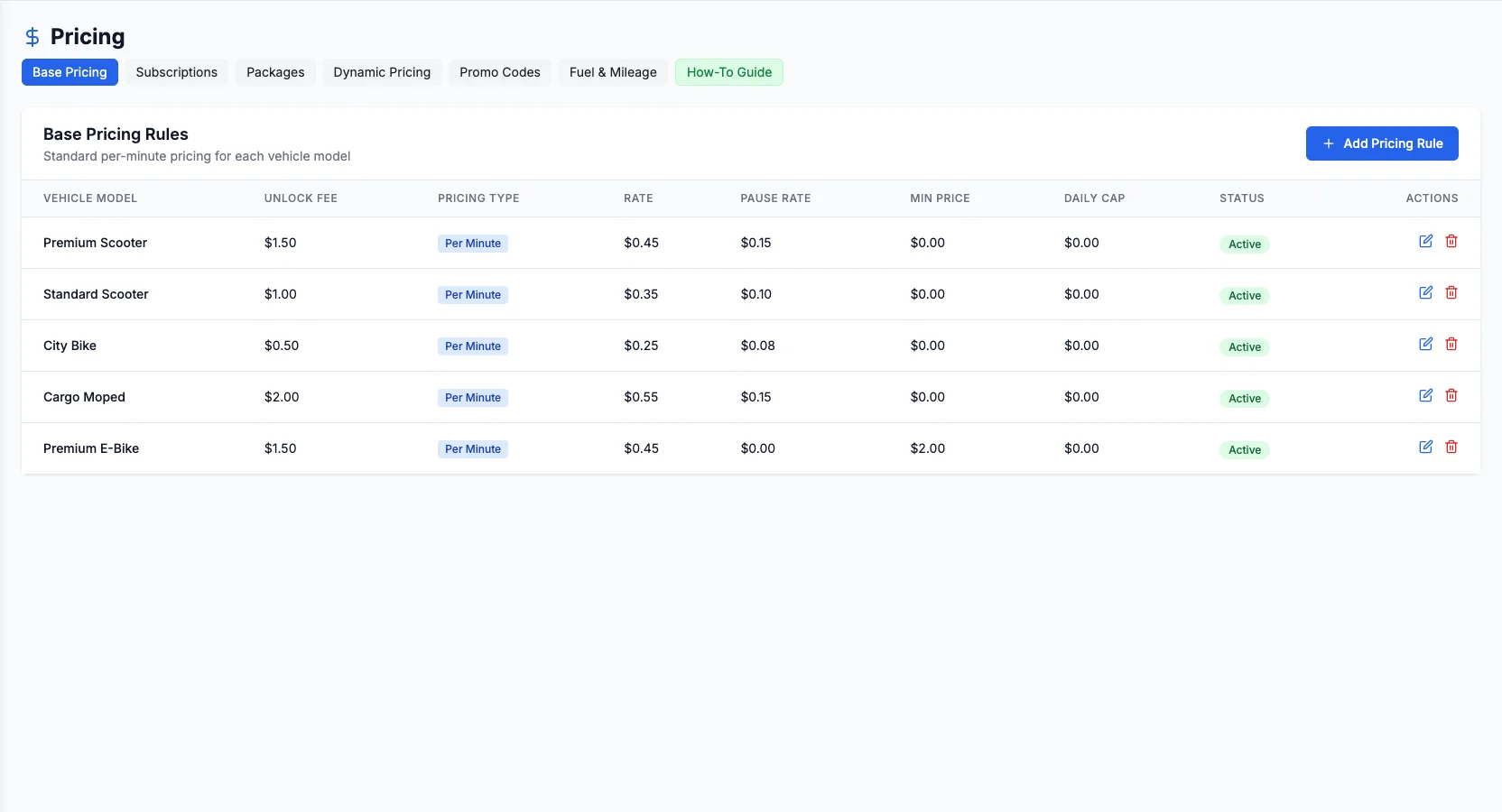
For teaching, say you set a $1.00 unlock and $0.35 per minute. A ten-minute ride bills $1.00 plus $3.50, so $4.50 in GMV. These figures are illustrative only, not a recommended rate card: those exact numbers are yours to choose in the dashboard, Levy does not set your rider prices, and the right rates vary by market, season, and how hard your fleet runs, so model your own in the Fleet Estimator. The point is that the same average fare can come from a high unlock and low per-minute (favoring short trips) or the reverse (favoring long ones). Pick the split that matches how your city actually rides.
Model the fare before you publish it
Write out three sample rides (a 3-minute hop, a 10-minute commute, a 25-minute leisure ride) at your proposed unlock and per-minute rates. If any of the three fares looks wrong for your market, adjust the split, not just the total. The mix of trip lengths in your city decides which lever matters most.
You can add a minimum fare, a per-ride cap, or a pause rate for riders who stop mid-trip. Configure all of it in Levy's pricing tools, and see the full list of supported controls in the pricing help center.
Price to your unit economics first
Before you look at a single competitor, make sure your price clears your own costs. Copying a rival's rate card without knowing your math is how operators run break-even fleets that feel busy but never bank cash. Start from how a rider payment flows on the Managed plan:
| Step | What happens | On a $6.00 ride |
|---|---|---|
| Rider pays | This is your GMV: gross rider payments before taxes, government fees, refunds, and tips | $6.00 |
| Payment processing | Levy's Stripe volume rate is 2.6% plus $0.20 per transaction (versus the standard 2.9% plus $0.30), shared proportionally between you and Levy | about $0.36 |
| Levy Managed fee | 20% of GMV under 100 active vehicles, 15% at 100 to 249 on qualifying terms | $1.20 at 20% |
| Your take-home | Partner share defaults to 80% under the Managed plan; this is a conservative estimate, not an exact net (see note below) | about $4.44 (estimate) |
That last row is deliberately labeled an estimate. Levy quotes its Managed fee as a percent of GMV (gross rider payments), while your operator payout base is net revenue after Stripe fees, with processing shared proportionally between you and Levy. Those are two different money flows, so a simple gross-minus-everything figure is a conservative floor, not your exact net. Treat it as a planning number and model your real take-home in the Fleet Estimator. Note too that your take-home is revenue, not profit: your own business costs (insurance, permits, storage, maintenance, marketing, and taxes) still come out of it before you reach true operator net.
Two things fall out of this table that change how you price:
- Processing has a fixed piece. The $0.20 per transaction is flat, so very cheap rides give up a bigger percentage to processing. If your market takes lots of sub-$2 rides, either lift the unlock fee so each ride carries its processing cost or nudge riders toward passes that batch many rides into one charge.
- The $250 monthly minimum is a volume target, not just a floor. At a 20% Managed fee, it takes $1,250 of monthly GMV to generate $250 in fees. Below that, Levy invoices the difference to reach the minimum. So at launch, your pricing and your marketing need to get you past roughly $1,250 in monthly rider payments before the platform minimum stops being a line item. Price and promote with that target in view.
For the deeper margin math (utilization, rides per vehicle per day, and the path to a profitable fleet), work through the scooter rental business profitability guide alongside this lesson.
Revenue share means your incentives are aligned
Because Levy earns a percentage of GMV rather than a fixed license, Levy makes more when you make more. There is no upfront software cost to amortize into your rider prices (the only fixed floor is the $250 monthly platform minimum, credited against your fees), so every pricing decision is about your margin and your growth, not about paying back a large platform bill.
Price for demand without automatic surge
Demand in micromobility is lumpy. Friday evenings, event days, good weather, and tourist season all spike rides, while cold rainy Tuesdays go quiet. You want your pricing to respect that pattern, and Levy gives you the tools to plan around it, with one important boundary.
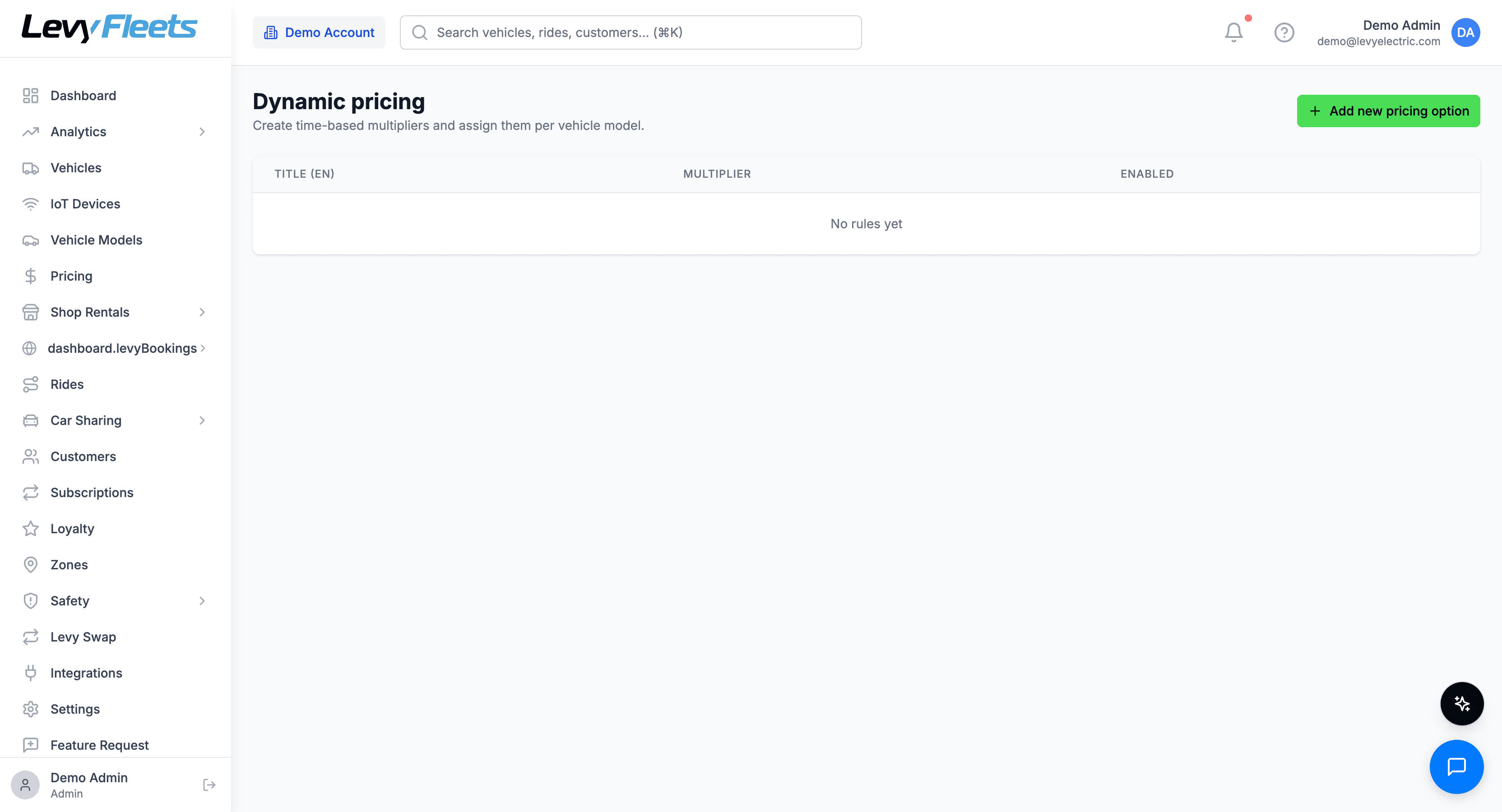
Levy's pricing tools support demand-based and scheduled rate rules that you configure: different rates by time of day, day of week, or promotional window, layered on top of your base pricing. Separately, Levy's AI Ops add-on produces demand forecasts, predicting rides per map hex over 1, 4, or 24 hour horizons, conditioned on weather and events, plus ROI-ranked rebalancing recommendations. AI Ops does not set prices. Its forecasts are an input to your own decisions: if AI Ops shows a demand spike near a stadium at 6 PM, you can stage vehicles there and set your own rate schedule to reflect peak demand.
You configure the rules, and AI Ops never sets prices
Levy supports demand-based and scheduled pricing rules, but you set them yourself. There is no automatic surge that raises a rider's price in real time based on live demand. AI Ops is a forecasting and rebalancing-recommendation tool only: it does not auto-execute or dispatch moves, it is not real time (the smallest bucket is one hour), and it never sets or changes prices. Use its forecasts to inform your own pricing and staging decisions.
The workflow is simple: read the forecast, decide whether a time window justifies a different published rate, set that schedule yourself, and stage vehicles where demand is predicted. You get the upside of demand-aware pricing without the rider backlash that automatic surge invites.
Price against your competition
Once your price clears your economics, position it against the alternatives in your city. Riders compare you to whatever else gets them across town.
Map the real alternatives
List the other shared scooter and bike operators in your market, plus the substitutes: rideshare for short trips, transit, and walking. Note each competitor's unlock fee and per-minute rate so you know the band you are pricing into.
Pick a position, not just a number
Decide whether you are the value option (priced under the incumbents to win trial), the match (priced at parity, winning on availability and reliability), or the premium (priced above, justified by newer vehicles, better uptime, or better parking compliance). Your position should reflect a real advantage, not a coin flip.
Compete on availability, not only on price
A vehicle that is charged, connected, and parked where riders are beats a slightly cheaper competitor that is hard to find. Levy's real-time GPS, battery monitoring, and demand forecasts keep vehicles available, which lets you hold price instead of racing to the bottom.
Revisit quarterly
Re-check competitor rates and your own ride mix every quarter. Change price on evidence, then let it run long enough to read the result.
A price war is the losing move for a small fleet, because the incumbent can usually outlast you on cash. Win on the things price cannot copy: uptime, vehicle quality, and being available at the exact corner where someone needs a ride.
Ride passes, subscriptions, and packages
Per-ride pricing captures the casual rider. Passes and subscriptions capture the regular one, and the regular rider is where the durable money is. Levy's pricing tools support subscriptions and packages, so build a ladder that moves your best riders from paying per trip to paying up front.
- Ride passes and packages bundle multiple rides or a block of minutes into a single purchase. A rider who buys a 10-ride pack has prepaid, which smooths your revenue and pulls forward cash, and they now have a reason to choose you over a competitor for the next ten trips.
- Day passes suit tourist and event markets: unlimited or capped rides for 24 hours at a flat price. They convert a visitor's whole day into one purchase decision instead of ten separate ones.
- Monthly subscriptions suit commuters. A recurring fee (often bundling a waived or reduced unlock, or a set number of rides) turns an occasional rider into a predictable monthly line of revenue and raises switching costs.
The reason to build the ladder is lifetime value. A subscriber who rides four times a week is worth many times a one-time rider, and passes reduce the per-transaction processing drag because many rides settle against one charge. Pair passes with Levy's loyalty tools (points, tiers, rewards, and referral programs) so your most frequent riders feel the benefit of staying.
Anchor the pass against the per-ride price
Price a pass so a moderately frequent rider clearly saves versus paying per ride, but a heavy rider still pays you well in aggregate. If a 10-ride pack costs about the same as eight single rides, the frequent rider takes the deal, prepays, and stops comparison shopping. That is a win even though the headline per-ride number is lower.
Promotions that build a habit, not just a discount
Promotions are for a job: acquire a new rider, reactivate a lapsed one, or drive volume in a slow window. Levy supports promotions and promo codes, so tie every promo to one of those jobs and to a stopping point.
- Launch and trial offers. A first-ride-free or discounted-first-ride offer removes the friction of trying an unfamiliar fleet. The goal is the second ride, so make the offer easy to redeem and the standard price obvious afterward.
- Referral incentives. Referrals turn happy riders into your cheapest acquisition channel. Levy's loyalty and referral tooling lets a rider earn credit for bringing a friend, which compounds because each new rider can refer again.
- Off-peak and win-back promos. Use a targeted code to fill a demand trough (weekday middays) or reactivate quiet riders, informed by the demand forecasts so you discount when it adds rides rather than giving away peak trips.
Give discounts an expiry and a purpose
A permanent discount is just a lower price with extra steps, and it trains riders to wait for the next deal. Every promotion should have a clear job and a clear end date. Track whether discounted riders come back and pay full price, because a promo that does not produce a second full-fare ride is a cost, not an investment.
Tune the model to the vehicle type
Different vehicles ride differently, so the same rate card does not fit all of them. Levy supports scooters, e-bikes, mopeds, golf carts, cars, and low-speed vehicles, so price each to its job.
Your launch pricing checklist
Before you publish a rate card, confirm every line:
- Model chosen: unlock fee plus per-minute, with a minimum fare and pause rate set to fit your city's trip mix.
- Economics cleared: your average fare covers processing (2.6% plus $0.20 per transaction, shared) and leaves margin after the 20% Managed fee, with a plan to pass roughly $1,250 in monthly GMV so the $250 platform minimum clears.
- Demand plan set: rate schedules configured for your peak windows, informed by AI Ops forecasts, with no reliance on automatic surge.
- Competitive position picked: value, match, or premium, backed by a real advantage in uptime or availability.
- Retention ladder built: at least one pass and, where commuters exist, a subscription, priced to reward frequency.
- Promotions scoped: each promo has a job, an expiry, and a way to measure the second full-fare ride.
Frequently asked questions
Put it into practice
Good pricing is a sequence, not a guess: set the model, clear your economics, adjust for demand and competition, then build passes and promotions that turn casual riders into regulars. Because Levy is $0 upfront and revenue-share, every dollar of that work funds your margin and your growth rather than a software bill. Ready to build your rate card? Book a demo and we will help you price for your market, or model the numbers yourself in the Fleet Estimator first.