.svg)
The electric bike rental market is one of the fastest-growing corners of micromobility — measured in the billions today and projected to several-x by the early 2030s. E-bikes go farther than scooters, appeal to a wider age range, and fit tourism, campus, hotel, and last-mile delivery use cases especially well. If you're weighing an e-bike rental business, this is the operator's playbook: demand, models, real costs, the bikes themselves, the tech, and how to scale.
It mirrors the structure of our electric scooter rental playbook, but every number and decision here is e-bike specific — bikes cost more per unit, last longer, get used for longer trips, and carry different theft and maintenance profiles.
Is an E-Bike Rental Business Profitable?
Yes, when utilization holds. E-bikes command higher per-ride and especially higher per-day rates than scooters — hourly, half-day, and full-day rentals are common in tourist markets — which offsets their higher purchase price. The same rule applies as with scooters: idle inventory is the enemy. A bike that turns several rentals a day pays back quickly; a bike sitting on a rack does not. Model your own scenario with the fleet estimator.
Choose Your Business Model
E-bikes suit several distinct models, and many operators run more than one:
- Tourism and leisure rentals. Waterfronts, parks, wine country, beach towns. Higher day-rate pricing, strong seasonality. See e-bikes for tourism.
- Campus and corporate mobility. Universities and large employers offering shared e-bikes for getting across campus. Predictable demand, lower acquisition cost. See e-bikes for campuses.
- Hotel and resort amenity. Branded guest e-bikes billed to the room or offered as a perk. See e-bikes for hotels and resorts.
- Multifamily resident amenity. Apartment communities adding e-bikes as a differentiator. See e-bikes for apartments.
- Last-mile and delivery. Renting or subscribing cargo and standard e-bikes to delivery riders — recurring revenue, heavier utilization, higher maintenance.
You don't have to pick one forever. Start where demand is densest and expand into adjacent models as the fleet grows.
How Much Does It Cost to Start an E-Bike Rental Business?
E-bikes are the biggest line item, and they cost more than scooters. A realistic starter breakdown for 10 fleet-grade e-bikes:
| Expense | Low | High | Notes |
|---|---|---|---|
| E-bikes (10 units) | $15,000 | $30,000 | $1,500–$3,000 per fleet-grade e-bike |
| IoT hardware per bike | $50 | $150 | GPS, smart lock, connectivity |
| Fleet management software | $0 | $500/mo | $0 upfront on a revenue-share platform |
| Insurance | $500/yr | $3,000/yr | Varies by location and fleet size |
| Registration & permits | $200 | $2,000 | LLC, local permits where required |
| Charging / battery handling | $0 | $3,000 | Swap vs. cluster charging |
| Marketing & branding | $500 | $3,000 | App, signage, launch promo |
| Typical to launch | $16,000 | $40,000 | Most start near the lower end |
The single biggest swing is the bikes. Don't under-buy on quality — a consumer e-bike will not survive fleet duty (more on that below). Contact us for current pricing across connected e-bike options.
How to Choose Fleet-Grade E-Bikes
A rental fleet punishes hardware. The bikes that last share a few traits:
- Removable, swappable battery. Lets you swap range in the field instead of pulling bikes off the road to charge — the single biggest operational lever.
- Real range under load. Look for honest 30–60 mi range that holds up with a heavier rider and hills, not a lab-best number.
- Theft-resistant build + integrated lock. Frame locks, GPS, and remote immobilization deter the theft that quietly kills bike-share margin.
- Low-maintenance drivetrain. Belt drives and hydraulic disc brakes reduce shop time versus cheap derailleur setups.
- Cargo and step-through options where the use case calls for it (delivery, older riders, tourists).
- IoT-ready. The bike must accept a smart lock and tracker. Levy is hardware-agnostic across 30+ IoT vendors, so you can source the right bike rather than being locked to one brand.
Browse connected options in the e-bike catalog, and use the spec guides — like battery capacity explained and the IP rating guide — to compare apples to apples.
Software & IoT: The Rental Backbone
The bikes are inventory; the software is the business. At minimum you need:
- White-label rider app (your brand on iOS and Android), QR-code unlock, and in-app payments.
- Real-time GPS on every bike, with a live operations map.
- Geofencing and zones — operating areas, no-ride zones, slow zones, and parking enforcement.
- Flexible pricing — hourly, half-day, full-day, subscription, and promo codes.
- Analytics — utilization, revenue per bike, and ride heatmaps to redeploy idle inventory.
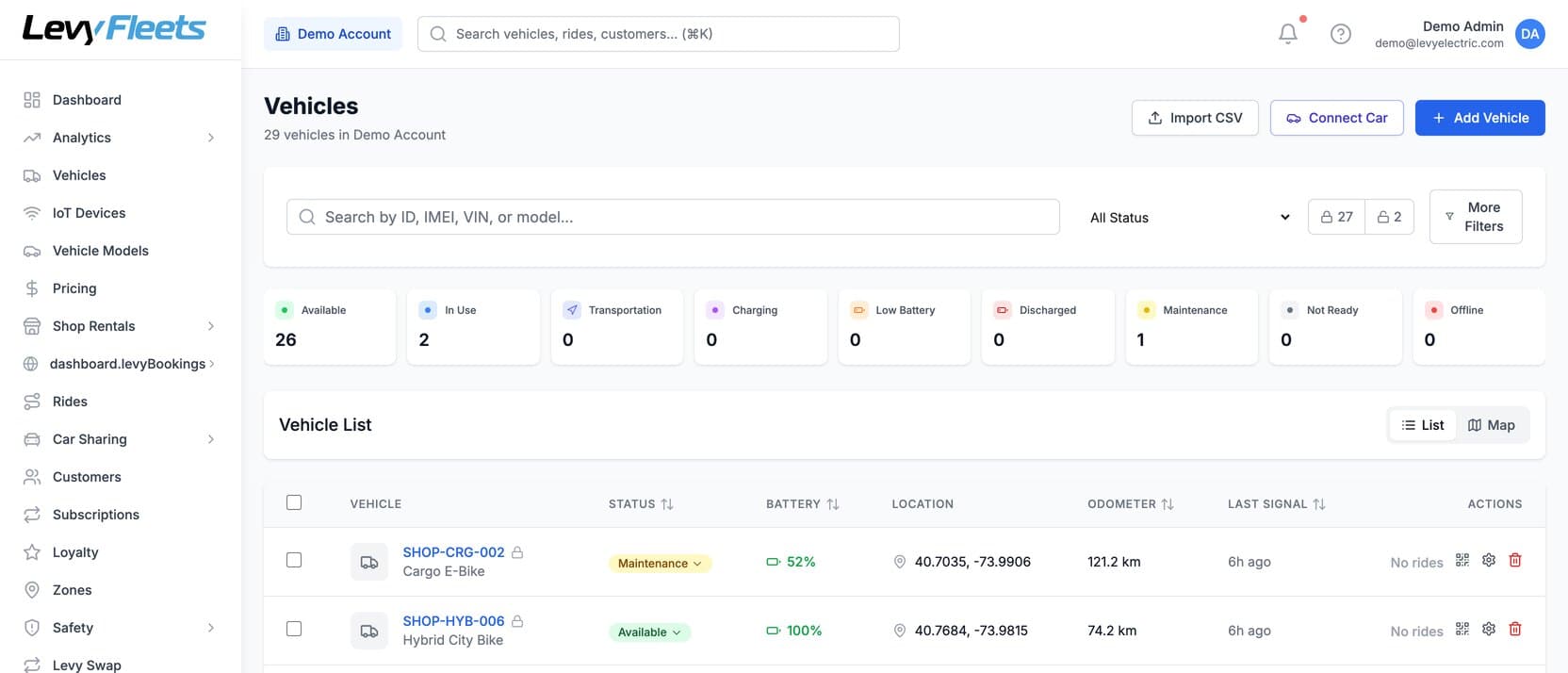
This is exactly what Levy Fleets provides as a turnkey stack — software plus vehicle sourcing, payments, and rider support — on revenue-share pricing with $0 upfront software cost. If you're weighing building your own app instead, read build vs. buy.
Pricing Your E-Bike Rentals
E-bike pricing skews toward longer durations than scooters:
- Hourly ($8–$15/hr typical) for quick leisure rides.
- Half-day and full-day passes for tourists — the highest-margin structure in leisure markets.
- Subscriptions for commuters, campus, and delivery riders — recurring revenue that smooths seasonality.
- Deposits and damage policies matter more for bikes than scooters given the higher unit value.
Insurance & Permits
Carry general liability and equipment coverage at minimum; some jurisdictions require more. Permitting for e-bikes is often lighter than for shared scooters, but it varies by city and by whether you operate on public right-of-way versus private property (hotels, campuses). We cover this in depth in the scooter & micromobility permits guide and the fleet insurance guide — both apply to e-bike fleets.
Launch and Scale
Start with ~10 bikes in one dense, validated location. Prove utilization, dial in pricing, then expand by adding bikes, then locations, then adjacent models. A single fleet dashboard can run e-bikes alongside scooters, mopeds, and golf carts as you diversify.
FAQ
How much does it cost to start an e-bike rental business?
Most operators launch with roughly $16,000–$40,000 for about 10 fleet-grade e-bikes plus IoT hardware, insurance, and registration. Software can be $0 upfront on a revenue-share platform; the bikes themselves are the largest cost.
Is an e-bike rental business profitable?
Yes, when utilization holds. E-bikes earn higher per-ride and per-day rates than scooters, which offsets their higher purchase price — but idle bikes still depreciate, so location and pricing decide the outcome.
What are the best e-bikes for a rental fleet?
Fleet-grade e-bikes with a removable swappable battery, honest 30–60 mi real-world range, a theft-resistant build with an integrated lock, low-maintenance drivetrain, and IoT readiness. Avoid consumer e-bikes — they don't survive fleet duty.
Do I need a permit to run an e-bike rental business?
Sometimes — it depends on your city and whether you operate on public right-of-way or private property. Permitting for e-bikes is often lighter than for shared scooters. Check local rules before you launch.
Launch your branded e-bike fleet with zero upfront software cost → Book a demo. Start with the e-bike catalog and the bike-sharing platform overview, then model returns in the fleet estimator. Tempted to build your own rider app instead of licensing one? Read build vs. buy first — the numbers are the same for bikes as for scooters.