.svg)
Switching fleet software feels risky, so most operators wait too long. They keep paying a per-vehicle license on scooters that sit parked all winter, they patch missing features with spreadsheets and manual refunds, and they eat slow support during the exact hours riders are stranded. The switch only looks scary because nobody hands you a plan. This lesson gives you one: the signals that your current platform costs more than it earns, the short list to evaluate in a replacement, and a step-by-step migration that moves your vehicles, riders, and historical data with as little downtime as a phased cutover allows. Because Levy Fleets runs on a $0-upfront, revenue-share model where you pay when riders pay, a switch does not require new capital before you have earned a dollar on the new stack, which changes the math on when a move is worth making.
Model your own numbers, and confirm current terms
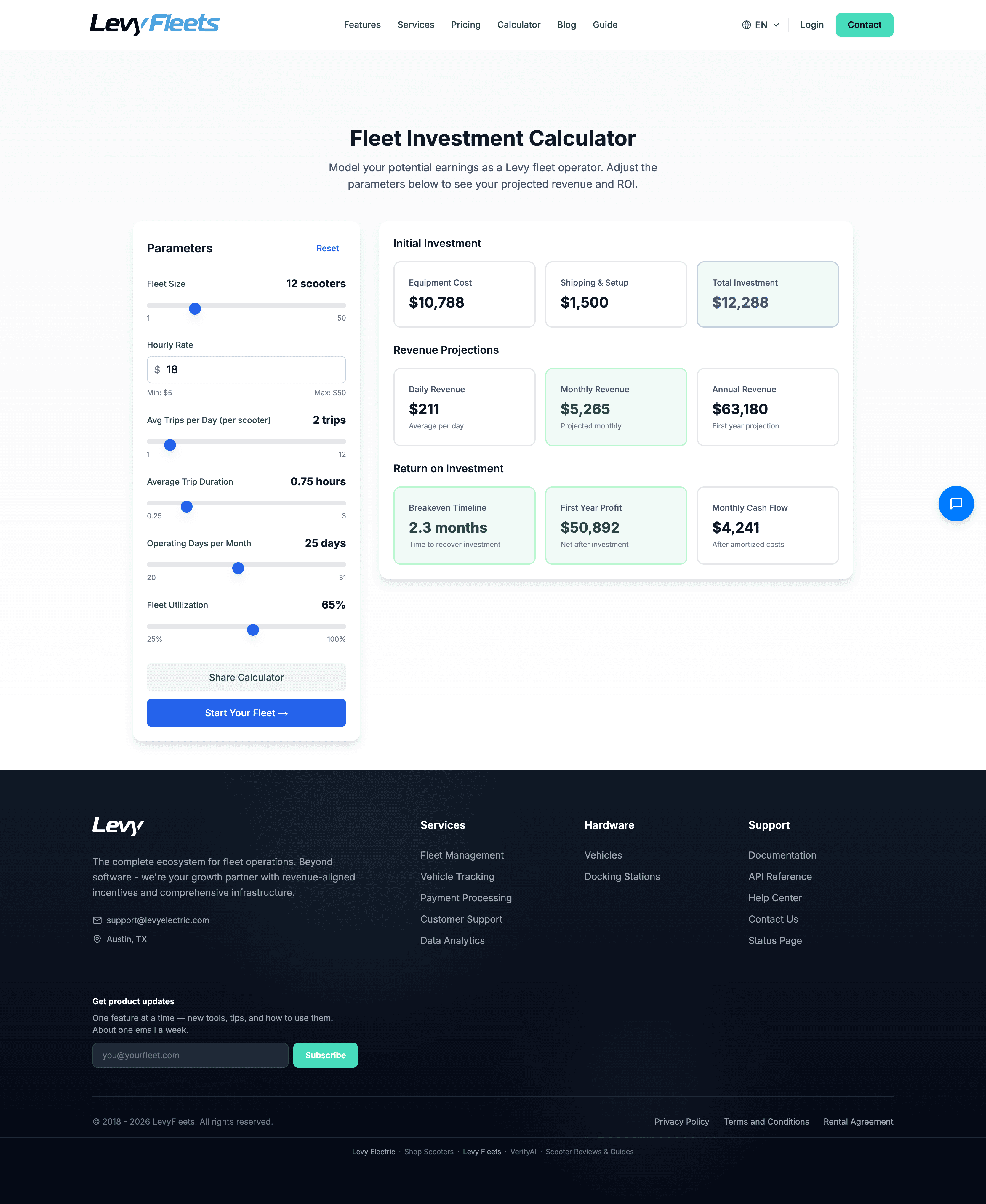
This lesson is general operator guidance, not financial, tax, legal, or insurance advice. Any figures here are illustrative, and pricing and terms (including the $250 per month platform minimum) can change, so confirm current terms with Levy and model your own economics before you commit. Run your real rides, fares, and revenue share through the Fleet Estimator, and consult your own advisors for tax, legal, and insurance questions specific to your fleet.
The signals it is time to switch
You do not switch software because a competitor has a nicer dashboard. You switch when the current platform is quietly draining margin, blocking revenue, or failing riders. Here are the signals that actually matter, in the order they tend to hurt.
Per-vehicle fees are outgrowing your revenue
A flat per-vehicle license is the most common margin leak in this business. You pay the same monthly fee on a scooter whether it earns 200 rides in July or zero rides in January, so seasonal fleets and any deployment with idle inventory pay for vehicles that are not working. The tell is simple: pull your last 12 months, divide your software bill by rides completed, and watch the cost-per-ride spike in your slow months. If a chunk of your fleet is parked for a full quarter and you are still paying full freight on it, the pricing model is fighting your business.
The alternative is a model that flexes with revenue. On Levy's Managed plan, the fee is 20% of GMV under 100 active vehicles (15% of GMV at 100 to 249 active vehicles on annual or approved terms), with a $250 per month platform minimum credited against fees, and $0 upfront software cost. A parked scooter that earns nothing costs you nothing beyond that minimum, because you pay when riders pay. If you run operations in-house at scale, Software-Only is $14 per vehicle per month at 100 to 249 vehicles. Either way, you match how you pay to how you earn instead of paying a fixed license against idle inventory.
Run the cost-per-ride test before anything else
Take your total annual software cost and divide it by rides completed, then do it again for your slowest month alone. If your slow-month cost-per-ride is several times your peak, a revenue-share model will almost certainly beat a flat license, because your platform cost falls when demand does.
The feature list has holes you patch by hand
The second signal is operational: you are doing with people and spreadsheets what the software should do for you. Count the manual workarounds. Are you issuing refunds by hand, chasing chargebacks one at a time, reconciling payouts in a spreadsheet, drawing geofences you cannot enforce, or exporting ride data to build the compliance report a city requires? Every manual patch is a feature the platform should ship and a recurring labor cost you absorb.
A platform worth switching to closes those holes as included capability, not tiered upsells. On Levy, geofencing, dynamic pricing, and analytics are included for everyone, not gated behind tiers, and real-time GPS, remote lock and unlock, and battery and speed monitoring are standard. Managed payments cover the rider wallet, disputes and chargebacks, and collections and dunning, so the money work stops being your night job. Zones tooling draws service areas, speed-limit zones, no-go areas, and parking rewards that actually enforce, and City Compliance ships MDS 2.0 and GBFS 3.0 feeds with real-time geofence enforcement, so the report a city demands is a feed, not a Sunday spreadsheet. Rebuild all of that by hand and you pay twice, once for the license and again in labor.
Support is slow when it matters most
The third signal is what happens at 11 PM when a rider cannot end a ride or a vehicle will not lock. If your platform's support is a ticket queue that answers next business day, every incident becomes your problem to field live, and rider trust erodes with each one.
This is where the managed model earns its keep. Levy is positioned as more than software: "we run your mobility business," a turnkey stack of software plus vehicle sourcing, IoT, payments, and 24/7 managed support, running at 99.8% uptime with active monitoring. If you are the only line of defense between a stranded rider and a refund request, a managed operation directly cuts your on-call load.
You are locked to one hardware vendor
The fourth signal shows up when you try to grow. If your platform only speaks to one manufacturer's IoT modules, every expansion decision is really a hardware decision, and you are boxed into one vendor's price, lead time, and quality. That lock-in is a switching cost the incumbent is counting on.
The counter is a hardware-agnostic platform. Levy is hardware-agnostic across 30+ IoT vendors and protocols, spanning scooters, bikes, and cars, with named integrations including OKAI, Segway, Queclink, Omni, Acton, Niu, Teltonika, Geotab, Digital Matter, and Smartcar, among others. The stance is explicit: bring your existing hardware or choose from supported vendors. That matters enormously for a switch, because it often means your current vehicles come with you rather than getting scrapped, which is the single biggest lever on migration downtime and cost.
Score shipped capability, not the roadmap
When you evaluate any platform (including this one), separate what ships today from what is pitched. For example, Levy's vision suite (Levy Vision) is parking, helmet, and sidewalk-detection compliance only, not a damage-inspection or condition-report tool for scooters and bikes. AI Ops produces demand forecasts and ROI-ranked rebalancing recommendations; it does not auto-execute moves and is not surge pricing. Hold every vendor to that same line.
What to evaluate before you commit
Once a signal tells you to move, evaluate replacements on what determines unit economics and downtime, not on demo aesthetics. Score every candidate on the same five axes.
| What to evaluate | The question that matters | Why it drives the decision |
|---|---|---|
| Pricing model | Do I pay for idle inventory, or do I pay when riders pay? | A flat license punishes seasonality; revenue-share and $0 upfront track your actual earnings. |
| Feature coverage | Are geofencing, dynamic pricing, payments, disputes, and compliance included, or upsold? | Gated features become manual labor and hidden cost. |
| Hardware compatibility | Can my current vehicles and IoT modules come with me? | Hardware-agnostic support is the biggest lever on migration cost and downtime. |
| Managed operations and support | Who handles payments, disputes, collections, and 24/7 rider issues? | Determines how much operational load stays on you after the switch. |
| Data portability | Can I export my data out and import history in through an API? | Portability protects you from the next lock-in and preserves rider and analytics continuity. |
Weight them like this. Pricing and hardware compatibility usually decide whether a switch is worth it, because together they set cost and downtime. Feature coverage and managed operations decide how much your labor bill falls after the move. Data portability is the axis operators skip and later regret: an API and webhooks let you pull history out of the old system and rebuild reporting continuity in the new one. Levy exposes a REST API and webhooks plus a Partner API, and includes analytics on every plan, so continuity is a build task, not a dead end.
For the full landscape of platforms to score this way, work through our roundup of the best scooter-sharing software, and if part of you is still tempted to build your own stack instead of switching to one, read the build-versus-buy breakdown for scooter-sharing software before you commit engineers to it.
How to migrate with minimal downtime
Migration downtime comes from doing the switch as one big-bang cutover. You avoid it by running the old and new platforms in parallel and moving in phases. Here is the sequence.
Inventory and audit everything you are moving
List every vehicle with its make, model, and IoT module type. List your rider base and its payment state (active wallets, saved cards, open balances). List the data you need to preserve: ride history, payout records, and compliance history. This audit tells you exactly what has to land on the new platform and in what order, which is what makes the rest predictable.
Confirm hardware compatibility vehicle by vehicle
Map each IoT module in your fleet to the new platform's supported vendors. Because Levy is hardware-agnostic across 30+ IoT vendors, most existing scooters, bikes, and connected cars can be brought online rather than replaced, which is the difference between a software migration and a capital re-purchase. Where a module needs a retrofit, Levy works with embedded IoT controllers and retrofit hardware, and keeps US stock of common parts (tires and tubes, brake cables and pads, display panels, batteries, fenders, throttle assemblies) so any touch-up ships in days, not weeks.
Stand up the new platform in parallel
Configure the new stack while the old one is still live: draw your zones (service areas, speed-limit zones, no-go areas, parking rewards), set your pricing, subscriptions, packages, and promotions, and connect managed payments. Nothing is cut over yet. You are building the destination so that when vehicles and riders move, everything they need is already in place.
Migrate riders onto your app
Decide the app path first. With White-Label ($2,750 one-time) you publish an operator-branded app on iOS and Android; with Levy Label you use the Levy app with no setup fee. Then move riders across with the included Marketing Automation tooling (segments, drip campaigns, and lifecycle messaging over email, SMS, and push) so the transition is communicated, not sprung on them. Managed payments run on Levy's Stripe volume pricing of 2.6% plus $0.20 per transaction. Confirm with Levy what can actually be migrated before you plan the rider cutover: carrying a rider wallet balance or card-on-file forward is not guaranteed, since it depends on processor token portability, rider consent, and possible rider re-authentication, so card-on-file may require token portability or a rider re-auth step rather than moving automatically.
Move your data through the API
Export ride history, payout records, and compliance history from the old platform and import what you need through Levy's REST API and webhooks, using the Partner API where a deeper connection helps. Preserve enough history that your analytics have a baseline on day one rather than starting from zero. This is the step that protects reporting continuity so no one downstream notices the platform changed underneath them.
Cut over in phases, not all at once
Move a single zone or a subset of vehicles first, run it live on the new platform for a defined window, and watch unlocks, ride-end, payments, and lock reliability. When that slice is clean, roll the next batch. Phased cutover keeps any surprise contained to a small group instead of your whole fleet, which is how this approach reduces planned downtime.
Decommission the old platform on your terms
Only after the full fleet is running clean, and after you have your final data export in hand, wind down the old contract. Do not cancel the old platform until the new one has carried a full billing and operations cycle without you reaching back for anything.
Hardware compatibility varies most by what you run, so map it deliberately by vehicle type.
Kick and standing scooters are the most widely supported case. Named integrations include OKAI, Segway, Omni, Acton, and Queclink, and Levy keeps US spare-parts stock for common OKAI and Segway components, so most existing scooter modules come online rather than getting replaced.
Why parallel-running reduces planned downtime
Because Levy has $0 upfront software cost and only a $250 per month platform minimum, running the new platform alongside the old one does not require a fixed bet up front. You configure, pilot a zone, and expand on real economics, so the only overlap you pay for is a short window where a slice of the fleet is live on both. That is far cheaper insurance than a big-bang cutover that risks your whole fleet at once.
Common questions about switching
Make the switch a decision, not a reaction
The operators who switch well do not wait for a breaking point. They run the cost-per-ride test, count their manual workarounds, and score replacements on pricing, feature coverage, hardware compatibility, managed operations, and data portability. They migrate in phases, keep the old system live until the new one has carried a full cycle, and only then decommission. Done that way, switching becomes a controlled move with a known cost and reduced planned downtime, not a leap.
Model the switch on your real numbers
Use the estimator to see how your rides, fares, and revenue share translate into a monthly payout on Levy, so you can compare the switch against your current per-vehicle bill before you commit.